Top pair is only as strong as the board lets it be, and few cards expose that faster than an overcard that smashes into your opponent’s range. When the turn pairs a card you beat, you can keep firing, but when it brings a card that is better than your pair and lives squarely in the caller’s hand, the hand that was value betting a moment ago can quietly become a check back. Reading that shift correctly is one of the most valuable skills in a cash game, and this hand is the cautionary version of the spot, where a bad turn forces discipline before the river offers a thin reward.
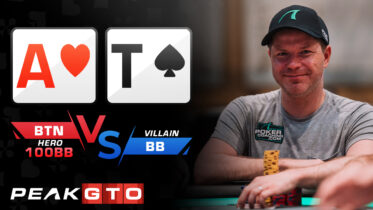
Today we will analyze a 100bb 6-handed hand where Hero opens A♥T♠ on the button, the big blind calls, and the board runs T♣6♦2♥, J♠, 3♠. Hero flops top pair with the ace kicker, pots the flop, checks back the jack turn, and then makes a thin value bet on the river. This hand shows why top pair top kicker is a clear big bet on the flop, why an overcard that improves the opponent demotes AT to a checking hand on the turn, and why the same hand still squeezes out value when the river checks through to it.
Assumptions
- Stacks: 100bb effective
- Format: 6-handed cash game
- Positions: BTN (Hero) vs BB (Villain)
- Action: BTN raises, BB calls
- Flop: T♣6♦2♥ (Pot: 5.5bb): BB checks, BTN bets 5.5bb, BB calls
- Turn: J♠ (Pot: 16.5bb): BB checks, BTN checks back
- River: 3♠ (Pot: 16.5bb): BB checks, BTN bets 9.9bb
Preflop
Hero opens A♥T♠ to 2.5bb on the button and the big blind calls. ATo is a standard button open, and Hero takes the lead in position against a wide, capped big blind defend. That positional edge matters most on later streets, because it is what lets Hero check back a tricky turn and still control the size of the pot rather than being forced to act first.
Flop: T♣6♦2♥
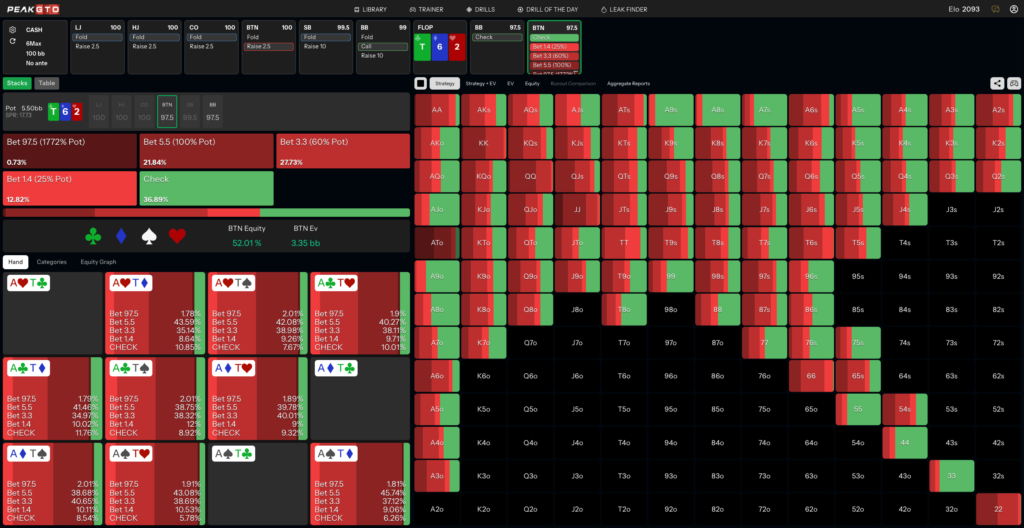
Hero flops top pair with the best kicker. The big blind checks, and top pair top kicker wants to bet very often here, usually with a medium or large size. It gets called by every worse top pair and by a wide set of draws, so checking would only surrender value. This is a clean continuation bet, and the strongest hands in the range prefer the bigger size. Hero pots it for 5.5bb and the big blind calls. So far this is identical to a hand that ends in three barrels, and the only thing that changes the story is the turn card.
Turn: J♠
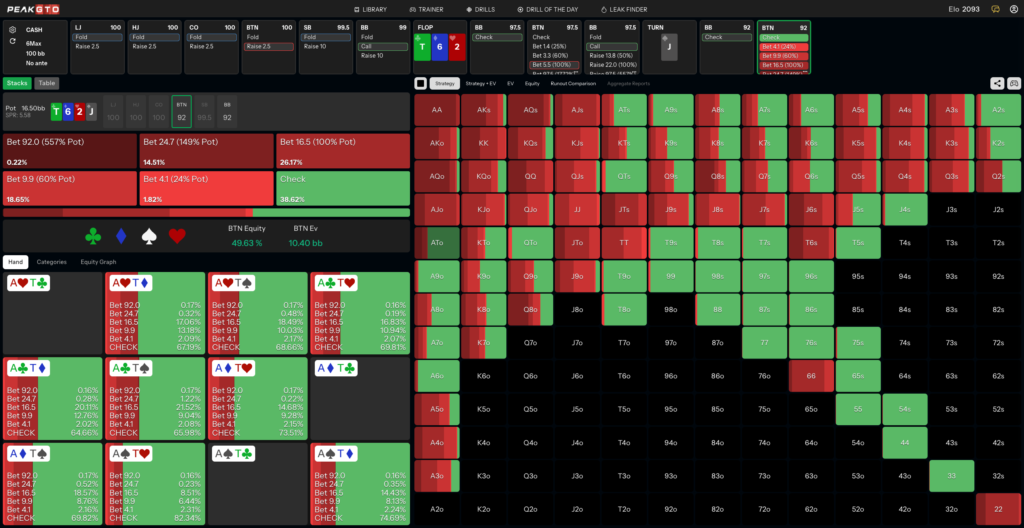
The J♠ is exactly the kind of card that makes this a bad turn. It is an overcard that demotes the tens to second pair, and unlike a random brick, it lands right in the middle of the big blind’s calling range. This is where players go wrong in two opposite directions: some decide AT can never bet again because the jack arrived, while others insist you should always keep firing on a card that looks good for your range. Both are half right. AT genuinely mixes here, but it leans toward checking.
The reason is what is left in each player’s range. Hero still has plenty of jacks, and those happily keep betting, alongside the real draws like KQ, K9, Q9, and Q8, plus the junky gutshots such as K4, Q4, J4, and A4. Those are the hands that want to build a pot. The medium-strength hands are a different matter. After potting the flop, Hero ran into a call, so the big blind’s range is already reasonably strong, and betting a hand like AT now mostly folds out worse and gets called by better. So the weak tens, the underpairs, many of the sixes, and AT itself all prefer to check. PeakGTO shows the overall range still betting often on this turn, but that betting is concentrated in the jacks and the draws, not in marginal made hands like this one.
There is a real exploit buried here. If the opponent does not raise often enough against a 60% pot or pot-sized bet, and instead calls too wide with hands like 99, 88, sixes, and weak pairs that should be folding, then Hero can start value betting thinner and turn AT, KT, J9, and similar hands into bets. Against a disciplined, balanced opponent, though, the default is clear. Hero checks back, keeps the pot small with a clear marginal made hand, and lets the river decide the rest.
River: 3♠
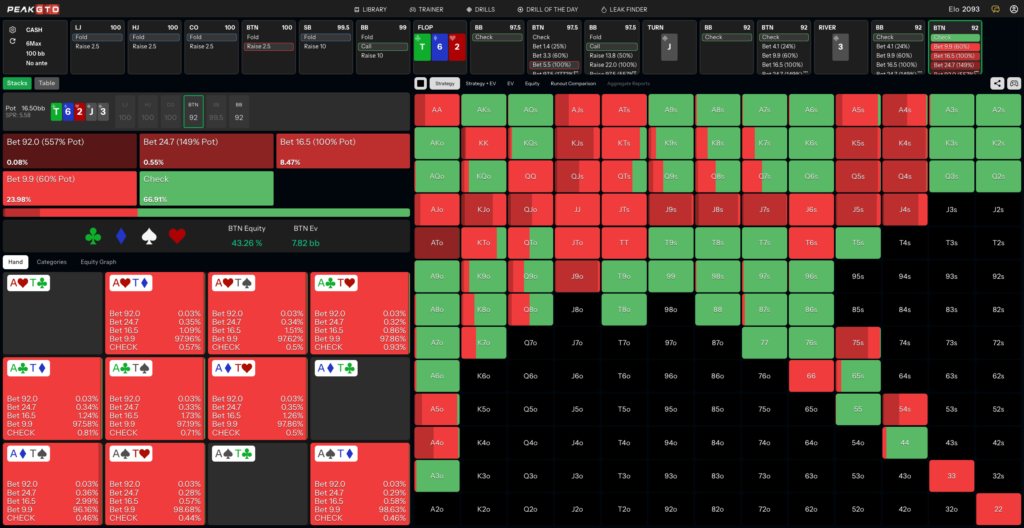
The 3♠ is a brick, and the big blind checks again. Checking back the turn paid off in two ways. First, AT is now a hand that is not folding to a bet, so Hero was never going to be blown off it. Second, because the turn went check-check, the big blind’s range did not get to narrow itself by calling another barrel, so when the river bricks Hero is often still ahead of a ten, a busted draw, or a weak pair. With the opponent checking, this becomes a thin value spot rather than a defensive one.
The cutoff for value betting sits right around QT, so QT and better all bet, sizing up as the hand gets stronger. The catch is what Hero’s value range actually contains. Because the jacks and better hands would have bet the turn, the river value bets are mostly tens, which means most of them should use a small size. AT fits squarely in that group and bets about 9.9bb, roughly 60% of the pot. A jack, on the rare occasions Hero still has one, would prefer a pot-sized bet, but those combos are scarce by now. In a solver world the bets split roughly three-quarters at 60% pot and one-quarter at full pot, but in practice the simpler approach is to use the 60% size with the whole value-and-bluff range, since an opponent is unlikely to call a pot-sized river bet with the tens and worse hands Hero is targeting.
The fascinating wrinkle, and a good lesson in why thin value carries risk, is the big blind’s only profitable raise. Because Hero’s range is so capped after checking the turn, the opponent’s correct response to the small river bet is to check-raise all in, jamming sets, two pair, and hands like J8 and KJ for value while using 55 and 44 as straight-blocker bluffs. Almost no one does this in practice, which is exactly why the thin value bet prints, but it is a reminder that a capped GTO range can be attacked. Here, Hero takes the small bet, collects from worse, and books a tidy pot from a hand that was demoted to second pair two streets earlier.
Key Takeaways
- Flop: Top pair top kicker on T♣6♦2♥ pots it as a clear value bet, getting called by every worse top pair while the draws and gutshots fill out the bluffs.
- Turn: The J♠ is an overcard that lands in the caller’s range and demotes the tens to second pair. The jacks and draws keep betting, but AT and the other medium hands check back rather than barrel into a strong range.
- River: When the brick checks through to Hero, AT bets about 60% pot for thin value. The value range is mostly tens, so the size stays small, and the bet collects from worse pairs and busted draws.
- Overall: A bad turn is not a reason to bet bigger, it is a reason to check and reassess. Give up the barrel when an overcard improves your opponent, then let your hand earn a smaller, safer reward when the action checks back to you.