Most players decide on a bet size by looking at the pot, picking a number that feels right, and moving on. They do the same on the next street. And the next. Then they arrive at the river with a stack that does not allow the move they actually want to make.
Good bet sizing is not reactive. In Texas Hold’em, the strongest exploitative players decide how they want the hand to end before they place the first bet. They use that target to work backward and choose street sizes that make the desired outcome possible.
This approach matters most when playing against opponents who make predictable mistakes. GTO strategy demands balanced sizing that is unexploitable. Against weaker players, you can plan around what you know they will do and size accordingly.

Think About the Outcome Before You Pick a Size
The core idea behind multi-street planning is straightforward: decide what you want to accomplish, then choose bet sizes that make that outcome likely.
With a value hand, you want your opponent to call on multiple streets. With a bluff, you want to either keep them involved until you push them off on a later street or force a fold earlier by making the pot odds unfavorable at a specific point.
Most players skip this step entirely. They fire each bet based on the current situation rather than working toward a planned endpoint. That reactive approach is why so many players end up with too little or too much stack left when they want to make their real move.
How to Size Your Value Bets
When you have a strong hand and want to get called, small, consistent sizing works best.
Betting 40% of the pot on the flop, 40% on the turn, and 40% on the river gives your opponent excellent pot odds to call at every decision point. Players holding marginal poker hands, such as weak top pairs, middle pairs, and second pairs, feel they are getting a price they cannot pass up. They call streets they should fold, and your strong hand collects value from all of them.
The goal is to stay within your opponent’s range. Large bets narrow calling ranges quickly. Small, consistent bets keep weaker holdings involved across multiple streets. That is where the money comes from against players who call too liberally.
How to Size Your Bluffs
With a bluff, the goal is to engineer a fold at the right point, not to get called. You have two main strategies.
The first is small-small-large. Bet 30% of the pot on the flop and 30% on the turn to keep your opponent calling with a very wide range. Players will call small bets with all sorts of marginal hands because the price is low. Then on the river, bet 1.5 times the pot or more. Your opponent has called twice and arrived at the river with their weak holdings intact. Now you give them terrible fold equity and fold out everything they limped to the river with.
The second is small-large. Bet 30% on the flop to keep a wide range in, then fire a pot-size bet on the turn. The large turn bet forces most opponents to fold, since the majority of their calling range is too weak to continue at that price. This approach resolves the hand earlier and avoids committing a third barrel, but you give up any river leverage.
Both are valid. The right choice depends on the opponent’s tendencies and how much risk you want to carry into the river.
Geometric Sizing and Stack Depth
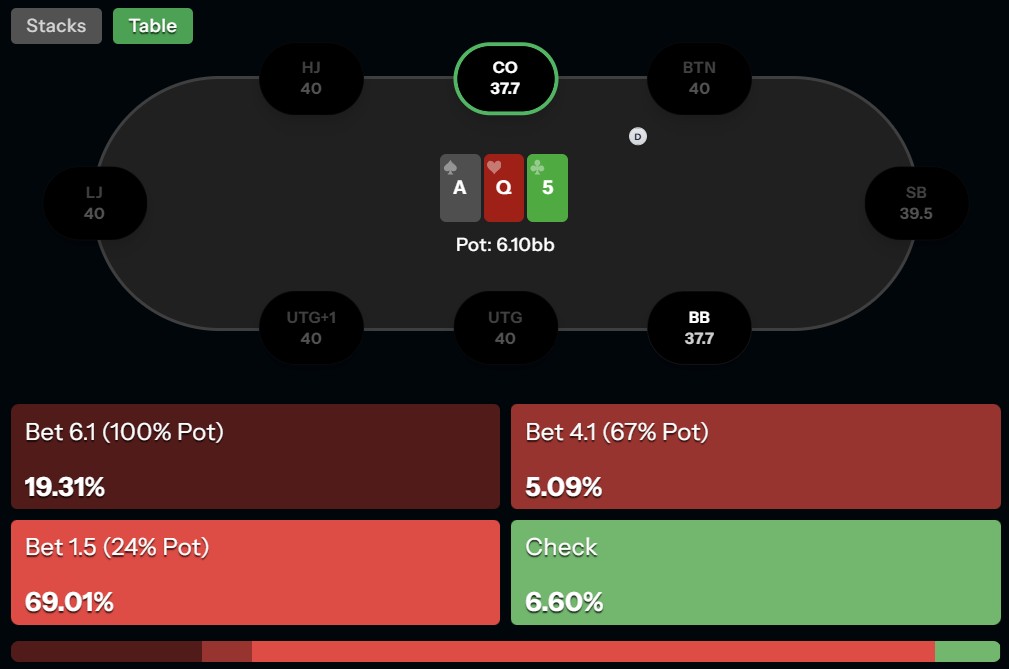
The reason bets grow larger as the hand progresses is mathematical. When you plan to put a certain amount of money by the river, the math requires smaller bets early and larger bets later. This is geometric sizing.
The exact numbers depend directly on stack depth.
20 Big Blinds
Raise to 2 big blinds preflop. Bet 2 big blinds on the flop, roughly 40% of a pot of around 5 big blinds. Bet 5 big blinds on the turn, roughly 50% of a pot of around 10 big blinds. Shove 11 big blinds into a 15 big blind pot on the river, a roughly 73% pot bet.
This creates a natural escalation with some fold equity at every street and a meaningful final bet that puts real pressure on marginal holdings.
40 Big Blinds
Raise to 2.5 big blinds preflop. Bet 4 on the flop. Bet 10 on the turn. Shove 23.5 into roughly 34 big blinds on the river. The flop and turn bets are larger relative to the 20 big blind example, but the river lands at roughly the same two-thirds pot size.
60 Big Blinds
Raise preflop, bet 6 on the flop, 15 on the turn, 36 into roughly 49 big blinds on the river. As stacks deepen, every street requires proportionally larger bets to reach all-in at a sensible size by the river. The deeper the stacks, the more critical it becomes to size correctly early.
The Sizing Mistake That Kills Your Options
The most common multi-street error is overbetting on the turn without considering what it leaves on the river.
Here is what it looks like. A player raises to 2 big blinds with a 20 big blind stack. They bet 2 on the flop. Then they bet 10 on the turn — a pot-size bet that felt right in the moment. Now they have 6 big blinds left.
If the opponent raises all in, the player needs to call 6 into a pot of roughly 40 big blinds. They need to win only about 15% of the time to break even on the call. They essentially cannot fold anything. What was supposed to be a pressure spot for the opponent has become a trap for the player.
In my experience, this mistake almost always comes from reacting to the pot size on the turn rather than planning the full three-street progression in advance. The stack-to-pot ratio on the river should never be an afterthought. Work out the sizing before you bet the flop and adjust every street to preserve real options at every point in the hand.
Conclusion
Multi-street bet sizing comes down to one habit: think about where you want to be on the river before you bet the flop. Know whether you are trying to get called or get a fold. Choose a progression that makes that outcome achievable. And always check what your remaining stack looks like before you commit chips on any street.
Running these progressions through a solver like PeakGTO makes the math concrete. Seeing how stack depth affects required sizes at each street builds intuition that translates directly into better decisions at the table.