Suited connectors are some of the most profitable and most misplayed hands in poker. When they hit, they win huge pots, but most of the time they whiff and leave you holding a weak draw or pure air. Calling a c-bet with a gutshot is one of those moments where the wrong instinct, folding because you “only” have four outs, quietly costs you money. In position with a hand that can continue, a gutshot is often more than enough reason to continue, and the line you take afterward is where the real profit lives.
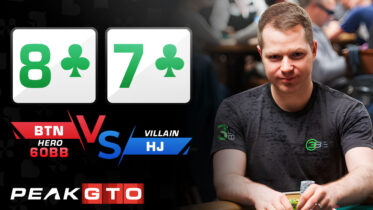
Today we will analyze a 60 big blind tournament hand where we call on the button with 8♣7♣ against a hijack open. The flop comes J♠6♥4♦, giving us a gutshot, and our opponent fires a big bet that we call. The turn is the T♥, they check, and we take the betting lead. The river is the 2♥, completing a backdoor flush, they check again, and we move all in with a hand that cannot win at showdown. We will walk each street and show why a busted gutshot can be one of your best bluffs.
Assumptions
- Format: 8-max MTT, 60bb effective stacks
- Positions: Hero is on the button (caller, in position); Villain is in the hijack (preflop raiser, out of position)
- Hero’s hand: 8♣7♣
- Preflop: Hijack raises to 2.3bb, Hero calls on the button. Single-raised pot.
- Flop: J♠6♥4♦. Villain bets 4.8bb, Hero calls.
- Turn: T♥. Villain checks, Hero bets 11.2bb (about two-thirds pot), Villain calls.
- River: 2♥. Villain checks, Hero jams all in for 41.6bb (just over pot).
Preflop
The hijack opens and we are on the button with 8♣7♣. Worth knowing: most suited connectors, including this one, want to 3-bet a meaningful share of the time, more so with the bigger connectors. A common mistake is to see that the preferred play is calling and then always call, but mixing in 3-bets matters, especially against opponents who fold too much to aggression. This time we just call, keeping a wide, disguised range on the button and position for the rest of the hand.
Flop: J♠6♥4♦
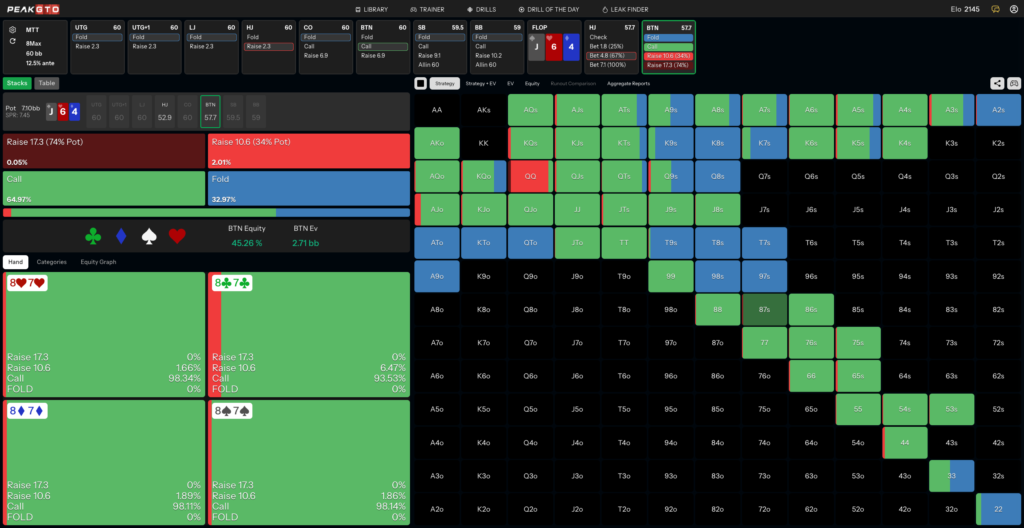
The flop gives us a gutshot, needing a five to complete the straight, with two undercards to the jack. The hijack mixes checking and betting, and when they bet they use a big size, often two-thirds pot or larger. They fire 4.8bb, and now we have a decision. The first key point is that we do almost no raising here. When a player bets big from out of position with a polarized, strong range that holds only a slight edge, around 55 percent equity against us, there is little reason to blow up the pot. We just defend against the continuation bet by calling.
The second point is that we need to be sticky. Our whole range only folds about 33 percent of the time here. All of our pairs continue, and so does nearly anything with a backdoor draw plus extra equity. A pure backdoor hand like T♦9♦, with no overcard, can fold, but a hand with an overcard or a real draw stays. Our gutshot with 8♣7♣ is just good enough to stick around. It may feel a little dirty calling a 4.8bb bet with eight-high, but in position you have to defend wide enough that you cannot be run over.
It is worth being honest about the math. A bare gutshot is only about four outs, so raw equity alone would not justify continuing against a big bet. Two things rescue the call: position and the threat of future bets. Acting last on every street, we get to see what the opponent does before committing more chips, and we can apply real pressure on turns and rivers that scare their one-pair hands. Equity plus the ability to credibly represent a huge range when good cards arrive is what turns a four-out draw into a comfortable continue.
Turn: T♥
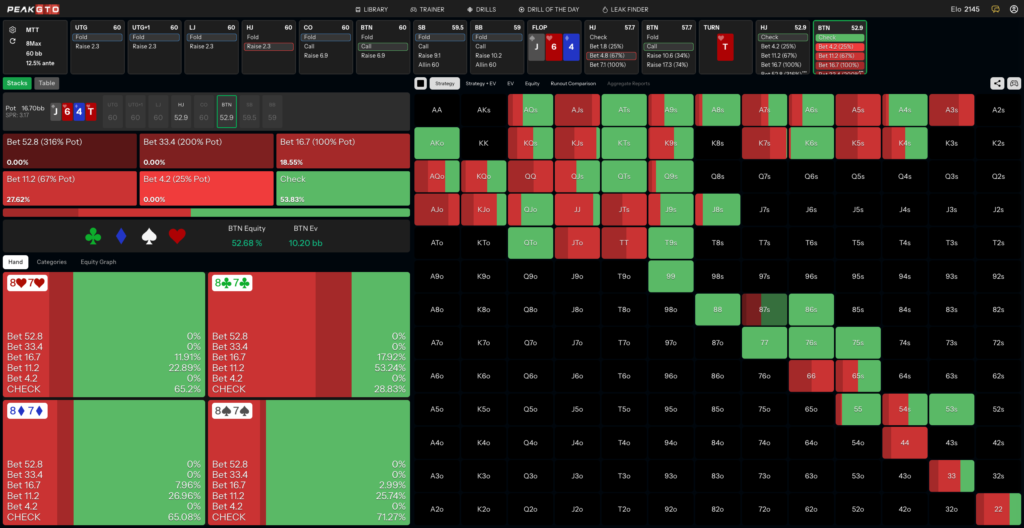
The turn is the T♥, a card that does not directly improve us. In theory the hijack should keep betting around half the time with a large size, and if they did, we would mostly call. Instead they check, handing us the initiative, and now the question is whether 87 wants to bluff. The answer is usually yes, and the size is large, around 11.2bb, roughly two-thirds pot, which is the solver’s most-used betting size at this node, with a full-pot bet also reasonable. Studying these turn frequencies in PeakGTO shows the whole range betting close to half the time after the check.
There is a subtle reason 8♣7♣ in particular is a great bluffing candidate. If we held the 8♥7♥, diamonds, or spades, we would be bluffing less, because those cards block the busted backdoor draws our opponent likes to check and fold. Holding the club version, we block none of those give-up hands, so it is more likely the opponent has exactly the kind of weak holding that will fold to pressure. We bet the large size and get called.
River: 2♥
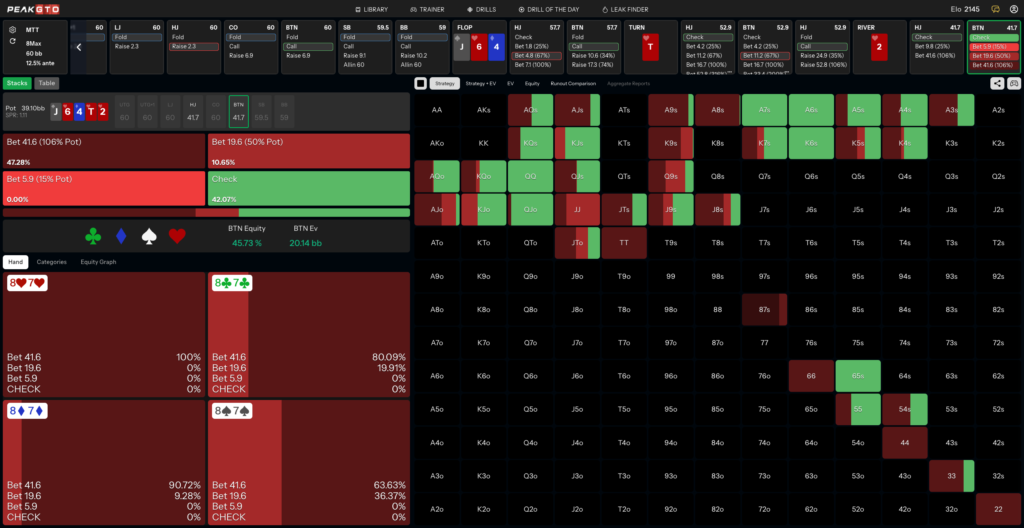
The river is the 2♥, completing the backdoor heart flush. Our gutshot has fully busted, and we are left with eight-high that cannot beat a single bluff-catcher at showdown. Many players think they need an actual heart to fire here, and while hands like AQ or KQ with a heart do bluff often, betting only those leaves us with far too few bluffs. To stay balanced after value betting our flushes and strong hands, we need to mix in plenty of pure air, and 87 of every suit bluffs almost every time.
Because our remaining stack is just over the size of the pot, the bet is simply all in for 41.6bb. This is a recurring pattern worth memorizing: when you arrive at the river with a junky hand that has no showdown value, and you also hold plenty of nutted hands in your range, which you should after betting the turn big, those air hands want to rip it in. The GTO reason is that your value hands need company, and your worst hands make the best bluffs because they can never win any other way. Do not be a chicken. We jam, and our opponent is left guessing with a bluff-catcher.
This logic holds even when the river is not a scary card. Imagine the river had been a blank like the two of spades instead of a flush-completing heart. The opponent still checks, and now our top pairs can value bet wide, because few of their hands want to call a big bet on such a dry runout. And because you still hold those value bets while villain has few hands that want to call big, 87 stays in the bluffing mix and jams all in to deny a cheap showdown. The broader lesson is that a busted draw plus position is a license to keep applying maximum pressure, whatever the river brings.
Key Takeaways
- Flop: Against a big out-of-position c-bet, raise almost never and defend wide. A gutshot in position is just good enough to call, and your range only folds about a third of the time.
- Turn: When the opponent gives up and checks, take the lead. With 8♣7♣ you bluff more, because the club version blocks none of their busted draws that are folding anyway.
- River: When the backdoor flush completes and you have no showdown value, you are a prime bluff candidate. With nut hands in your range, jamming is correct.
- Overall: Suited connectors profit from sticky flop defense plus relentless pressure when the opponent shows weakness. The busted draw is a feature, not a failure.