If you had told him at the 2012 U.S. Olympic Trials that the $5 game he played with teammates would be the start of Chris Brewer’s poker journey to a career in the game’s highest-stakes arenas, he’d have laughed.
Back then, poker was a casual diversion for the University of Oregon track standout. “I thought it was pretty fun and figured I’d play again if people wanted to,” Brewer recalls. “No idea it would become the crux of my life. But straight away, I liked the idea of competing in a mind game. I’ve always been drawn to strategy games.”
That competitive instinct, honed on the track, would eventually carry over to the ultimate strategy game of poker, though it took years before poker became a serious pursuit. Brewer’s first WSOP cash came in 2015, when he was still in college, but tournaments didn’t become his focus until 2020.
The “Unluckiest” Player in Poker?
For years, Brewer developed an unusual reputation: one of the “unluckiest” pros on the circuit. Painful beats, bubbles, and near-misses became a frustrating theme.
“I can’t say I always handled it great,” he admits. “It’s not fun to take a lot of bad beats. It’s easy to feel like the world’s against you. But I try to keep perspective: I’m healthy, I’ve got a fiancée I love, a good family, a college degree, and I get to play a game for a living. There are many ways to measure luck.”
His motivation during those years was rooted in proving he could win despite the setbacks. “I wanted to show I could succeed even if variance wasn’t on my side.”
The 2023 Breakthrough
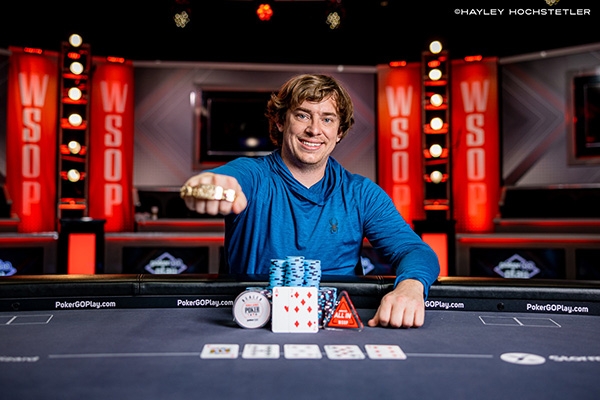
When 2023 arrived, everything changed. Brewer captured two WSOP bracelets, including the $250K Super High Roller for over $5 million. The turnaround prompted obvious questions – was it skill, mindset, or just the cards finally falling his way?
“Mostly, I just ran better,” Brewer says plainly. “The years before, I’d lose the big all-ins. This year I won them. But I also had a slightly more structured study routine, and after briefly quitting at the end of 2020 to try a ‘real job’ I didn’t like, I had more gratitude for playing poker. I was a little less frustrated, a little more focused.”
If he could speak to the version of himself grinding through those downswings, Brewer’s advice would be simple: relax.
“Don’t blame yourself for things you can’t control. Enjoy it as much as you can. Stay focused and don’t let outside stuff bother you. Control what you can control.”
Brewer is known for his in-depth study of solvers. “Between 2016 and 2022, I didn’t have much life outside of poker and studying. I’ve probably spent as much time in solvers as almost anyone.”
When it comes to balancing GTO poker with live adjustments, he prefers to lean on his strengths. “If you play a good theoretical game, you’ll win. There are exploits out there, but guessing games aren’t my best skill. My edge is understanding the game tree better than most, so I focus on showing up and playing good poker.”
Joining PokerCoaching.com
Brewer’s move into coaching wasn’t just about sharing knowledge. It was about joining a team he respected.
“I really like the people at PokerCoaching.com. It’s a high-quality team, and I like that the focus isn’t only on high-stakes poker. We help players beat their local cash games, too. That’s how I started, spinning it up from small stakes.”
Teaching has also sharpened his own game. “Hearing other people’s thought processes can be eye-opening. Sometimes they see spots differently than I would, and it expands my understanding of how players think.”

One recurring misunderstanding Brewer sees is around equity.
“Players underestimate how much equity determines your strategy, your bet sizing, your frequency, and how aggressive or passive you should be. People often check back too many middling equity hands and fail to bluff enough with low-equity hands. In position, you want to be more polarized and more aware of what your equity means for your plan.”
Brewer’s advice for players stuck without the results they want: keep walking.
“You can always improve. Get in the lab, identify your mistakes, put in the effort, and find a good game. If you’re stuck in a game you can’t win in, even if you think you’re just running bad, try a different one. Play where you’re winning.”
What Separates Elite Players from the Rest & How To Start Studying Today
At the top of the game in series such as Triton or PokerGO Tour, Brewer says the difference isn’t just technical skill.
“The truly elite aren’t afraid to be wrong. Many very good players fear making a big river call and being wrong, or making a big bluff and getting called. That fear pushes them into cookie-cutter strategies. The elite are willing to take those risks when the spot calls for it.”
If he were starting today, Brewer’s learning plan would begin with the basics.
“Preflop is the most important part of the game. You can’t do anything until you understand it. I’d spend a lot of time on preflop ranges, then bucket different flop types instead of memorizing every spot, for example, two Broadway cards, Broadway straight boards, monotone, etc. Then I’d move to turns and rivers.”
He also recommends toy games to understand poker math fundamentals. “A lot of players now learn just from solvers and streams, but without the underlying math, they make huge mistakes when they face a spot they haven’t seen before.”
From a $5 game at the Olympic Trials to $5 million wins in the biggest events on earth, Brewer’s journey shows both the grind and the glory. And now, as a coach, he’s distilling those lessons for the next wave of players, from local cash grinders to aspiring high rollers.
“Poker’s always evolving,” he says. “If you’re willing to keep learning, you’ll always have a shot.”