

Casino card games vary enormously in how much mathematical edge the house holds over you. The best casino card game for long-term winning potential is poker: you are playing other people, not the house, which means a skill edge translates directly into profit over time.
I have played and coached at casino poker rooms across the country, and the single most common mistake I see is players drifting to higher-edge table games between poker sessions without realizing how much it costs them.
Among house-banked games, Baccarat (Banker ~1.06%) and Blackjack 3:2 (~0.3-0.8%) offer the best player odds. Video Poker with optimal strategy can be even lower. Variants like Ultimate Texas Hold’em, Three Card Poker, and Pai Gow Poker are enjoyable but carry higher edges.
Here is the full ranking of casino card games by house edge:
- Poker – no house edge
- Blackjack (3:2) – ~0.3–0.8%
- Spanish 21 – ~0.4–0.8%
- Baccarat – Banker bet 1.06%
- Pai Gow Poker – ~1.46%
- Ultimate Texas Hold’em – ~2.2–2.4%
- Casino War – ~2.9–3.7%
- Three Card Poker – ~3.3%
- Let It Ride – ~3.5%
- Mississippi Stud – ~3.8–4.9%
- Caribbean Stud – ~5.2%
#1. Poker (Texas Hold’em, Omaha & more) – no house edge
Poker is not a house-banked game since the casino isn’t your opponent. Instead, it hosts the game and takes a rake or charges an hourly seat fee. Because there’s no built-in mathematical edge against your hands, skilled players can win long-term.
You can win by mastering basic poker strategy, learning about positions, hand ranges, table selection, and sticking to a proper bankroll. Over a large sample, strong decision-making beats weaker opponents even after rake.
Beware that games like Three Card Poker and Ultimate Texas Hold’em feel “poker-ish” but are house-banked and have very different math.
Key facts & odds
- Edge model: No house edge on your hand; the casino earns rake.
- Long-term winners: Possible with a skill edge over opponents.
- Variance: High in tournaments; steadier in cash games.
#2. Blackjack (3:2) – 0.3-0.8% house edge
You play Blackjack against the dealer. The goal is to get closer to 21 than the dealer without going over. You can hit, stand, double, and split pairs.

A natural blackjack (A + 10-value) pays 3:2 on good tables. The dealer hits or stands on a soft 17, depending on the rules.
Key facts & odds
- With 3:2 payout and basic strategy: ~0.3–0.8% house edge.
- Avoid 6:5 payout tables (adds roughly +1.39% against you).
- Use a basic-strategy chart that matches your table’s rules/deck count.
- Skip most side bets (usually much higher edge).
#3. Video Poker (Jacks or Better) — ~0.46-0.5% house edge
Video Poker is the most player-friendly house-banked game in the casino when played on a full-pay machine with optimal strategy. Unlike table games where you have no control over the outcome, Video Poker rewards correct decision-making on every hand, and on a full-pay Jacks or Better machine (9/6 pay table), the house edge drops to approximately 0.46%.
In my experience, Video Poker is underutilized by recreational players who walk past entire banks of machines without realizing they offer better expected value than most table games. The catch is that you must learn and apply basic strategy — a strategy card exists for every major variant, and using it correctly is the only way to achieve that ~0.46% edge.
Key facts & odds
- Full-pay Jacks or Better (9/6): house edge approximately 0.46% with optimal strategy.
- Avoid short-pay machines (8/6 or 8/5 pay tables) — the edge more than doubles.
- Use a strategy card for the specific variant you are playing.
- Common variants: Jacks or Better, Deuces Wild, Double Double Bonus.
- The Trips side bet and side games typically run much higher edges.
#4. Spanish 21 – 0.4-0.8% house edge
Plays just like blackjack, but the deck removes the 10s (still keeps J-Q-K). To balance that, Spanish 21 adds player-friendly rules: player 21 always wins, late surrender, liberal doubling (often after splits), and bonus pays for certain 21s and 5-card/6-card/7-card 21s. You still aim to beat the dealer without busting.
Key facts & odds
- Typical house edge with correct strategy: ~0.4–0.8% (varies by rules).
- Use a Spanish 21 chart (different from standard blackjack).
- Bonuses and flexible rules can offset the missing 10s.
#5. Baccarat – 1.06% house edge
In Baccarat, you only need to place one bet: Banker, Player, or Tie. The dealer draws cards by fixed rules, and you don’t need to make any further decisions.
The hand closest to 9 wins (tens/face cards count as 0; Aces count as 1). If you bet the winning side, you’re paid; if it’s a tie and you didn’t bet Tie, your Banker/Player bet pushes.
Key facts & odds
- Typical edges: Banker ~1.06%, Player ~1.24%, Tie ~14% (varies by pay table).
- Tip: Bet Banker (or Player). Avoid Tie and most side bets.
- Pace/variance: Simple, steady, friendly to beginners.
#6. Pai Gow Poker – 1.46% house edge
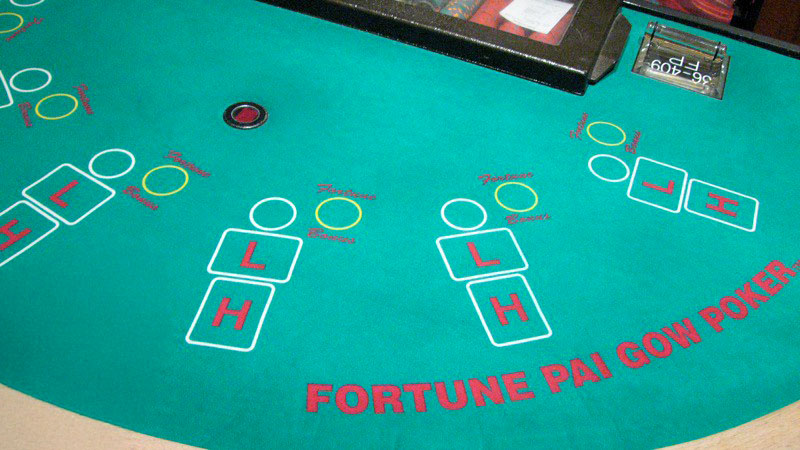
You get 7 cards in Pai Gow Poker and have to set two hands: a 5-card “high” hand and a 2-card “low” hand.
Your high hand must rank above your low hand. The dealer sets hands using fixed house rules. To win the main bet, both your hands must beat the dealer’s; if one wins and one loses, it’s a push; if both lose, you lose the bet.
Key facts & odds
- House edge vs dealer: about ~1.46%; many pushes = lower volatility.
- Good for stretching your session and keeping swings smaller.
#7. Ultimate Texas Hold’em – 2.2-2.4% house edge
In Ultimate Texas Holdem, you need to make Ante and Blind bets (optional Trips side bet).
You get 2 cards when the hand starts and then decide when to commit your Play bet: up to 4x preflop, 2x on the flop, or 1x on the river.
Five community cards are dealt, and your best 5-card hand is compared to the dealer’s. If you win, Play/Ante usually pays even money; Blind pays from a pay table on straight or better. If the dealer wins, you lose the main bets.
Key facts & odds
- House edge: ~2.2–2.4%; element of risk ~0.53–0.58%.
- Strategy: Use 4x preflop with strong holdings; raise later with medium hands.
- Trips side bet: Fun sweat, usually poor value.
#8. Casino War – 2.9-3.7% house edge
You and the dealer each get one card in Casino War, and the higher card wins. On a tie, you can either surrender by losing half of your bet or go to war by matching your bet.
In war, more cards are dealt; if you win, you’re paid even money on your bet.
Key facts & odds
- House edge: roughly ~2.9–3.7%, depending on the tie rules.
- You’re paying for simplicity; the tie rule drives most of the cost.
#9. Three Card Poker – 3.3% house edge
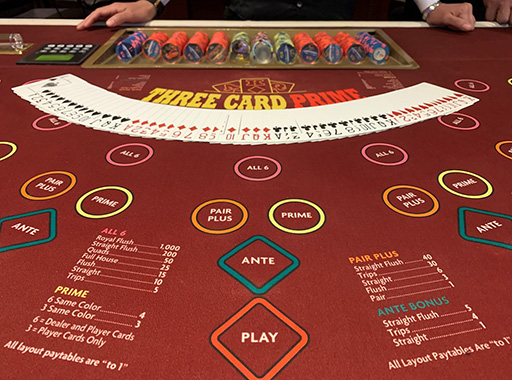
In Three Card Poker, you can make two separate bets: Ante/Play (vs the dealer) and Pair Plus (your hand only).
You and the dealer get 3 cards. If you like your hand, place a Play bet to continue; otherwise, fold and lose the Ante.
The dealer qualifies with Queen-high or better. Outcomes for Ante/Play depend on the dealer qualifying and who has the higher hand. Pair Plus pays from a separate pay table regardless of the dealer.
Key facts & odds
- Ante/Play (full-pay): about ~3.3% house edge.
- Pair Plus: often ~7%+ depending on pay table.
- Simple tip: For Ante/Play, raise with Q-6-4 or better; otherwise fold.
3 Card Poker Rules and 4 Card Poker Rules
#10. Let It Ride – 3.5% house edge
You place three equal bets to start Let It Ride. You get 3 cards; two community cards are dealt face down. After seeing your 3 cards, you can pull back one bet or “let it ride.”
One community card is revealed; you can pull back a second bet or let it ride. After the final card, your 5-card poker hand is paid from a table (usually pays on a pair of 10s or better). There’s no dealer hand to beat.
Key facts & odds
- Main game house edge: about ~3.5%.
- Use a simple pull-back strategy to cut losses.
- Skip the 5-card bonus side bet (often double-digit edge).
#11. Mississippi Stud – 3.8-4.9% house edge
Place an Ante to start the game, and you will receive 2 cards. Three community cards are turned up one at a time (3rd, 4th, 5th street). Before each reveal, you can bet 1x–3x your ante or fold. There’s no dealer hand; your final 5-card hand is paid from a pay table.
Pairs below 6s usually lose, and the bigger the hand you make, the higher the payout.
Key facts & odds
- House edge: commonly ~3.8–4.9% (depends on pay table).
- Very swingy: bets escalate on later streets; use a chart if available.
#12. Caribbean Stud – 5.2% house edge
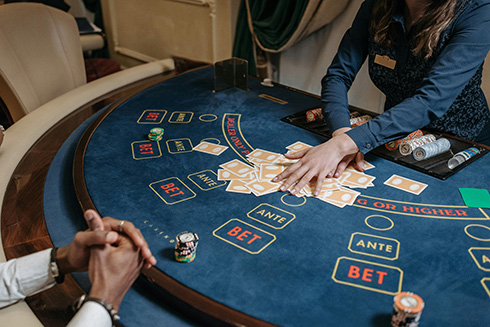
When you place an Ante bet, you receive 5 cards (dealer takes 5 with one up). Then you can decide to Fold and lose the Ante or raise 2x to continue. The dealer qualifies with A-K or better.
- If the dealer doesn’t qualify: Ante usually pays even money; raise pushes.
- If dealer qualifies and you win: Ante pays even money; raise pays from a hand-strength pay table (e.g., straight, flush, etc.).
- If the dealer wins: you lose both Ante and raise. The progressive side bet is optional and has high variance.
Key facts & odds
- House edge: about ~5.2% overall; element of risk ~2.6%.
- Fun if you like stud, but costly compared to other options.
Picking the Right Casino Game for You
Here is how I think about choosing a casino card game based on what you are actually trying to achieve:
- If your goal is long-term profit, the only game on this list that gives you a realistic path to winning is poker. Improve your skill, choose good games, manage your bankroll, and you can beat the rake over a large sample.
- If you want the best odds against the house with almost no decisions to make, play Baccarat (Banker bet, ~1.06% edge).
- If you want skill to matter in a house game, play Blackjack (3:2) with basic strategy — the edge can drop below 0.5% with the right table rules.
- If you are comfortable learning strategy and want surprisingly good odds from a machine, play Video Poker on a full-pay Jacks or Better machine.
- If you want a poker-style experience against the house, play Ultimate Texas Hold’em — but learn the main strategy decisions or the edge climbs quickly.
- If you want a relaxed, low-variance session that stretches your bankroll, play Pai Gow Poker, where pushes are frequent and the swings are small.
My general rule: the more decisions you are allowed to make in a casino game, the more your skill can affect the outcome. Games with no decisions (Baccarat, Casino War) are pure house edge. Games with decisions (Blackjack, Video Poker, poker) reward the player who studies.
FAQ: Casino & Gambling Card Games
Is poker the best casino card game?
For long-term profit potential, yes. In my experience playing and coaching poker, the fundamental advantage is that you are not fighting a built-in mathematical edge on every hand — you are fighting other players. The casino takes a rake, so your profitability depends on how much better you play than the other people at your table. That is a very different math problem than any house-banked game.
Which house card game has the best odds?
Baccarat (Banker bet at ~1.06%) and Blackjack 3:2 (~0.3-0.8% with basic strategy) are the standouts. Video Poker on a full-pay Jacks or Better machine (9/6 pay table) can match or beat both at approximately 0.46% — but only with correct strategy. House edge figures on this page are sourced from the Wizard of Odds, a widely cited authority on casino game mathematics.
Why do some sources list two numbers for the same game?
They are typically showing two different measurements: house edge (calculated against the initial bet) and element of risk (calculated against the total amount wagered across all betting rounds). Games like Ultimate Texas Hold’em and Mississippi Stud look “cheaper” by element of risk because players frequently fold early before committing all bets.
Are 6:5 blackjack tables really that bad?
Yes, and I would avoid them. Changing a blackjack payout from 3:2 to 6:5 adds roughly +1.39% to the house edge on your naturals alone. That single rule change can take a 0.5% edge game and push it above 1.8%. Always look for 3:2 tables.
What’s the safest game for my bankroll?
For variance control (fewer big swings), Pai Gow Poker is the best option because a large percentage of hands end in pushes. Baccarat is similarly low-variance. For long-term bankroll health, poker is the right answer if you have a genuine skill edge over your opponents — because a skill edge eventually compounds, whereas every house-banked game gradually erodes your stack regardless of short-term results.