

We have already covered how to defend on High-Card boards in position with a 100bb, and today we will analyze tournament scenarios with a 40bb stack.
In this article, we will cover how to play on different board textures after calling preflop in position and see how to adjust our strategy on dry and connected boards.
Playing on Dry High-Card Boards in Position – Kh8d2c
Our preflop calling range from the BTN when facing a CO open is around 18%, which is something we need to remember when analyzing this spot. This is how it looks according to the PeakGTO solver.
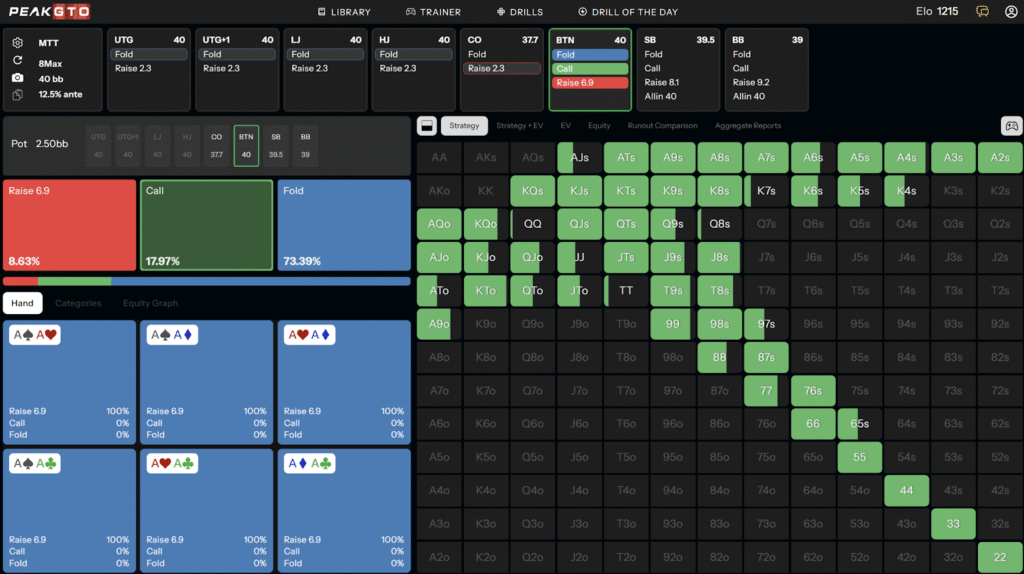
Key assumptions for the hand:
- The hand is played 40bb deep with 12.5% ante
- The cutoff is opening the pot
- We call his preflop raise from the BTN
- Both of the blinds fold
- We face a c-bet on the flop
On a Kh8d2c, the CO will be c-betting around 28% of the time and usually using bigger bet sizing of two-thirds of the pot. When facing this bet, we will need to defend 66% of our hands.
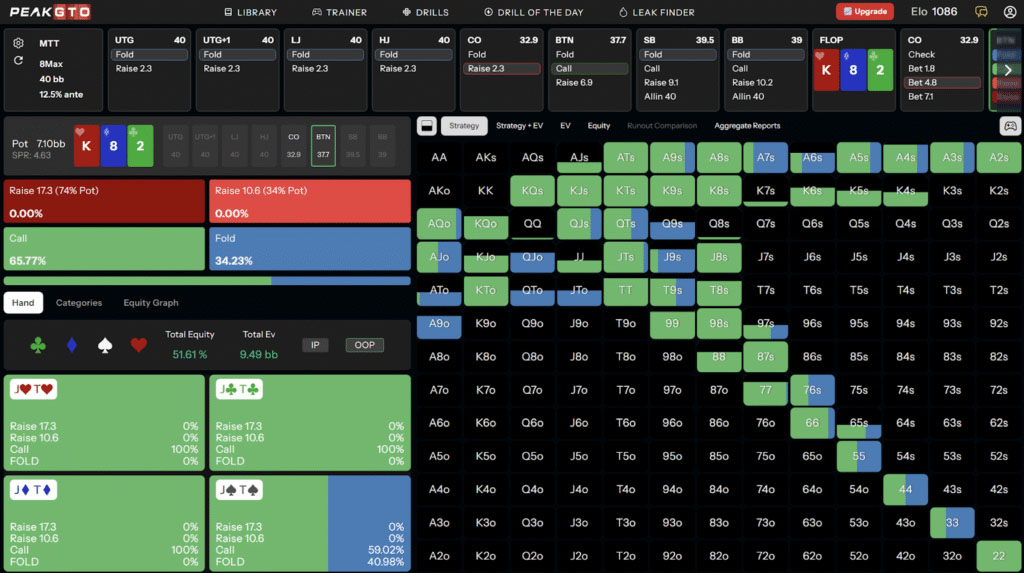
As you can see from the image above, we do not have a raising range on a dry board. Therefore, even with our sets, two pairs, and the strongest top pair combinations, we will be just calling to balance out our weaker holdings.
The only hands we are folding in this situation are the ones that do not have any showdown value and have very little backdoor potential. Mostly Broadway hands, some weak ace-highs, and a few combinations of low pocket pairs while calling with everything else.
When the stacks drop to 20bb effective, the CO c-bets around 36% of the time, but this time will stick to a small bet size in almost all cases.
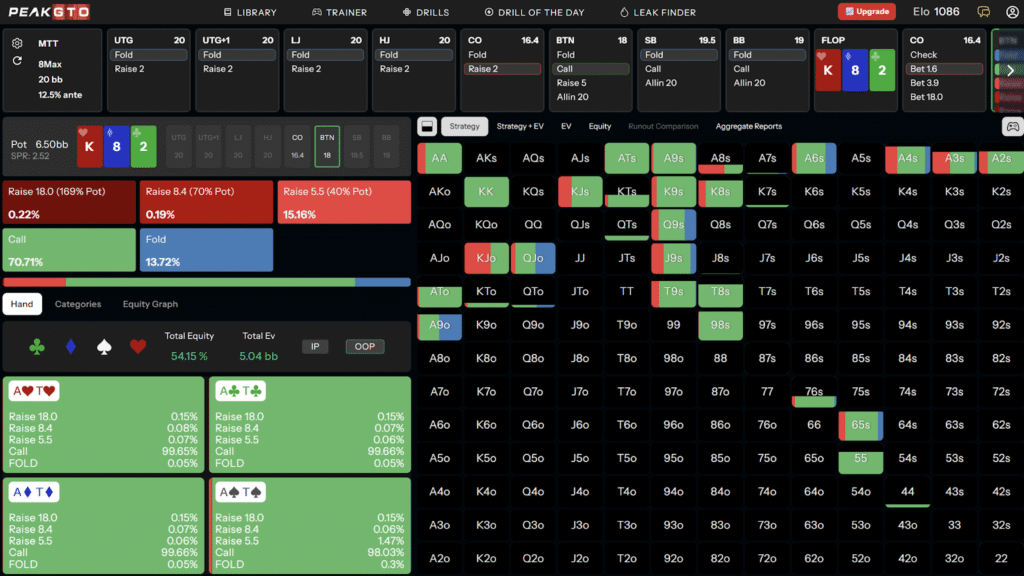
Since we are facing a small bet and have a shorter stack, relative hand values increase, so we will defend much more aggressively. In fact, we are only folding 14% of the hands in this situation, calling 71%, and even having a raising range of 15%.
As you can see, we are only folding a few combinations of ace-highs and Broadway holdings, specifically Q-highs.
We start raising some of our top pair hands and a few runner-runners with blockers, while calling the rest.
Key takeaways
- Defend around 66% of your hands by calling your entire range with a 40bb stack
- When stacks drop to 20bb, continue with 84% of the hands, only folding the weakest holdings
- Start raising your strong top pair hands and some runner-runners with blockers with shorter stacks
Defending on Connected High-Card Boards – Kh9h8d
Key assumptions:
- The hand is played 40bb with 12.5% ante
- The cutoff is opening the pot
- We call his preflop raise from the BTN
- Both of the blind fold
- We face a c-bet on the flop
Let’s take a look at an example of Kh9h8d. In this case, CO will c-bet 44%% of the time, mostly using smaller bet sizing of one-fourth of the pot.
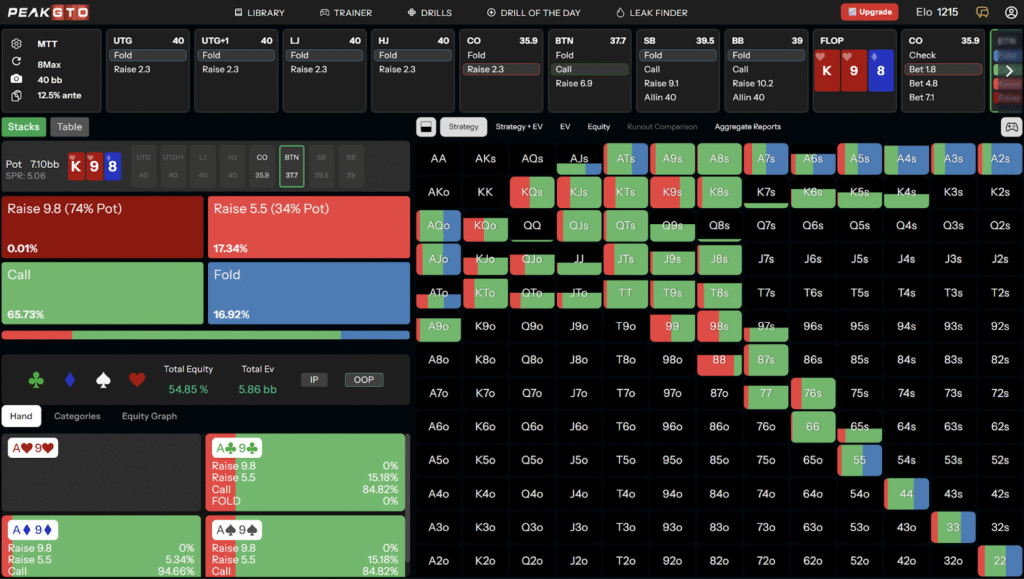
When facing this bet, we have the pot odds to defend by calling 66% and raising 17% of our hands. We will fold only 17% of the time, mostly letting go of ace-highs and small pocket pairs half of the time.
You should be looking to raise your strongest holdings like sets, two pairs, and strong top pair combinations more than half of the time, and balance it out with occasional bluffs that have some runner-runner potential.
When stacks drop to 20bb, the CO will check 92% of the time and mix between small and big sizing when betting with the rest of the range, with a slight preference for bigger bets.
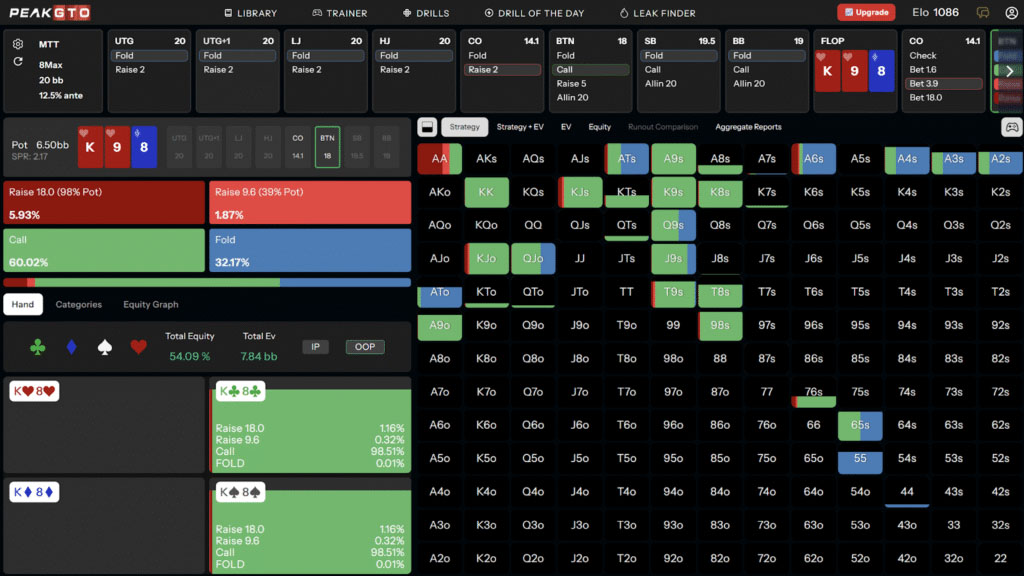
When facing a 60% pot size bet on the BTN, you will need to defend around 68% of your range and will be calling with most of the hands you continue. In fact, the only hand that you will be raising more often than calling is pocket aces.
Other than that, you will raise a few combinations of the strongest top pairs and some bluffs, but will mostly continue calling with any pair or any draws that you have.
Key takeaways
- When facing a c-bet defend 83% of the time by calling 66% and raising 17% of our hands
- Raise a part of your strongest holdings and balance it out with some bluffs that have runner-runner potential
- Defend less often when stacks fall to 20bb and do so by mostly calling with your entire range