
We analyzed how to defend on Low-Card boards in position with a 100bb, and today we will review tournament scenarios with a 40bb stack.
In this article, we will cover how about defending in position on different board textures after calling preflop in position and see how to adjust our strategy on dry and connected boards.
Playing on Dry Low-Card Boards in Position – 9s6d2c
We defend around 18% of hands against a CO open, and this is how our range looks in these situations.
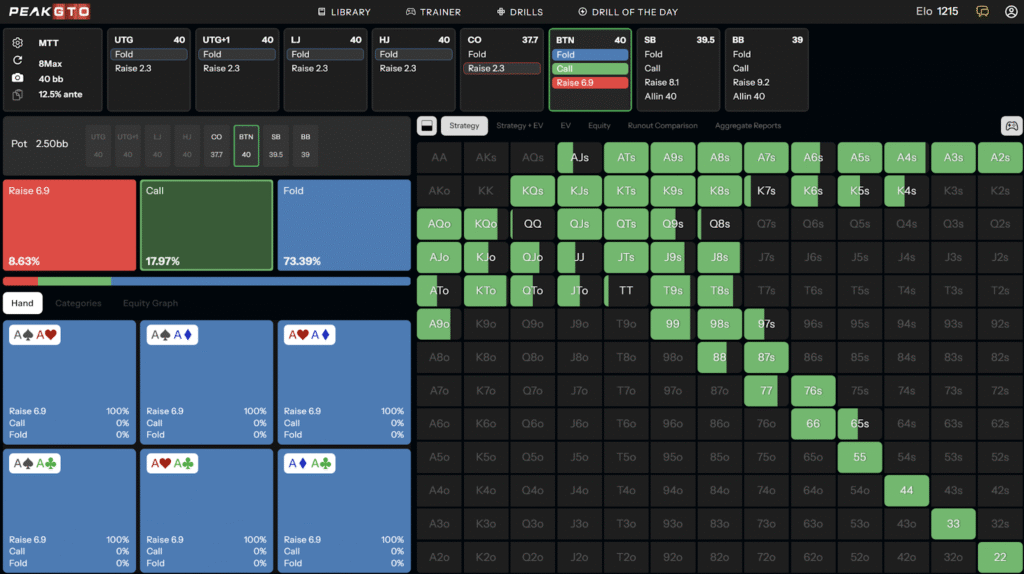
Key assumptions for the hand:
- The hand is played 40bb deep with 12.5% ante
- The cutoff is opening the pot
- We call his preflop raise from the BTN
- Both of the blinds fold
- We face a c-bet on the flop
On a 9s6d2c, the CO will be c-betting around 46% of the time and sticking with a bigger sizing of two-thirds of the pot in the vast majority of cases. Against this bet, we will have to defend 66% of our hands.
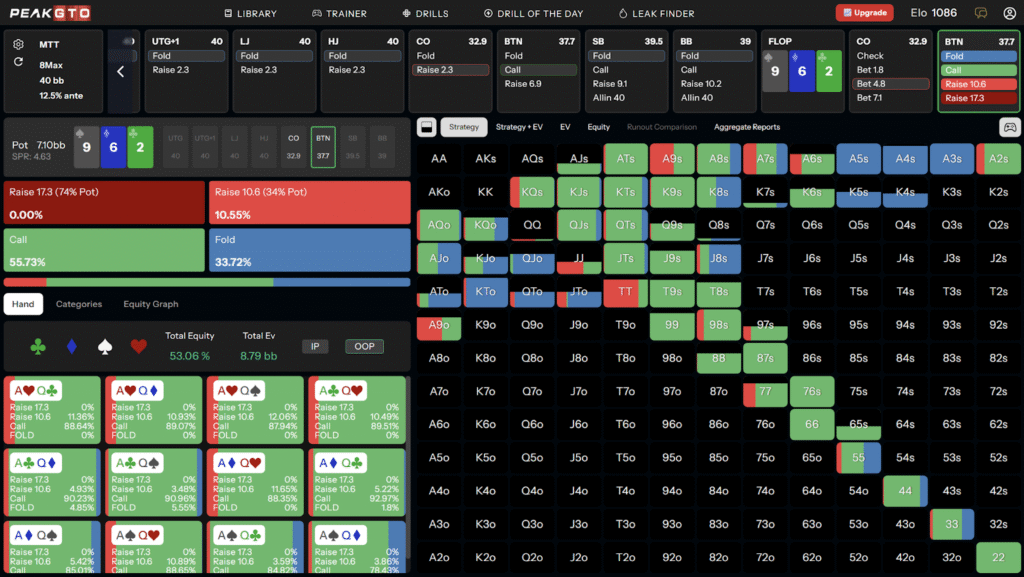
In this spot, we are calling with 56% of the hands and raising a bit over 10% of our holdings.
Our raising range here consists of strong poker hands like overpairs, top pair top kicker combinations, and some bluffs with overcards. It is worth noticing that sets never raise here.
Other than that, we are calling all playable hands and even floating with a lot of suited Broadway combinations because we can put the pressure back on our opponent on later streets. In this spot, we only fold our weakest ace-high and king-high hands and offsuit Broadways.
Things drastically change when our stack drops to 20bb, because CO will be checking pretty much his entire range OOP.
Since our preflop calling range includes many suited 9x combinations, we actually have more equity in this spot and should be betting very aggressively.
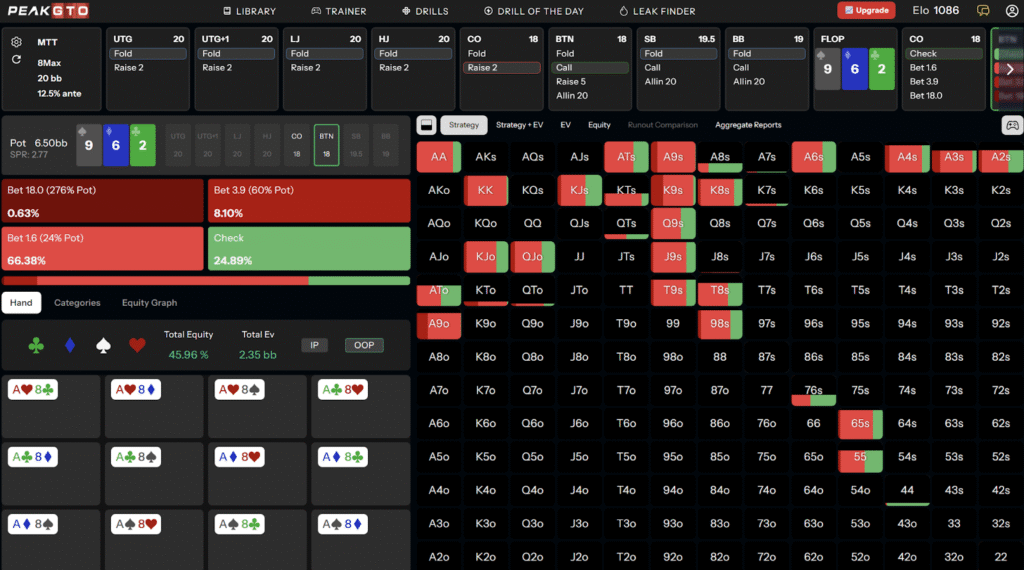
PeakGTO suggests firing a bet 75% of the time across our entire range and sticking to a default small size of 1/4 the pot.
Key takeaways
- Defend around 66% of your hands by calling 55% and raising 10% of your holdings
- Mostly raise operpairs and the strongest top pair combinations, along with some bluffs that contain overcards
- Your opponent will be checking his entire range when stacks drop to 20bb, so you need to be stabbing here very aggressively and bet around 75% of the time with small sizing
Defending on Connected Low-Card Boards – 9h8d6d
Key assumptions:
- The hand is played 40bb with 12.5% ante
- The cutoff is opening the pot
- We call his preflop raise from the BTN
- Both of the blind fold
Let’s take a look at an example of 9h8d6d. On a connected board like this, CO will use a mixed strategy, distributing his bets and checks across the entire range.
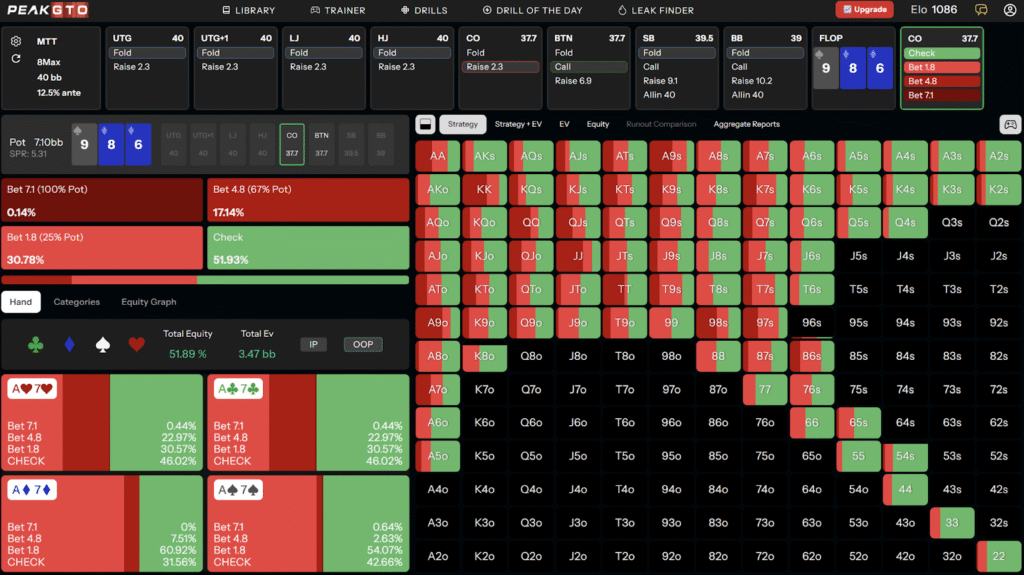
In this spot, CO will bet 48% of the time and check 52% of his range. When betting, he will pick small sizing twice as often as the bigger one, so we will analyze the former.
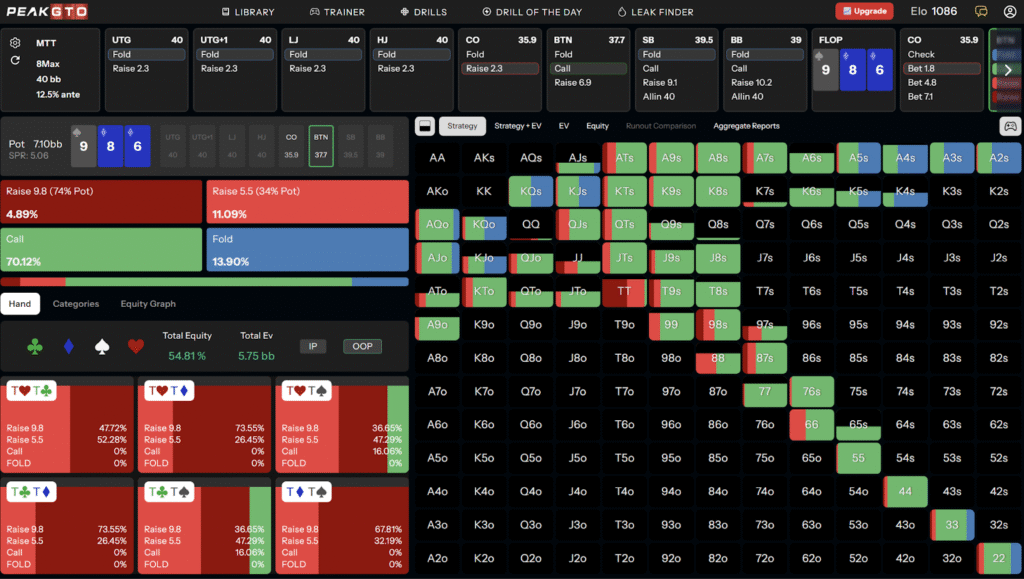
In position, against that small one-forth pot size bet, we will continue with 86% of our range. We will be calling with the vast majority of hands around 70% of the time, and raising 16% of our holdings.
We raise with almost all of the hands with very low frequency, and balance this out with top hands like sets, two pairs, and overpairs in particular, which we use more often for an aggressive action.
Other than that, we call almost all hands with even a little equity or runner-runner potential and only fold the weakest holdings.
When stacks drop to 20bb, the CO will be checking over 88% of the time, so we will have to take a stab ourselves with 53% of the hands.
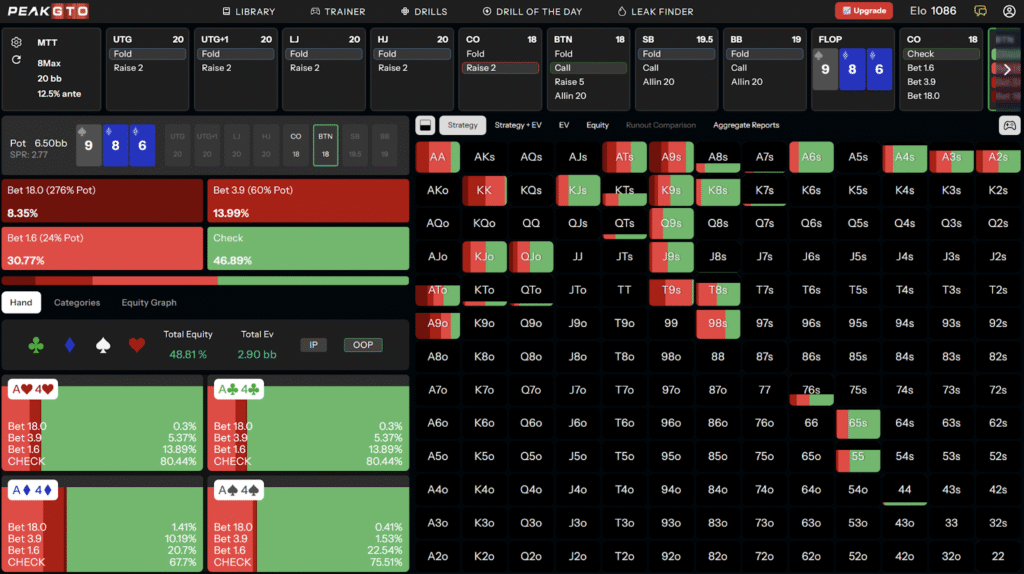
In this spot, we will bet small 31% of the time and use a larger bet size with 22% of our holdings.
We are mixing our strategy between checks and bets throughout our entire range.
Key takeaways
- When facing a small c-bet on a connected board, we will defend 86% of our range
- We will be mostly calling when facing a bet and raising around 16% of the time with strongest hands and some bluffs
- CO will be checking most of the time with a 20bb stack size, so we will stab aggressively ourselves around half of the time