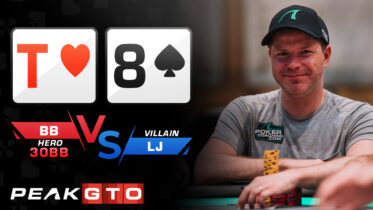
Draws are where a lot of money is won and lost, and playing a draw from the big blind is especially tricky because you are out of position for the rest of the hand. The plan is rarely just “bet when I hit.” More often it is a sequence: check when your draw is junky, apply pressure when the turn gives you real equity, and then make the tough decision on the river when the draw bricks. The hand that misses can still win the pot if you understand why you were betting in the first place.
Today we will analyze a 30 big blind tournament hand where Hero defends T♥8♠ in the big blind, checks a K♠ 7♥ 5♠ flop that checks through, picks up an open-ended straight draw on the 6♦ turn and leads big, then bricks the J♦ river and jams as a bluff with nothing but ten-high. It is a clean template for playing a draw from the big blind across all three streets.
Assumptions
- Stacks: 30 big blinds effective
- Format: 8-handed MTT
- Positions: Hero in the big blind (out of position), Villain in the lojack (the preflop raiser, in position)
- Preflop action: Villain opens the lojack, Hero defends the big blind
- Flop (pot ~6bb): K♠ 7♥ 5♠, two-tone. Hero checks, Villain checks back
- Turn: 6♦. Hero leads 6.1bb (100% pot), Villain calls
- River: J♦. Hero jams an overbet as a bluff, Villain calls
- Hero: T♥8♠ | Villain: J♥J♠
Preflop
The lojack raises and Hero defends T♥8♠ from the big blind. Against a smallish open you want to defend a wide range, and if the raise were even smaller you would defend wider still. Offsuit T8 is a comfortable call closing the action from the big blind. Because you are defending so wide and you are out of position, much of your range will flop weak made hands and draws, which is exactly why a clear street-by-street plan matters so much.
Flop: K♠7♥5♠
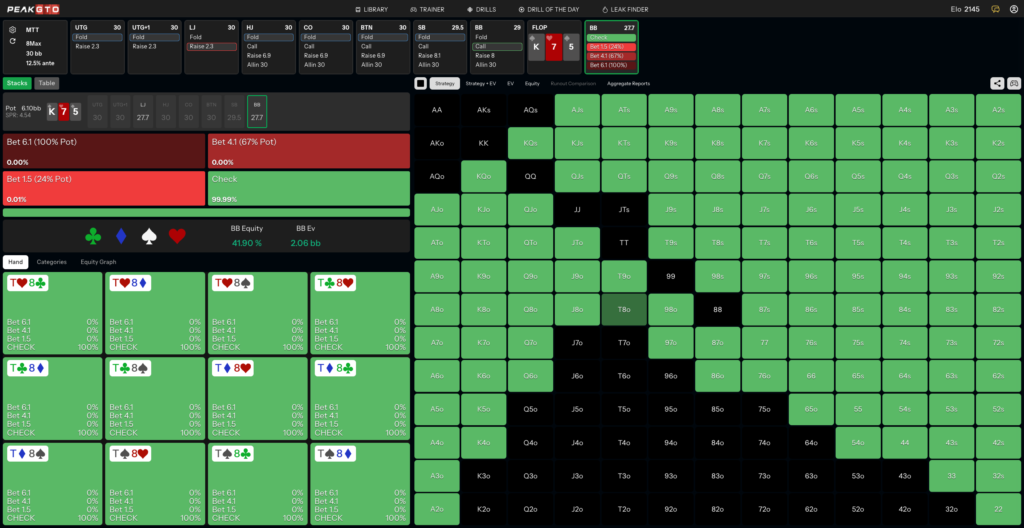
The flop is K♠ 7♥ 5♠ and Hero has T8 high, ten-high with two junky backdoor draws. Hero checks, and this time the lojack checks back. That should not happen often: this is a board the in-position raiser is supposed to continuation bet frequently with a small size, and the GTO check-back frequency is only around 6%, though many opponents will check back far more than that.
It is worth noting what Hero does facing a bet rather than a check. If the lojack had bet small, T8 with just two junky backdoor draws is mostly a fold. The specific T♥8♠ can mix in an occasional check-raise over a tiny bet, but with so little equity it usually gets out of the way. Since the lojack checks behind, however, Hero takes a free card and moves to the turn with a hand that is about to get much more interesting. That free card is the entire reason the hand becomes profitable: a holding that could not have called a bet gets to see a turn for nothing, and a six or a nine transforms it into a genuine open-ended semi-bluffing weapon. Punishing an opponent who checks back too wide starts with simply being there to capitalize when your equity arrives.
Turn: 6♦
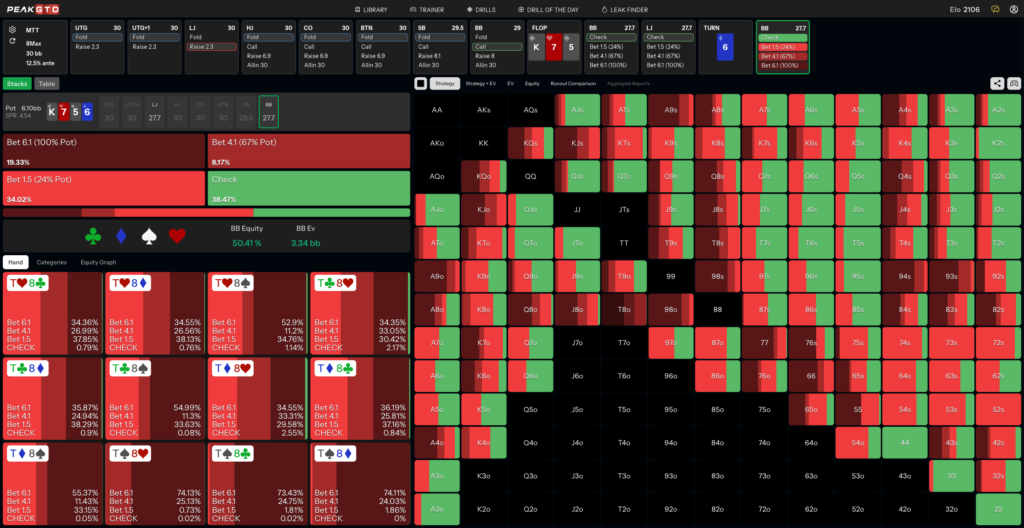
The turn is the 6♦, and now Hero has an open-ended straight draw, with any four or nine completing the straight. This added equity flips the hand from a check-and-give-up holding into an aggressive one. With the new draw, T8 uses a mix of bet sizes and basically never checks. The exploitative read reinforces it: when the lojack checks back a king-high flop, their range is full of underpairs and ace-high that you can pressure, so leading is clearly correct.
The size choice is deliberate. Because T8 completely lacks showdown value, it prefers a big bet, which folds out random ace-high and queen-high more often than a small one would. Hands that have a sliver of showdown value, like A4 or A8, are the ones that lean toward a smaller size, while pure-equity draws with no made-hand backup pick the large size to maximize fold equity. The PeakGTO solutions favor the big bet with T8 in particular for exactly that reason. The mechanism is simple: you are not just betting your equity, you are denying the opponent the chance to realize theirs, and you are setting up the river. A big turn bet builds the pot so that a river jam is a credible, pressure-packed shove rather than a token stab, and it starts narrowing the opponent’s range to hands that can withstand more heat. Hero leads 6.1 big blinds, a full pot-sized bet, and the lojack calls.
River: J♦
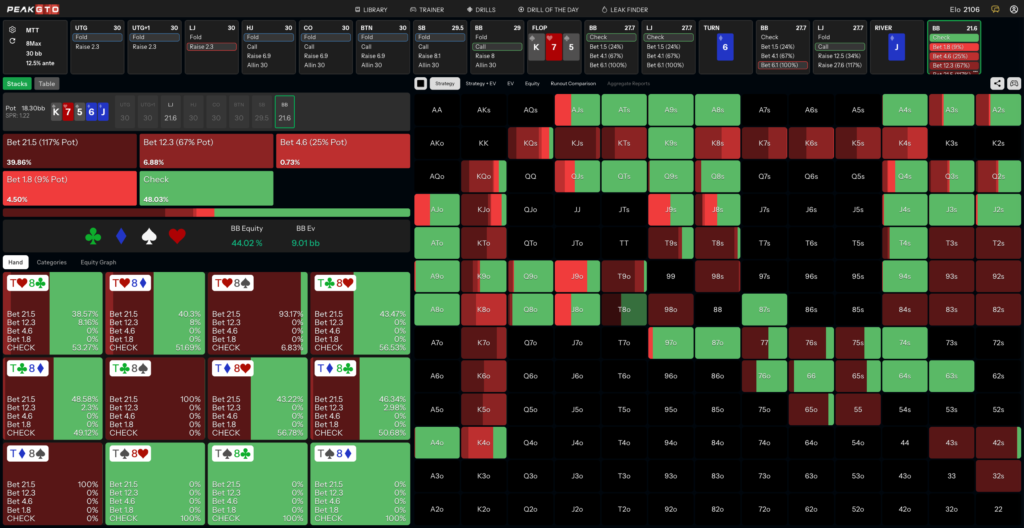
The river is the J♦, the draw misses, and Hero has nothing but ten-high. With roughly a pot-size bet behind from out of position, the river strategy is a barbell: a tiny bet with marginal made hands, or a big all-in with the polar hands. The solver jams its remaining 21.5 big blind stack about 40% of the time, mixing in tiny bets with marginal value, and the question for Hero is whether T8 should be in the bluffing group.
It should. The hands you want to jam are the ones that lack showdown value and block the straight and villain’s eights. T8 does exactly that, and the solver bluffs hands like 82, 83, T9, and T8 all in a large chunk of the time, leaning on the eight as the key blocker. Exploitatively this is even stronger: when the lojack checks back the flop and calls the turn, their range is loaded with medium-strength hands that overfold to a jam, and tournament players are especially incentivized to fold. Holding what is effectively the nut-low busted draw, jamming is the clear choice for almost any thinking opponent.
This is the part that makes the line so instructive. You bet the turn with a hand that lacked showdown value, you got called, and you arrived at the river with air, but you also represent all the strong hands like a king that would barrel the turn big and jam the river. That credibility is what makes the GTO bluff print over the long run. This particular time, Hero runs into the top of the range: Villain holds JJ and rivers a set, an easy call that sits at the very top of what they can have here. It is a reminder that a correct bluff is about the opponent’s entire range, not the one hand that happens to call. If you put the lojack all in, they should be calling QQ only about half the time, 99 about half, and folding their eights, which is a huge chunk of their range. Folding out a hand as strong as a pair of eights is a real success, and it is why this jam profits against everyone except the rare opponent who shows up with a set or finds a hero call.
Key Takeaways
- Flop: A junky backdoor draw out of position is a check, and mostly a fold facing a bet. Take the free card when the in-position player mistakenly checks back.
- Turn: When the card gives you a real open-ended draw, lead out, and prefer a big size with hands that lack showdown value to maximize fold equity.
- River: When the draw bricks, do not give up by default. Hands that block the straight and lack showdown value, like T8, jam as bluffs against a range that overfolds.
- Overall: Playing a draw from the big blind is a three-street plan. Your turn aggression sets up a credible river jam, and the busted draw with the right blockers is exactly the hand that should fire.