Most of the time your opponent checks to the preflop raiser and lets you steer the hand. Every so often they do something stranger: they check the flop, call your bet, and then come out firing into you on the turn. Facing a turn lead is one of the most misread spots in tournament poker, because a bet from the player who is “supposed” to check feels like strength when it often is not. The right response depends on what that lead actually represents, which hands in your range want to raise it, and which ones are happy to simply call and re-evaluate.
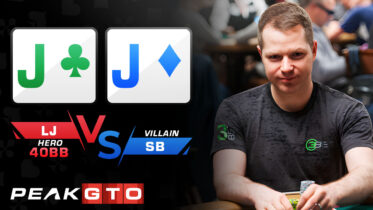
Today we will analyze a 40 big blind tournament hand where we hold JJ in the lojack and the small blind calls. The flop comes T♠4♥4♦, we make a small continuation bet, and our opponent calls. The turn double pairs the board with the T♦ and the small blind unexpectedly leads into us for a small size. We call. Then the river brings the Q♦, completing the obvious flush draws, and our opponent rips in an overbet shove worth roughly twice the pot. We will walk each street and show why our strong looking two pair turns into a pure bluff-catcher by the river.
- Format: 8-max MTT, 40bb effective stacks
- Positions: Hero is in the lojack (preflop raiser, in position); Villain is in the small blind (cold-caller, out of position)
- Hero’s hand: J♠J♦
- Preflop: Hero raises, the small blind calls. Single-raised pot.
- Flop: T♠4♥4♦, paired and rainbow. Villain checks, Hero makes a small continuation bet, Villain calls.
- Turn: T♦. Villain leads small into Hero.
- River: Q♦. Villain shoves all in, roughly two times the pot.
Preflop
We open JJ from the lojack, a clear raise that wants to play a big pot. The small blind calls out of position, which is a reasonable but slightly loose decision that keeps a wide, capped range of suited broadways, suited connectors, and middling pairs in the pot. Because the small blind only called rather than three-bet, their strongest holdings are largely missing here, and that fact will matter on every later street. When we think about what they can credibly represent once they start betting into us, we have to keep this capped preflop range in mind.
Flop: T♠4♥4♦
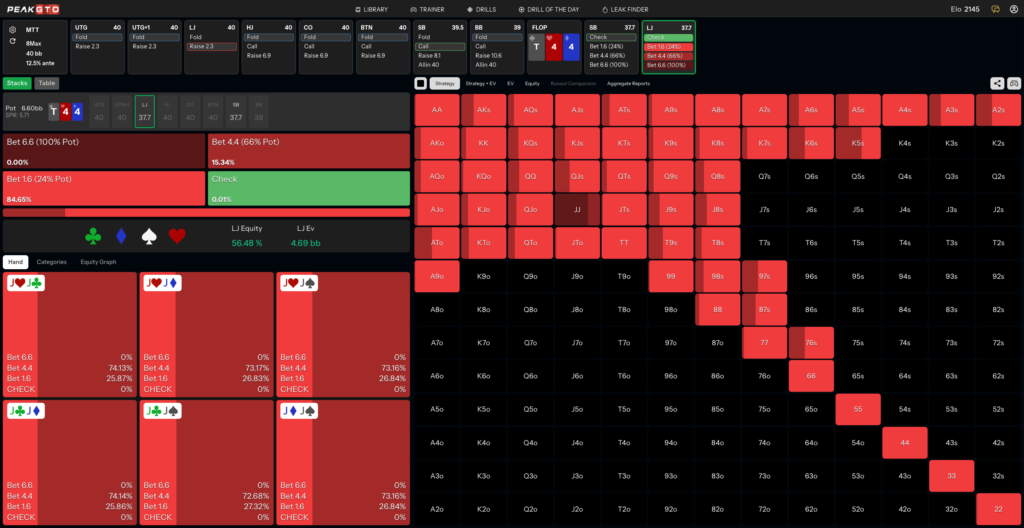
The small blind checks and we have an easy continuation bet. On a paired, dry board like this, the correct approach is to c-bet frequently and small with most of our range, mixing in a larger size around 15 percent of the time. JJ is exactly the kind of hand that likes the bigger size a good chunk of the time, because it is almost always the best hand yet still vulnerable to overcards. Large bet sizes here tend to come from hands that are almost always good but vulnerable, such as JJ or AT, paired with a few backdoor-heavy hands like QJ or 97 that do not mind folding out the opponent.
For simplicity, we can just use the small size with our entire range, and that is the line we take here. We make the small bet, the small blind calls, and we head to the turn with what looks like a comfortable overpair. The data behind these frequencies is straightforward to study inside PeakGTO, which lets you see how the entire range splits between the small and large sizes on this exact texture rather than guessing from feel.
Turn: T♦
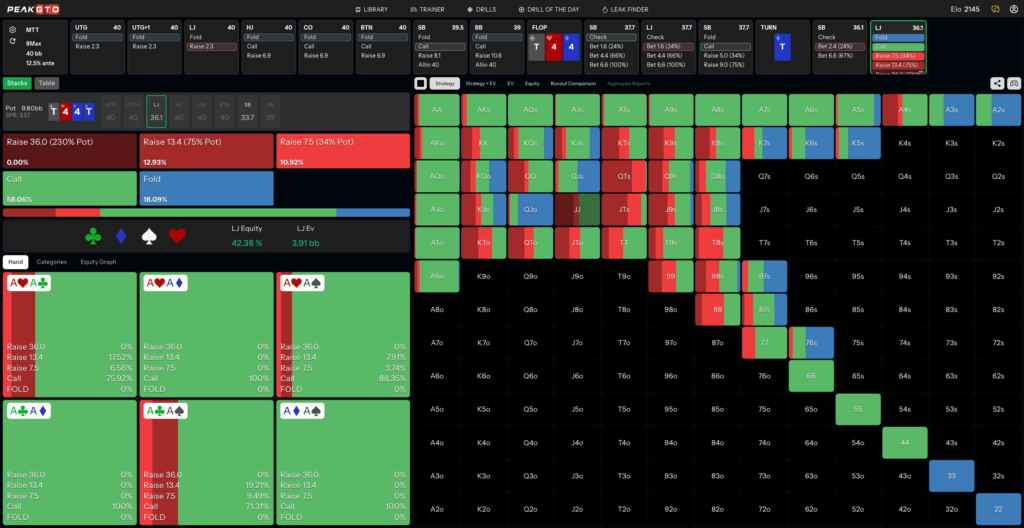
The turn is the T♦, pairing the board a second time. Our jacks are now two pair, jacks and tens, which still beats most of the hands that called the flop. Then the small blind does something rare: they lead into us for a small size. This is a very low frequency play. In a balanced strategy the out of position player only leads here around four percent of the time, so the moment it happens you should slow down and ask what it means before reacting.
The theoretical leading range is a medium-strength mix: some tens that just turned a full house (tens full), a few diamond flush-draw hands like Q♦9♦ or 8♦7♦, the occasional trip fours such as 54, and assorted random bluffs. When we face this small lead, the solver wants to do a lot of raising, around 25 percent of the time, using strong made hands like kings and queens plus some protection raises with middling pairs such as nines, eights, and sevens, and some pure trash like K9 or Q9 that benefits from folding out the opponent’s air by the river. Raising protects our equity and charges the draws.
JJ specifically mixes between calling and raising, and our exact combo, J♠J♦, leans toward calling. The reason is the J♦ in our hand. Holding a diamond makes it less likely the opponent holds a flush draw, which means their lead is more likely to be a value hand. Against value we are in medium shape rather than crushed, and when we are behind a made hand we are usually drawing thin anyway. So we take the flat, keep their bluffs in, and see a river. In the real world these leads are often a touch bluff-heavy, so calling and even raising more than the solver suggests is a fine exploit against unknown opponents.
River: Q♦
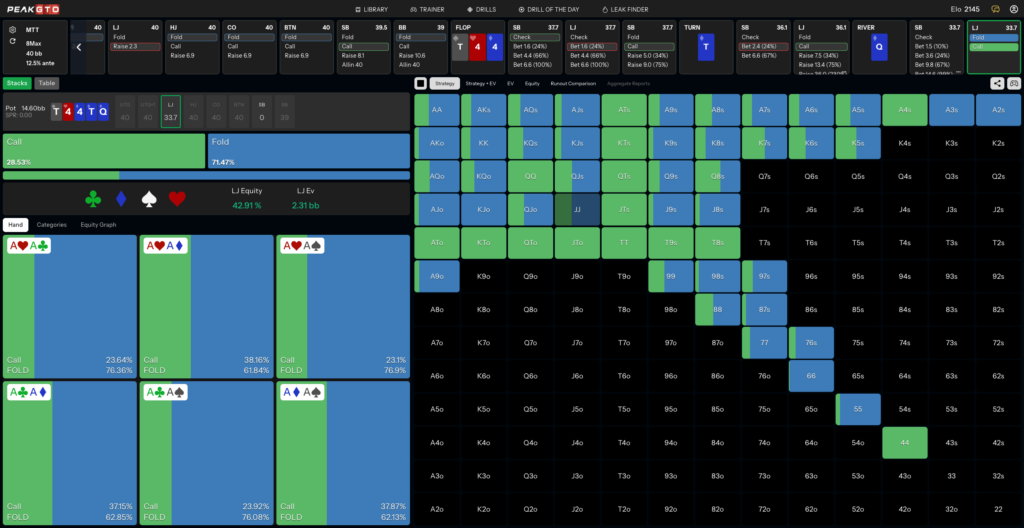
The river is a rough card for us. The Q♦ completes the diamond flush, and many of the hands that were leading as draws on the turn just got there. It is at least nice that we hold the J♦, which blocks some of the most obvious flushes. Then the small blind rips in an overbet shove worth about twice the pot. Our jacks and tens, which felt strong two streets ago, is now a pure bluff-catcher that beats only missed draws and outright air.
When an opponent takes a polarized turn-lead line and then jams the river, they are essentially representing the nuts or nothing. In theory you defend by mixing in calls with your bluff-catchers, and the blocker matters: the hands that hold a diamond call more often than the hands that do not, because they reduce the number of flushes the opponent can have. Our J♦ combo is therefore exactly the type of JJ that leans toward a theoretical call.
Practice and theory diverge here, though, and the difference comes down to your read on the population. A two-times-pot shove asks us to be good roughly 40 percent of the time to break even on the pot odds, and against most tournament fields that bar is simply too high. Players who lead small on the turn and then shove the river are overwhelmingly value-heavy in practice, in part because they fear we showed up with a ten and they do not want to miss value against our flushes. Against a world-class opponent in a high-stakes game, the call with the diamond blocker is correct every time. Against an unknown in a typical buy-in, the disciplined fold is correct, and that is the line we take. AA and every worse pair can let it go for the same reason. Knowing when the population deviates from GTO is what turns a theoretically thin call into a clearly profitable fold.
Key Takeaways
- Flop: On a paired, dry board, c-bet small with your whole range and reserve the larger size for hands that are almost always good but vulnerable, like JJ.
- Turn: A small lead from out of position is a rare, roughly four percent play. Raise about a quarter of the time with your strong-but-vulnerable hands, but let combos like J♠J♦ that block flush draws simply call.
- River: When the flush completes and a polarized opponent overbet jams, your two pair becomes a pure bluff-catcher. The diamond blocker argues for a thin theoretical call, but the price is steep.
- Overall: The math says this is close, but the population read breaks the tie. Most opponents are value-heavy after a turn lead and river jam, so folding JJ here is the correct, profitable adjustment.