The Game Theory Optimal (GTO) strategy has become one of the most discussed concepts in modern poker. Many players study solver outputs, memorize preflop charts, and attempt to model their play on theoretical perfection.
Despite this effort, a substantial portion of small-stakes players still struggle to win consistently.
The problem is not that GTO is wrong. The problem is that GTO is often misunderstood.
GTO preflop strategy is best viewed as a baseline with a mathematically sound starting point that assumes your opponents are playing optimally as well. Real poker games, especially at small stakes, rarely meet that assumption. Players fold too much, call too wide, under-bluff, and make predictable mistakes. When that happens, blindly following GTO can leave money on the table.
This article will walk through the core principles of GTO preflop strategy and show you when and how to deviate profitably.

Core GTO Preflop Principles
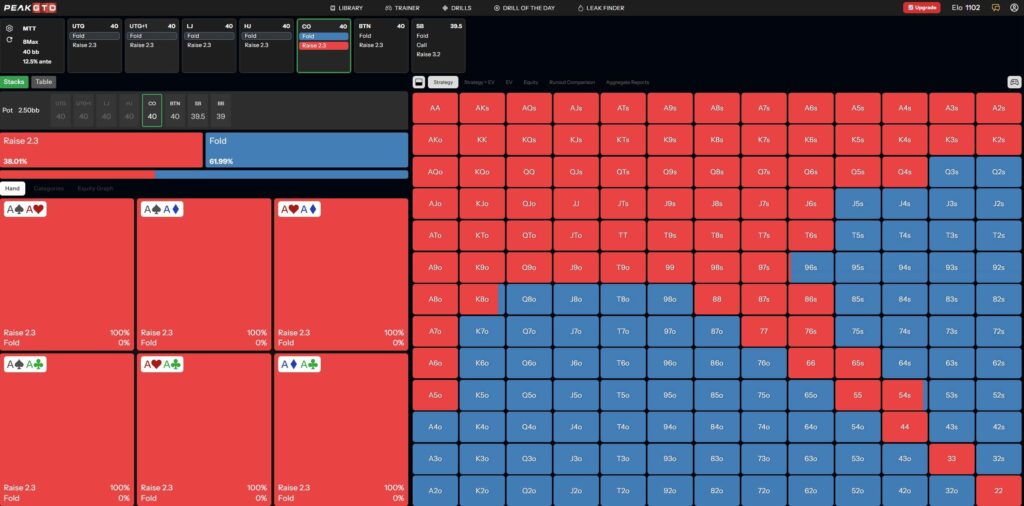
At its core, GTO preflop strategy aims to create ranges that cannot be exploited over the long run. If both players follow GTO perfectly, neither can gain an edge, and the game reaches equilibrium.
Especially at small stakes, your goal is not to be unexploitable. Your goal is to exploit opponents who are making clear, repeated mistakes.
Before discussing deviations, it’s important to understand what GTO aims to accomplish preflop and why certain ideas appear in solver-based strategies.
Position as the Primary Edge
GTO places enormous weight on position. Acting last allows you to realize more equity, control pot size, and apply pressure more effectively. This is why GTO opening ranges widen significantly in late position and tighten dramatically in early position.
From a theoretical standpoint, position increases the expected value of nearly every hand. That’s why GTO strategies encourage aggressive Button and Cutoff play while remaining cautious under the gun.
Balanced Opening Ranges
GTO opening ranges are designed to avoid predictability. Instead of raising only the best starting hands, solvers include weaker hands that mix raising and folding. These hands serve a purpose: they prevent opponents from exploiting overly tight ranges.
In theory, balance matters because good opponents will adjust. In practice, most small-stakes players never do.
Polar vs Linear 3-Betting
GTO uses different 3-bet structures depending on position and situation. Against late-position opens, 3-bet ranges are often polarized with strong value hands combined with bluffs that have good blockers. Against tighter ranges, 3-betting becomes more linear.
The goal is to pressure opponents across their entire range while protecting against counter-adjustments.
Defense Frequencies
GTO assumes players will defend their blinds, call 3-bets, and continue versus aggression at correct frequencies. This is where concepts such as Minimum Defense Frequency (MDF) originate.
The problem is that most players don’t defend nearly enough.
Preflop Sizing Theory
Solvers prefer smaller, standardized sizing because it allows wider ranges and balanced play. Small opens and consistent 3-bet sizes make it harder for opponents to gain information from bet sizing alone.
This works well in theory, but less so against players who call regardless of size.
Common Population Tendencies & Profitable Preflop Adjustments at Small Stakes
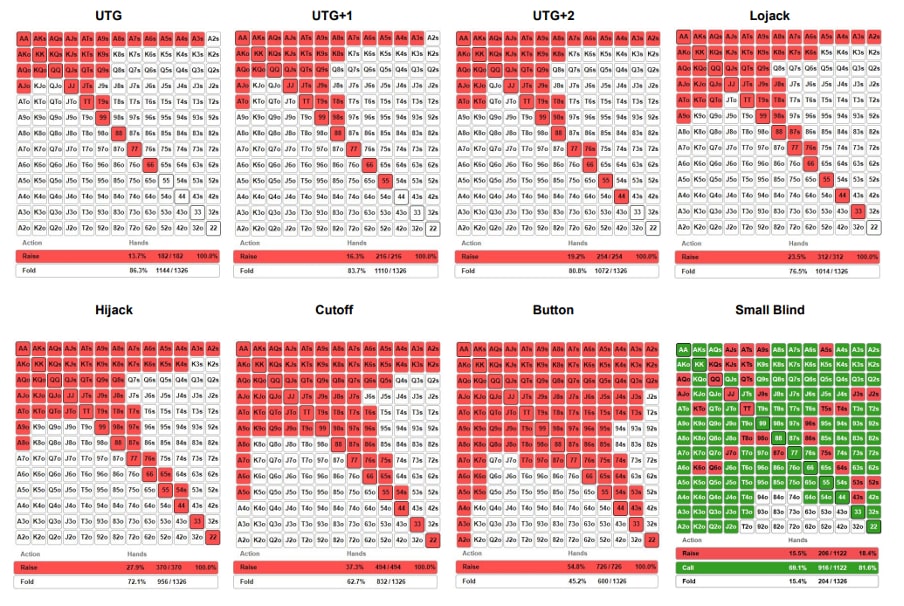
Understanding how people actually play is what allows profitable deviation. Across both live low-stakes and online micro-stakes, several patterns appear again and again:
- Blinds fold too often to late-position opens
- Early-position opening ranges are too tight
- 3-bets are heavily value-weighted
- Players do not adjust to larger sizing
- Recreational players limp and play passively
These tendencies create opportunities to increase expected value by moving away from GTO.
Tip 1. Opening Wider in Late Position
GTO opens wide on the Button, but in real games, you can often go even wider. When blinds over-fold and defend poorly, stealing becomes extremely profitable.
Expanding your Button and Cutoff ranges allows you to pick up dead money preflop and play more pots in position. Even modest increases in steal frequency can significantly affect win rate over time.
Tip 2. Tightening Up Against Early-Position Opens
Against early-position raises, many players attempt to apply pressure with 3-bets and aggressive lines. At small stakes, this often backfires.
When early-position ranges are too strong, wide bluff 3-bets lose their effectiveness. Flatting strong hands and folding marginal ones often produces better results than aggressive re-raising.
Tip 3. Folding More Often to 3-Bets
GTO assumes that 3-bets include a healthy number of bluffs. In practice, most small-stakes 3-bets represent strength.
Over-folding to 3-bets—especially when out of position—avoids dominated situations and difficult postflop decisions. Many hands that look playable in theory lose money in reality because opponents are simply not bluffing enough.
Tip 4. Adjusting Preflop Sizing
When players call too wide and fail to adjust, larger preflop sizing becomes a clear exploit. Bigger opens build pots when you have the edge and reduce the number of opponents seeing the flop.
This is especially effective in live games, where players are far less sensitive to bet size and far more focused on the absolute cost of calling.
Tip 5. Exploiting Recreational Players Preflop
GTO strategies assume rational opponents. Recreational players are not rational in the game-theory sense, and that’s where your profit comes from.
Aggressively iso-raising limpers, using value-heavy ranges, and prioritizing position play simplify the game and put you in control. Balance is far less important than value extraction in these spots.
Conclusion: GTO as a Compass, Not a Destination
GTO preflop strategy provides structure, discipline, and protection. But Texas Hold’em is not played in a vacuum. It is played against imperfect, emotional, and often predictable humans.
The most successful small-stakes players understand GTO, respect it, and then move beyond it. They treat it as a compass pointing in the right direction, rather than as a fixed destination.
Learn the principles. Observe the mistakes. Deviate with confidence.