
Pocket Kings is the second-best hand in all of Texas Hold’em, yet one that is so often misplayed by a great number of players. Playing pocket Kings can seem easy when seen on TV, but there are several situations in which it is anything but.
From choosing how much to raise before the flop to picking the spots to trap in and finding the best ways to get full value for your pocket Kings, we will go over several common spots you may find yourself in with this monster of a hand.
Keep reading and get the top tips on how to play pocket Kings in your poker games to maximize your winnings with this hand and get away at just the right time.
Tip #1 – Always Play Kings Aggressively with Deep Stacks
Getting dealt pocket Kings is one of the best things in No Limit Hold’em, regardless of whether you play online at ClubWPT Gold or in a brick and mortar casino.
That said, there are a few things to consider between deep stack and shallow stack play. When playing with deep stacks, you should always opt for aggressive action with your pocket Kings before the flop.

If the pot is unopened, raise it. If you are facing a raise, 3-bet. If you get 3-bet, go over the top once again.
There is very little advantage in slow-playing pocket Kings before the flop with deep stacks, as it is a hand that can get you into trouble if you don’t play it aggressively.
This can change as stacks get super-deep, as putting in 500 big blinds or more with just a pair of Kings could spell disaster without many players.
Tip #2 – C-Bet Your Kings on Most Flops
If you play your pocket Kings right, you will be going to the flop as the aggressor in the vast majority of cases.
Once the flop comes down, you should opt to continue with that aggression in most cases, especially in heads-up pots.
One of the most common spots in which players often give up on flops with pocket Kings is when an Ace hits the board.
In such spots, many players will often forego a c-bet and check, allowing their opponents to take over the betting lead and possibly blow them off their hand.
Whether an Ace hits the board or not, you should almost always continue with aggression on the flop if you are only facing a single opponent.
Regardless of the flop texture, there is a good chance your opponent will have missed and will simply fold their hand, allowing you to win the pot uncontested.
Tip #3 – Be Careful on Very Connected Flops
The one time you should be pretty careful with your KK on the flop is when the board is very connected low boards, heavily favoring the ranges of your opponents.
For example, if the flop comes 9s8c6c or 7d6d4h, you may want to check your Kings if you are out of position but still usually bet in position.
The reason behind slowing down with KK on a board like this is quite clear. Your opponents will have a lot of hands like 88, 77, 66, 87s, 76s, 65s, all of which smash these kinds of boards.
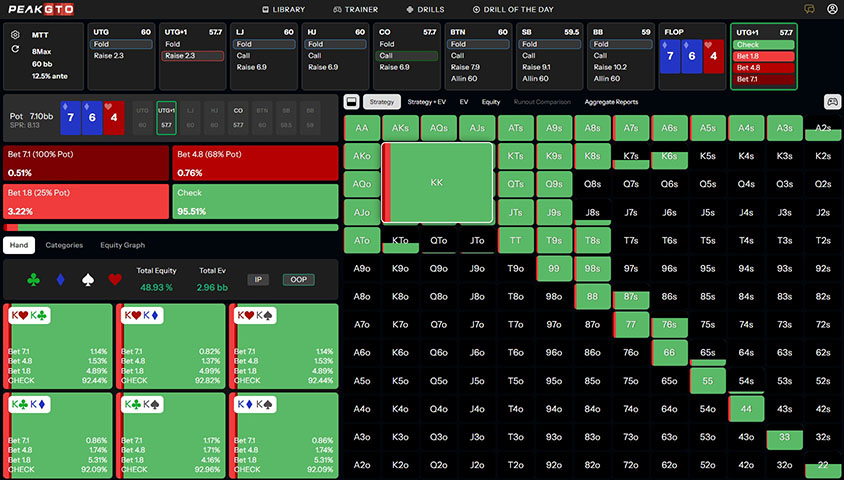
On the other hand, your opponents may also have hands like suited Aces or suited Broadways that did not connect with this board and that you are still beating.
When you check the flop, it does not mean you are giving up on the hand altogether. Rather, you can control the size of the pot, allow your opponents to bluff later streets, or even pay your value bets on turn or river.
Tip #4 – Beware of Multiway Pots
Multiway pots are notoriously difficult to navigate regardless of your holdings, and simply having pocket Kings does not mean it will get any easier.
Even against multiple opponents, your KK will still come to the flop as the best hand, but things will get quite dicey as players in different poker positions turn their draws into bluffs and multiple players put money into the pot.
Playing multiway posts with pocket Kings can be very tricky because there are many situations in which your hand is likely to be best, but it can get quite costly to find out.
Much like on connected boards, multiway pots can be a good time to check your KK and try to control the size of the pot instead of going for value right away and allowing your opponents to apply pressure and force you to fold before the showdown.
Tip #5 – Know When to Give Up
Pocket Kings may be one of the best hands, but they are not unbeatable, and folding them once in a while is necessary.
In particular, Ace-high boards provide a good time to potentially fold Kings after facing resistance on the flop and seeing further bets on later streets.
For example, imagine 3-betting pocket Kings from the small blind against a button raise and getting the player to call, only to see a flop of As9d4c.

On the flop, you fire a small continuation bet, which your opponent calls. You check the turn, and your opponent fires a bet for 2/3 of the pot.
In this spot, you may want to give up KK right away, and you will definitely want to fold on the river if you face another bet and don’t improve.
Without any obvious draws on the board and with your opponent having many Ax hands in their range, there is simply no reason to continue with your Kings.
That can be said for very connected low boards where your opponents show resistance and continue playing aggressively across the streets.
While there are exceptions to every rule, most players will only put the big chips in if they have your KK beat, and the occasional bluff you could catch will not be worth all the times you pay off a better hand.
Tip #6 – Slow Play Kings Sometimes in Tournaments
While pocket Kings is a hand you always want to play aggressively in deep-stacked cash games, tournament poker allows for many situations where slow playing can be the smart play.
Of course, you should still not slow play KK if the stacks are deep and there are a lot of chips behind, but in shallow stack situations, slow playing can turn out quite nicely.
For example, imagine a scenario where you have just 12 big blinds and are seated in the big blind. A player with a 30 big blind stack opens the button, and the action is on you.
While you could easily move all-in right now, just calling with a hand as strong as KK can be quite valuable as well.
Since most players will call with a very wide range out of the big blind, your opponent will never give you credit for such a strong hand postflop.
On the other hand, there are still many hands that will fold if you move all-in preflop, not allowing you to win any further chips.
The same can be said for a spot where you raise KK in a position of a 25 big blind stack and are faced with 3-bet to 7 big blinds.
In this spot, moving all-in would only allow your opponent to call off with strong hands, while just calling allows them to catch up with some weaker hands or simply bluff off their stack on the flop or further streets.
Tip #7 – Don’t Fold Kings Preflop (Almost Ever)
Pocket Kings is the second-best hand in Texas Hold’em Poker and one that you should almost never fold before the flop, regardless of the circumstances.
The one time you may consider folding KK is when facing a massive all-in bet from a player, you know very well and know to be a massive nit.
In a spot like this, where there is almost no chance of your opponent having anything but AA, a fold with KK could be found.
Most professional poker players only report folding KK preflop a few times in their careers, and at least one of those was probably a bad fold.
On the other hand, in most other situations, you should be more than happy to call off any all-in bet or put all your chips into the middle yourself.
The reason, of course, is that people will stack off with far worse than a pair of Kings, and even when you happen to run into the one hand that beats you, you are still not drawing dead.
If you play KK right, you will lose to AA once in a while, but you will win all those chips back the times you have AA, and someone else has KK.
The real trick is in navigating your KK against other hands and finding the right ways to get the most money from opponents who have many inferior hands to your KK.
So, the next time you think about folding your Kings preflop, remember that running into Aces is a rare occurrence and one you should not be too worried about. Stick your chips into the pot and leave the rest up to the dealer.