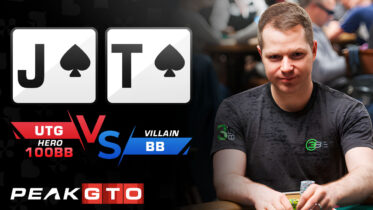
Some boards force the preflop raiser to bet often, but still require discipline when the runout changes incentives. This Texas Hold’em hand is a great example where UTG opens, gets called by BB, and faces a high-card flop where solver strategy drives a high c-bet frequency, then mixes turn pressure, and finally prefers a high check rate on a paired river. With J♠T♠, Hero’s line follows the solver’s preferred pattern of applying pressure early and then slowing down when the river shifts value thresholds.
Assumptions
- Stacks: 100bb effective
- Positions: UTG (Hero) vs BB (Villain)
- Action: UTG raises, BB calls
- Flop: A♥ K♦ T♣ (Pot 6.5bb)
- Turn: 7♠ (Pot 15.7bb)
- River: A♣ (Pot 47.1bb)
Flop: A♥ K♦ T♣
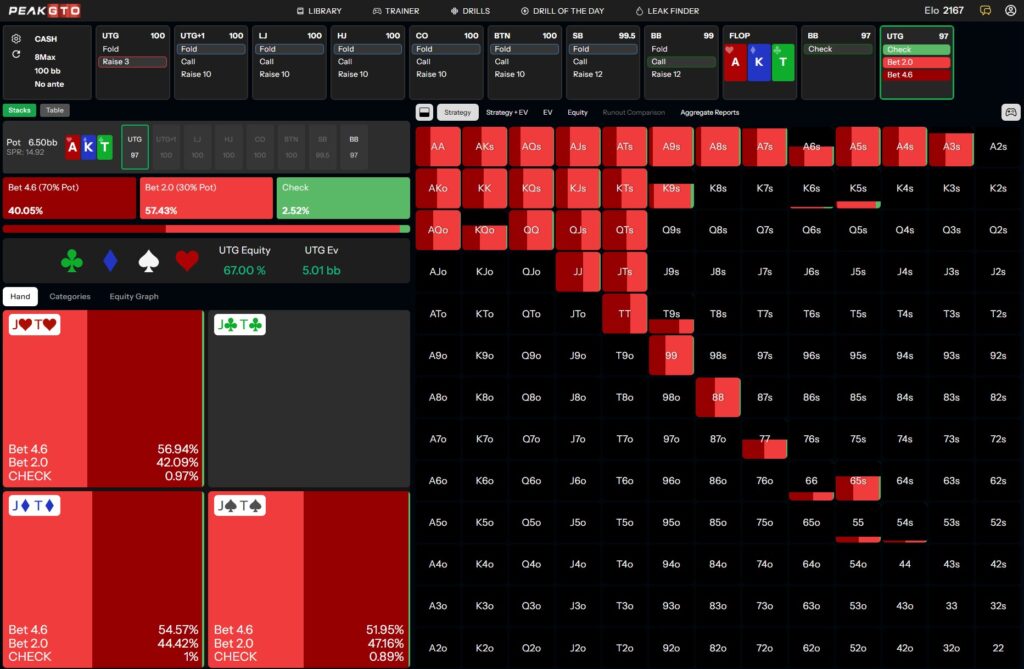
BB checks range (100%), and solver has UTG betting almost always: 2.0bb (57.4%), 4.6bb (40.1%), and checking only 2.5%. Hero chooses the 4.6bb sizing. With J♠T♠ specifically, Hero holds a weak made hand (pair of tens) plus strong connectivity to broadway runouts, which fits well into a large size c-betting range that pressures BB’s wide, under-connected holdings while still allowing UTG to realize equity when called.
Facing 4.6bb, BB folds 60.0%, calls 35.3%, and raises at low frequency (12.4bb 3.3%, 20.3bb 1.4%). This time the BB calls.
Turn: 7♠
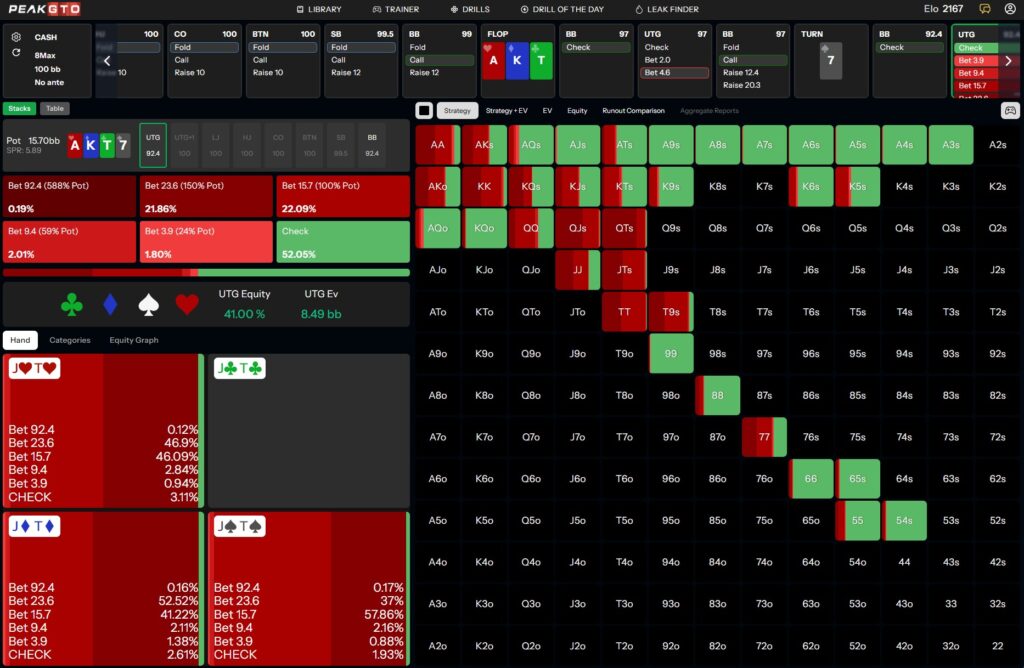
BB checks range again (100%), and solver shifts UTG into a mixed strategy: check 52.0%, with bets spread across several sizes. The solver’s most relevant aggressive options here are 15.7bb (22.1%) and 23.6bb (21.9%), with smaller turn bets used rarely.
Hero chooses the 15.7bb pot-sized bet, which is a solver-approved barrel. Against this bet, BB folds 48.7%, calls 47.2%, and raises very rarely (combined raises remain low frequency).
This line reflects a pressure point: UTG can force a near-indifferent response from BB on a turn that doesn’t materially cap UTG’s range, while BB’s continuing range becomes narrower once it calls a pot-sized barrel.
River: A♣
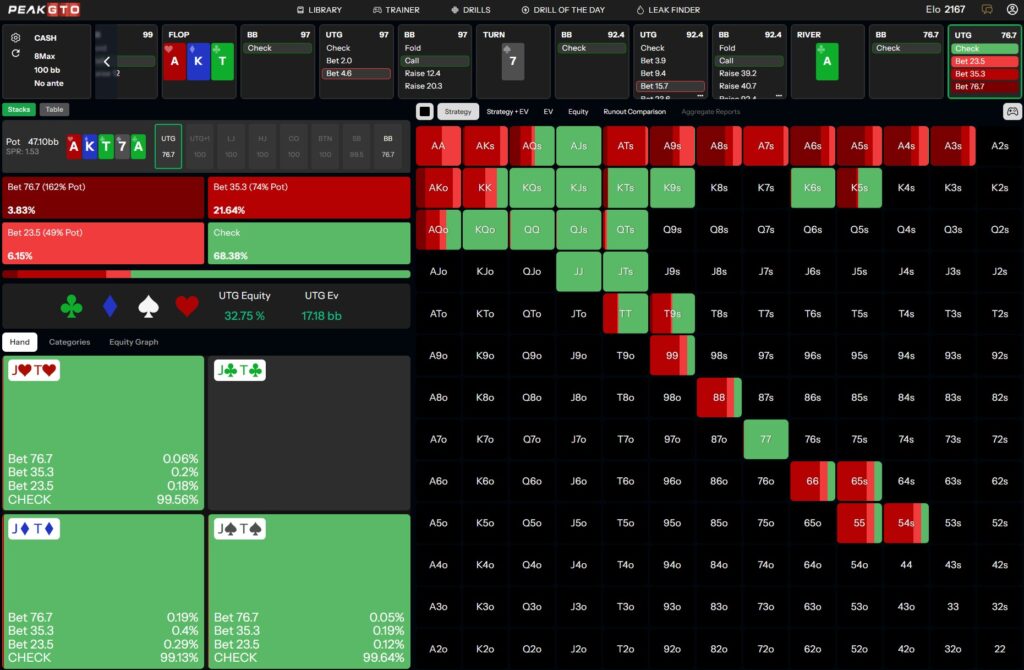
BB checks range again (100%), and PeakGTO strongly prefers UTG checking: check 68.4%. When UTG does bet, the solver uses 35.3bb (21.6%) most often, with smaller 23.5bb (6.2%) and larger 76.7bb (3.8%) appearing at lower frequency.
Hero checks, matching the solver’s dominant action. The paired ace meaningfully changes value betting thresholds: BB’s call-down range after calling flop and turn is more concentrated, and UTG’s incentive to turn medium-strength holdings into thin value decreases. With J♠T♠, the solver’s high check frequency aligns with preserving showdown value and avoiding value-betting into a range that is more likely to contain strong Ax/Kx than hands that can profitably call a third bet.
Key Takeaways
- Flop: Solver has UTG betting at extremely high frequency on A♥ K♦ T♣, primarily using 2.0bb (57.4%) and 4.6bb (40.1%).
- Turn: UTG mixes, but meaningful pressure continues with large sizes, including 15.7bb (22.1%) and 23.6bb (21.9%), while checking remains common (52.0%).
- River: On the paired A♣, solver prefers checking heavily (68.4%) and uses betting as a selective, mixed option rather than an automatic triple barrel.
- Overall: This hand shows a solver pattern of high flop aggression, selective large turn pressure, and a frequent river check when the runout raises the risk of thin value and narrows the caller’s range.