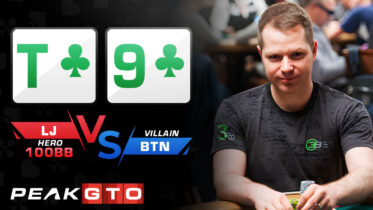
Single-raised pots with an early-position opener against a late-position caller are among the most demanding out-of-position cash game spots in poker. The opener holds nut advantage — strong pairs and premiums the caller cannot have — but being out of position means positional control belongs to the button, and the solver accounts for that imbalance by checking the flop at high frequency from lojack.
Today we will analyze a 100bb 8-handed cash game hand where the lojack opens with T♣9♣, the button calls, and the flop runs out J♣T♦5♠. This hand illustrates how range dynamics shape out-of-position play across all three streets, how a turn check-back resets the river dynamic, and why a small river probe that draws a raise puts second pair in a near coin-flip between calling and folding.
Assumptions
- Stacks: 100bb effective
- Format: 8-handed cash game
- Positions: LJ (Hero) vs BTN (Villain)
- Action: LJ RFI, BTN calls
- Flop: J♣T♦5♠ (Pot: 7.5bb)
- Turn: 2♠ (Pot: 17.9bb)
- River: 3♥ (Pot: 17.9bb)
Flop: J♣T♦5♠
LJ checks 70.9% of the time on this board. This is not passive play — it reflects a structural adjustment to BTN’s range advantage on a connected, broadway-heavy texture. BTN’s calling range arrives at J♣T♦5♠ dense with suited connectors, offsuit broadway combinations, and pocket pairs — hands that interact heavily with this flop. LJ holds nut advantage through overpairs and strong top pairs that BTN cannot have, but betting into a calling range this well-connected carries real risk of running into the top of BTN’s distribution.
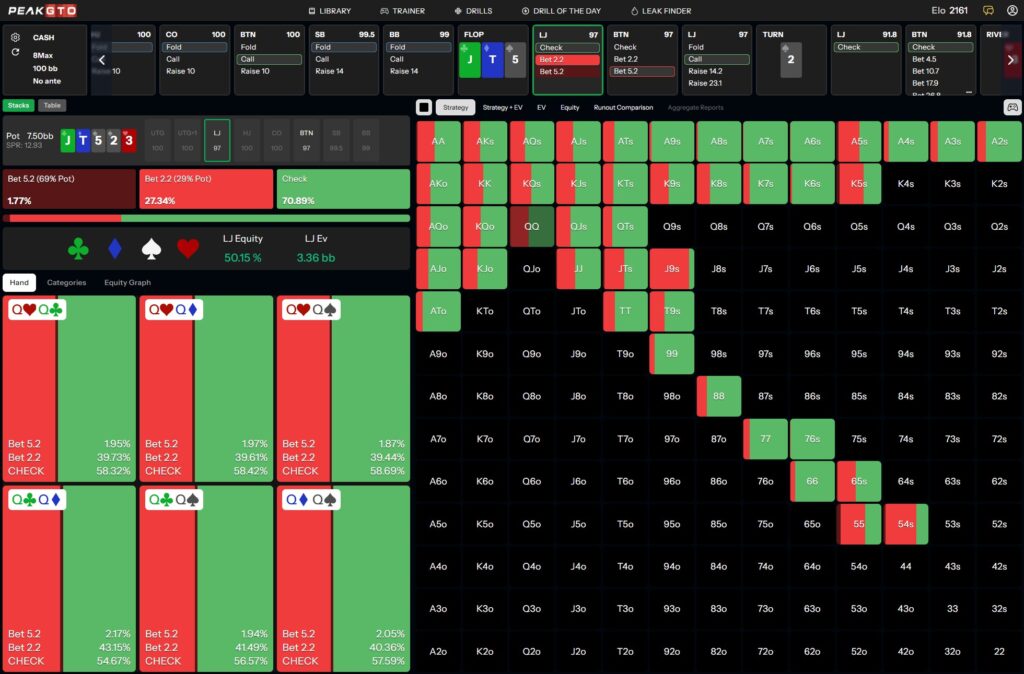
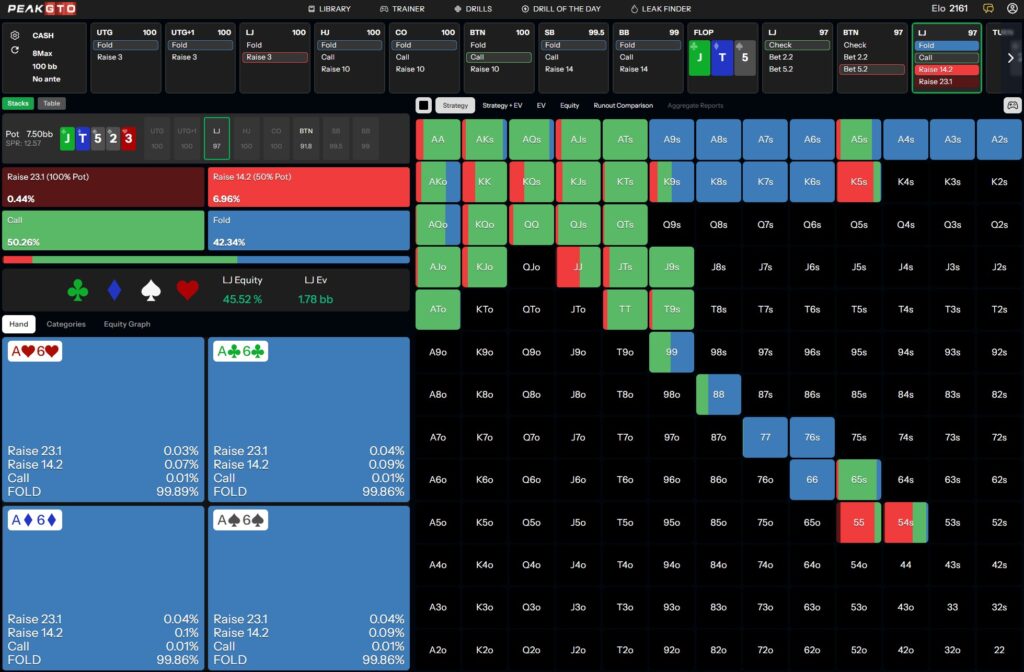
PeakGTO shows BTN betting a combined 43.5% after LJ checks — 5.2bb at 40.5% and 2.2bb at 3.0% — and checking back 56.5%. When BTN selects the 5.2bb size (roughly two-thirds of the 7.5bb pot), LJ’s response splits three ways: call 50.3%, fold 42.3%, and raise 14.2bb at 7.0%.
T♣9♣ is a clear candidate for the calling range. Hero has second pair (tens, with J as the top card on board), a backdoor nut flush draw from three clubs already in play (J♣ on board plus T♣9♣ in hand), and a hand that retains equity against the portion of BTN’s c-betting range that is betting draws and weaker top pairs. Folding here surrenders that equity without enough evidence that BTN’s bet is weighted toward the top of their range.
Turn: 2♠
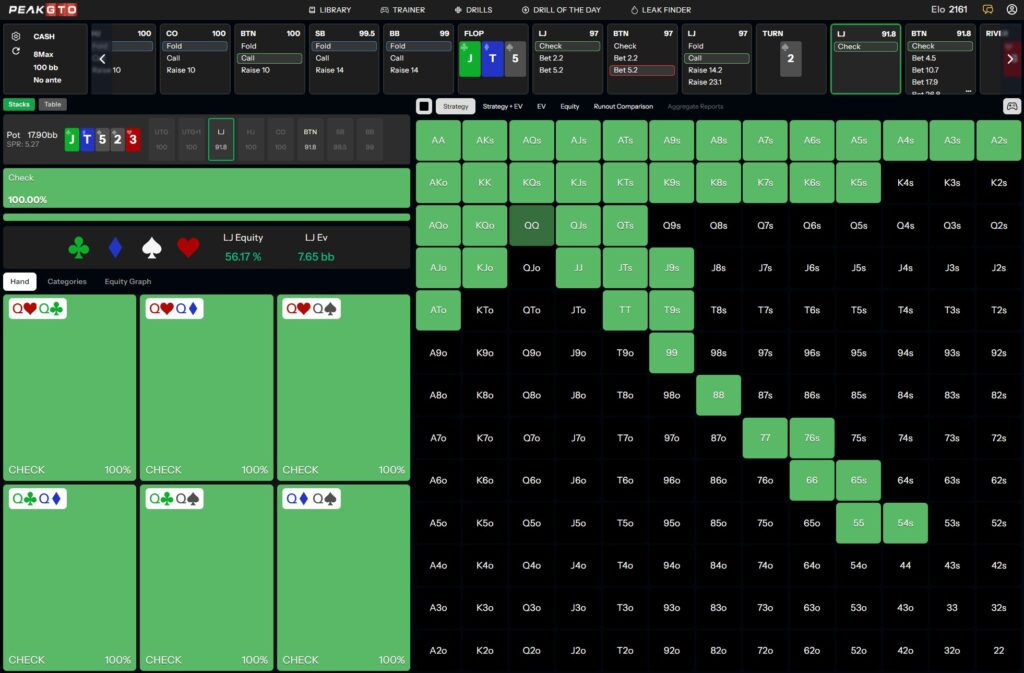
After calling the flop bet, LJ checks 100% — the solver never leads the turn after calling an out-of-position flop bet in this configuration. Leading into a range that just showed aggression is rarely profitable without positional control, and the check is mandatory regardless of hand strength.
The 2♠ brings a second spade to the board but changes little about the fundamental structure. BTN’s primary action facing LJ’s check is a pot-sized bet — 17.9bb at 48.1%. Yet BTN checks back 44.2% of the time, nearly as often as BTN pots it. This check-back carries strategic weight. It can represent strong hands declining to build the pot and preferring to let LJ lead the river, medium-strength hands that prefer a free card on a turn that doesn’t improve their equity realization, or draws that are willing to take the turn off. The result is that the river is reached with 17.9bb in the middle and both players having taken a passive line on the turn.
River: 3♥
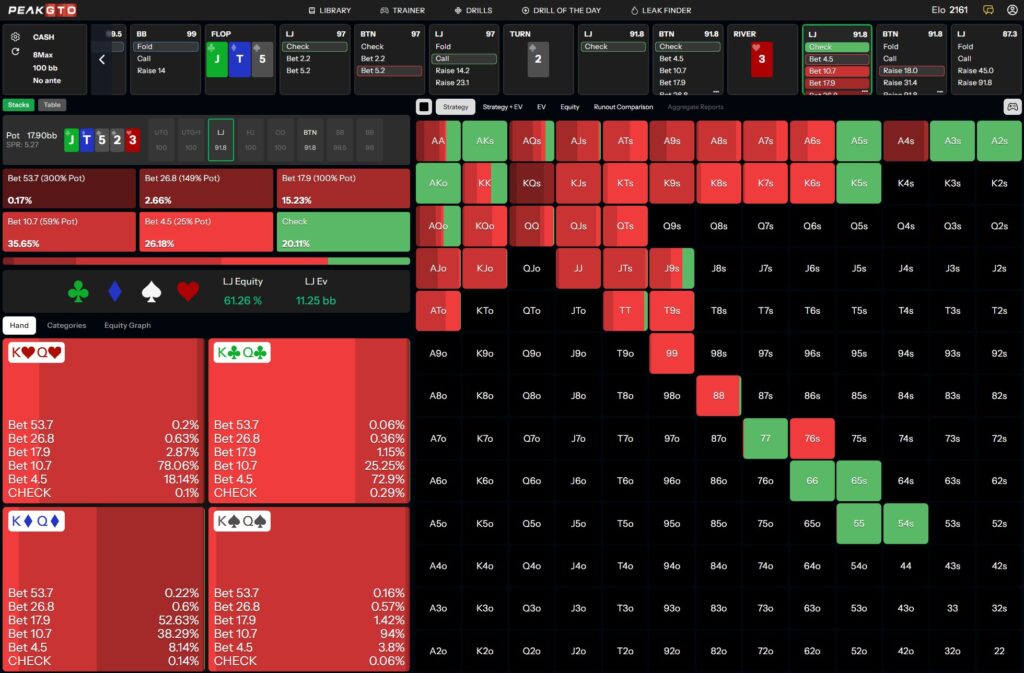
The 3♥ bricks all remaining draws. Spades did not complete. Clubs did not complete. The board finishes J♣T♦5♠2♠3♥. After BTN’s turn check, LJ leads river for 4.5bb into 17.9bb, a 25% pot probe. The solver’s most common river action for LJ is a 10.7bb bet at 35.4%, making the 4.5bb a secondary line at 26.3%, with checking at 20.2% and pot-sized bets used at 15.3%. Leading small reflects a merged approach: extracting value from BTN’s weaker made hands while keeping the pot manageable after two streets of controlled play.
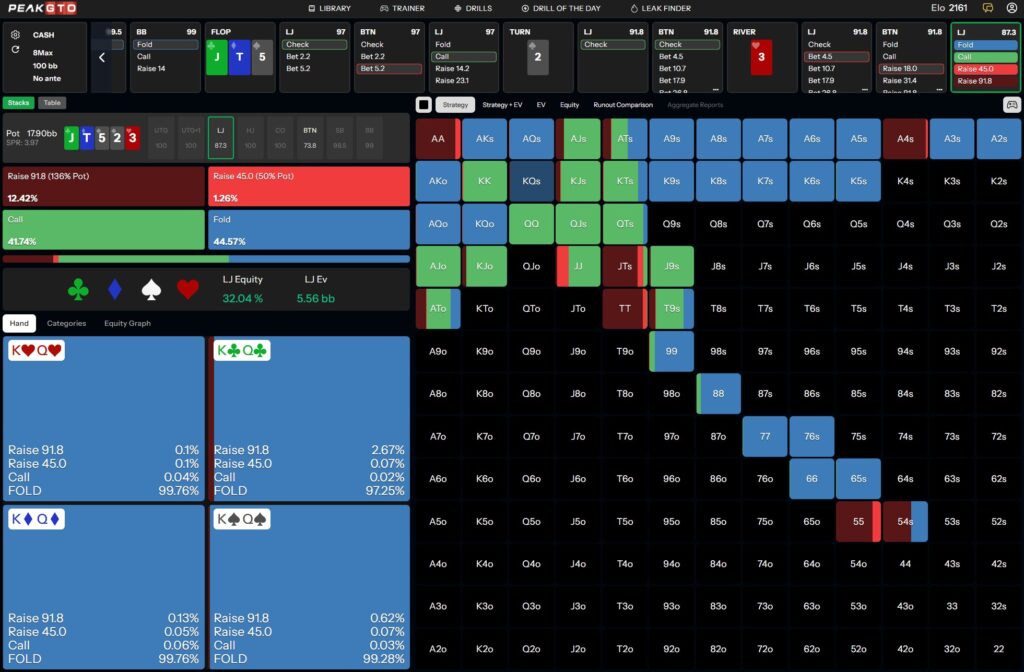
BTN’s response to the 4.5bb probe: call 43.5%, fold 33.1%, raise 18.0bb at 13.0%, raise 91.8bb at 8.0%, and raise 31.4bb at 2.3%. That BTN raises at a combined 23.3% facing a small river bet is significant. BTN is polarizing — the raise range contains strong value hands that checked back the turn (two pair, sets, strong top pairs that declined to barrel) and bluffs looking to take the pot on a runout where LJ’s probe range is weighted toward thin value and weak made hands.
Hero now faces an 18.0bb raise into 17.9bb with T♣9♣. Second pair with a bricked flush draw, facing a raise that costs roughly four times the original bet to call. The solver distributes: fold 44.6%, call 41.8%, raise 91.8bb at 12.5%, raise 45.0bb at 1.2%. The call and fold frequencies are close enough that this is a genuine decision point — one that turns on the exact composition of BTN’s raising range and the pot odds required to continue. With draws cleared, folding is marginally favored at 44.6%, though calling at 41.8% remains a valid mixed-strategy option.
Key Takeaways
- Flop: LJ checks 70.9% on J♣T♦5♠, reflecting BTN’s range advantage on a connected board rather than hand weakness. When BTN bets 5.2bb at 40.5%, T♣9♣ calls at 50.3%, retaining second pair, backdoor flush draws, and equity against BTN’s c-betting range without elevating the pot against a range that is heavily connected to this texture.
- Turn: LJ checks 100% after calling the flop bet — leading OOP is never correct in this configuration. BTN’s primary action is a pot-sized bet (17.9bb at 48.1%), yet BTN checks back 44.2%, resetting the river dynamic. That check-back narrows BTN’s perceived range and sets up a river where LJ can take initiative.
- River: LJ probes 4.5bb at 26.3% into a 17.9bb pot after the turn check-back. When BTN raises to 18.0bb at 13.0%, the solver distributes fold 44.6% vs. call 41.8% for LJ. With draws fully bricked and a raise that signals a polarized range of strong value or bluffs, folding is marginally correct — but the margin is narrow enough that calling is part of a balanced mixed strategy.
- Overall: This hand shows how positional disadvantage compounds across streets: checking connected boards OOP, checking turn after calling a flop bet, and then reading the implications of a turn check-back before deciding how to proceed on a fully bricked river. The river raise against a small probe is not automatically a fold — it requires assessing BTN’s raise distribution against the hand’s exact strength at that decision point.