Big draws and big made hands are two sides of the same coin. The way you play a flush draw on the flop should set up exactly how you play the flush when it arrives, and nowhere is that clearer than from out of position. If you take a passive line with the draw, you reach the river with a small pot and a hand that screams strength when you finally bet. If you build the pot while you are drawing, you arrive at the nut flush with a stack you can get all in for value, hidden inside a range full of other strong hands. This is the difference between winning a small pot and stacking your opponent.
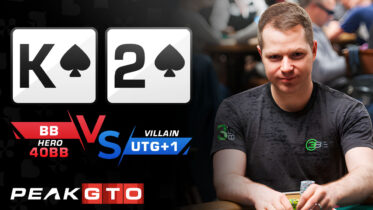
Today we will analyze a 40bb 8-handed tournament hand where the big blind defends K♠2♠ against an under-the-gun-plus-one open, check-raises a paired J♠J♣7♠ flop with the flush draw, makes the nut flush when the A♠ turns, and gets the stack in for value across the turn and river. The draw raises rather than calls, the scary ace is actually a green light to keep betting, and the river is a pure jam. The throughline is a single idea: aggression with the draw is what makes the value bets pay off later.
Assumptions
- Stacks: 40bb effective
- Format: 8-handed MTT
- Positions: BB (Hero) vs UTG+1 (Villain)
- Action: UTG+1 opens, BB calls
- Flop: J♠J♣7♠ paired (Pot: 6.1bb)
- Turn: A♠ (Pot: 15.5bb)
- River: 6♦ (Pot: 36.3bb)
Preflop
UTG+1 opens to 2.3bb and the big blind calls with K♠2♠. Getting a good price closing the action, this is a routine defend. The hand has little high-card value, but a suited king flops flush draws and, on other boards, the occasional top pair, and it will play its equity loudly when it connects. As always from the big blind, the key is that the big blind is out of position, which makes proactive aggression the tool of choice rather than passive calling.
Flop: J♠J♣7♠
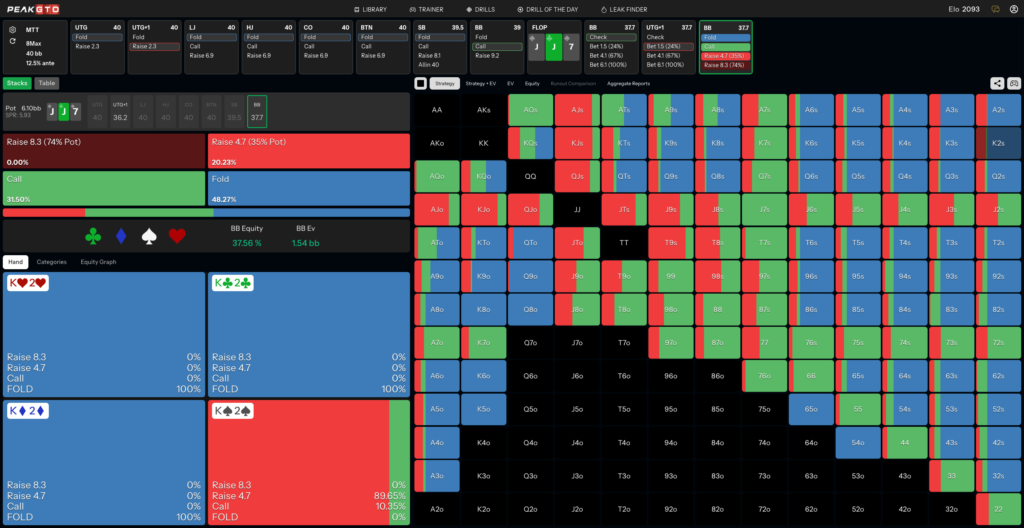
The big blind checks its entire range, and UTG+1 fires a tiny 1.5bb continuation bet with its whole range. There is a common error to flag immediately: most players just call here with everything, worried about the jack. That worry is backwards. On a paired board, the big blind’s calling range contains plenty of jacks itself, so it is the big blind that gets to be the aggressor. The check-raise range is built from trips, some sevens, and a whole stack of draws, primarily flush draws like K♠2♠ along with backdoor and gutshot straight draws such as T9, T8, and 98.
K♠2♠ is a flush draw, so it joins that raising group. The big blind check-raises about 20% of the time here, and the sizing is deliberately small, just 4.7bb. You do not need to make it huge, because when you are raising you have a lot of jacks that do not care, and then a whole lot of draws. A modest raise keeps the bluffs cheap and the value hands safe, and it starts building the pot while the hand is still a draw. Hero raises to 4.7bb, and UTG+1 calls.
What this pressure accomplishes is just as important as the raise itself. UTG+1 folds only about a quarter of the time here and calls the large majority, so the raise primarily builds the pot rather than winning it outright. That is fine, because the hands UTG+1 continues with, like jacks and middling pairs, are now committing chips against a range loaded with trips and strong draws while the big blind still has equity to improve. The draw and the made hand reinforce each other, and that balance is exactly why a flush draw like K♠2♠ gets to apply pressure rather than meekly calling.
Turn: A♠
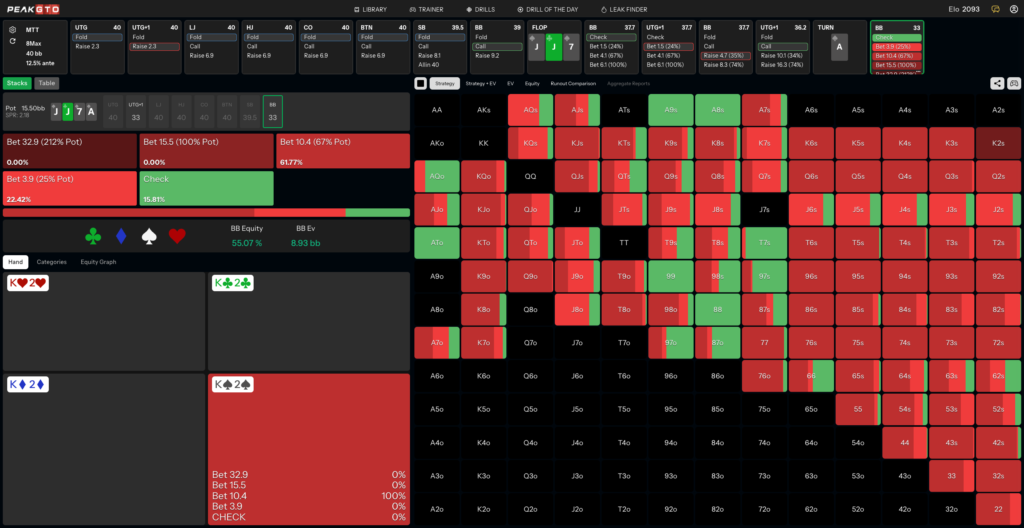
The A♠ completes the flush. Because the ace of spades is on the board and the big blind holds the K♠, K♠2♠ now makes the nut flush, the best flush anyone can have. PeakGTO recommends betting almost the entire range here, primarily a 10.4bb bet of roughly two-thirds pot. The mistake players make on this card is clear: a lot of people think this ace should be good for the opponent, therefore they should check. That is exactly wrong. The big blind’s jacks are still so strong that it is happy to play for stacks, and the flushes are obviously strong too. With both categories wanting to bet, checking would only slow down a range that should be pressing its advantage.
The hands that do check are the ones that whiffed, like 98, T8, and T♣9♣, plus other backdoor draws that did not improve. K♠2♠ is not one of them. Holding the nut flush, it bets the 10.4bb size for value, charging worse flushes, jacks that refuse to fold, and any ace that paired. Hero bets 10.4bb, and UTG+1 calls. The pot is now 36.3bb and the stacks are primed for a river that the big blind can shove.
River: 6♦
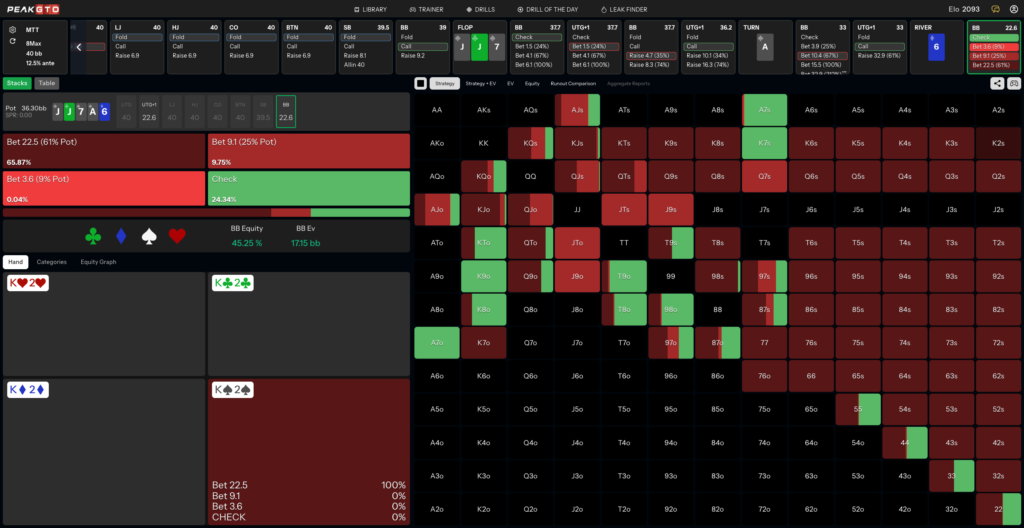
The 6♦ is a total brick that changes nothing. K♠2♠ is still the nut flush, and the only hands that beat it are full houses, which the opponent can almost never have after this action. The solver jams roughly 22.5bb, which is about 61% of the pot but, more importantly, the rest of the effective stack. The conclusion is blunt: with all of your flushes, shoving is the only play that makes sense, because you have the best hand almost always and you want to get a lot of money in, so you simply rip it in.
The jacks mostly jam too, and for simplicity you can just shove any hand you intend to bet, since the range is already strong and polarized. A few hands prefer to check, like AJ, which blocks a lot of the opponent’s calling combinations, plus A7 and the busted draws that have no value. But the nut flush is never one of them. This is the payoff for the aggressive flop line: because the pot was built while drawing, the river bet is a full-stack value GTO jam rather than a thin stab into a small pot. Hero jams, and UTG+1 folds two pair.
It is worth contrasting this with the passive alternative. Had the big blind merely called the flop and turn, the river pot would be a fraction of the size, and a sudden lead with the nut flush would look exactly like what it is, leaving the opponent free to fold everything but a boat. By raising the draw and betting the made flush, the big blind both grows the pot and disguises the nut flush inside a range that also contains jacks and bluffs. The opponent has to pay off a much larger bet far more often, which is where the extra expected value comes from.
Key Takeaways
- Flop: On a paired J♠J♣7♠ board, the big blind check-raises about 20%, not just calls. With many jacks in range, K♠2♠ raises its flush draw as part of a polarized range, using a small 4.7bb size.
- Turn: The A♠ makes the nut flush, and the big blind bets almost its whole range for about two-thirds pot. The ace is not a reason to slow down: the jacks are still strong and the flushes want value.
- River: On a brick, the nut flush jams. It is the best hand almost always, so the only goal is to get the rest of the stack in. For simplicity, jam every hand you would bet.
- Overall: Playing draws and the nuts well from out of position is one continuous plan. Raising the draw builds the pot so that, when the flush arrives, the value bets are large and natural rather than transparent stabs.