A flop that looks like a mandatory bet sometimes plays best as a check. When you hold a hand that beats your opponent’s air but loses to the top of their range, betting can fold out the very hands you are ahead of while building a pot that only their strongest holdings want to play. Checking back instead keeps your range uncapped, controls the size of the pot, and sets up comfortable bluff catching on later streets. The discipline to pass up a thin bet now is what makes the easy call possible later.
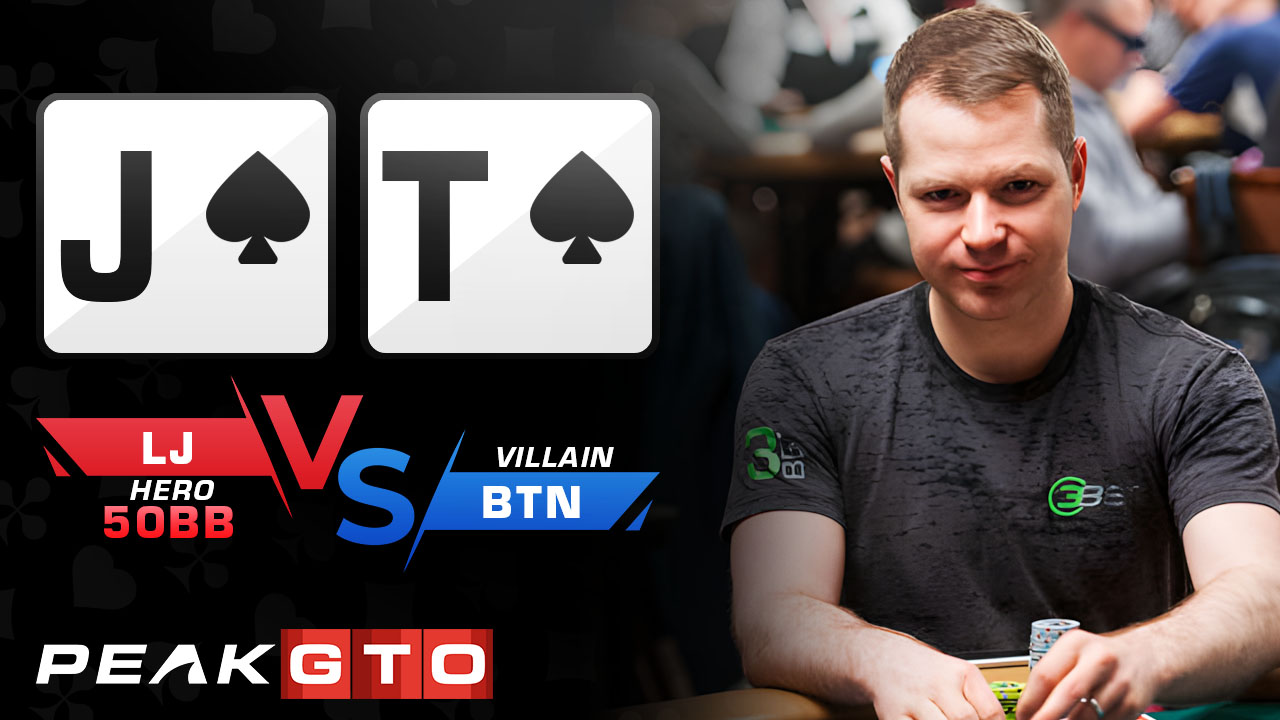
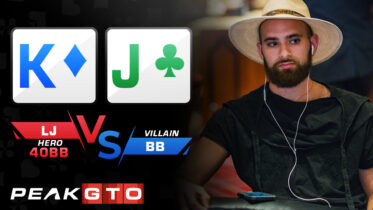
Today we will analyze a 40bb 8-handed tournament hand where the lojack opens K♦J♣, the big blind calls, and the board runs A♠K♥6♥, the 2♦ turn, and the 5♦ river. Hero flops second pair, checks back the flop and the turn, and then faces a river stab. This hand is a clinic in bluff catching: why an ace-high flop that crushes the in-position range is still checked 40% of the time, how checking back protects your range, and why the river call becomes easy once you have done so.
Assumptions
- Stacks: 40bb effective
- Format: 8-handed MTT
- Positions: LJ (Hero) vs BB (Villain)
- Action: LJ raises, BB calls
- Flop: A♠K♥6♥ (Pot: 6.1bb), checks through
- Turn: 2♦ (Pot: 6.1bb), checks through
- River: 5♦ (Pot: 6.1bb), BB bets 4.1bb
Preflop
KJo is a comfortable open from the lojack at 40bb, and the big blind defends by calling. Defending from the big blind is correct with a wide range here because of the excellent price, so Villain arrives on the flop with everything from suited connectors and suited gappers to weak aces, king-x, and assorted broadway and one-gap hands. That is the backdrop for the whole hand. Hero’s position and range advantage are large, but the big blind’s range is wide and loaded with hands that will completely miss most boards.
Flop: A♠K♥6♥
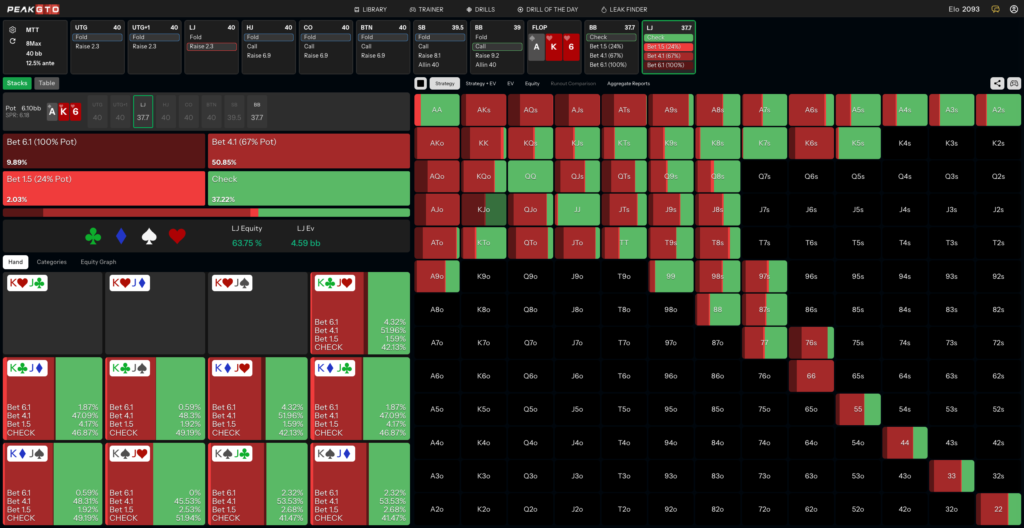
The big blind checks and Hero has the option to fire a continuation bet. A♠K♥6♥ is enormously favorable for the preflop raiser, who holds the aces, the AK, and most of the strong top pairs. Yet the solver checks back about 40% of its range here. The logic is worth sitting with. Take a hand like QQ. If Hero bets and the big blind folds its air, all that accomplishes is folding out a hand with roughly 5% equity. Keeping that air in the pot is a small win, not a loss. And if the queens bet and get called, they are now frequently up against an ace, a king, or a draw with real equity. Betting the worse hands out and the better hands in is the opposite of what a medium-strength hand wants.
KJo fits the same mold. Hero has a pair of kings, but it is second pair behind the board ace, and it cannot comfortably bet three streets for value. The hand is not able to go through streets for value, so betting now only inflates a pot Hero does not want to play large with a marginal made hand. Checking back also protects the range. Because Hero shows up to later streets with slow-played aces, the occasional trapped two pair, and pure air as well as hands like this one, the checking range stays uncapped. Hero does not always need to bet with air, and that balance is exactly what makes the river so comfortable. Hero checks back.
Turn: 2♦
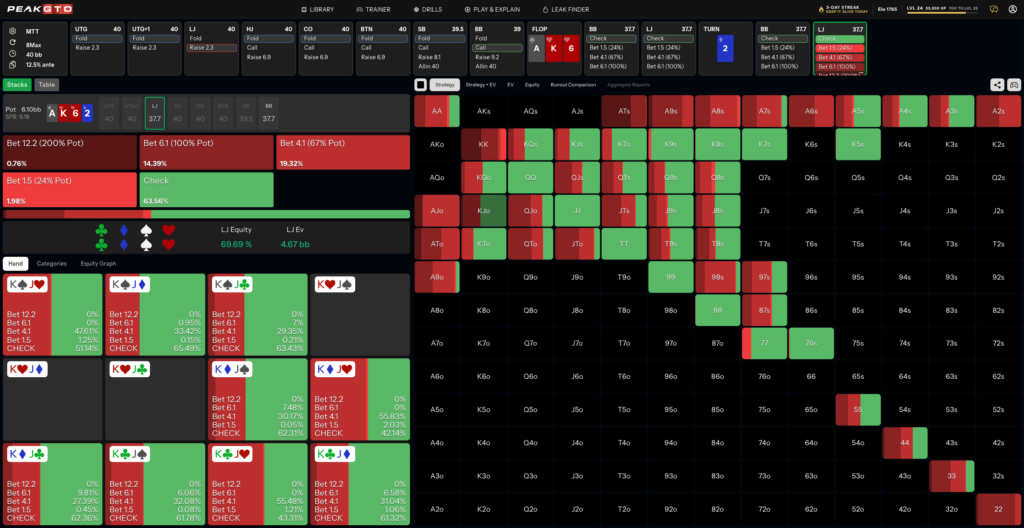
The 2♦ is a brick, and after the big blind checks again, Hero is back to the same passive-versus-aggressive decision. The solver still checks 63.6% of its range on this turn. PeakGTO shows the choice is largely opponent dependent. Against a player who can never resist betting an ace, you might start betting here to target lower king-x hands and the flush draws, turning KJ into a thin value-and-protection bet. But against a competent, balanced opponent, checking is simply fine.
The reason is that KJ is unlikely to collect two full streets of value. If Hero bets the turn and bets again on the river, the worse hands that would have paid a single bet will usually fold by the end, and the hands that call twice mostly beat second pair. Keeping the big blind’s weak holdings in the pot, the hands that will pay off one river bet but never call two, is worth more than a turn bet that folds out air and isolates Hero against better. Checking back also keeps the river decision tree simple and protects the rest of Hero’s checking range. Hero checks again, and the turn goes check-check.
River: 5♦
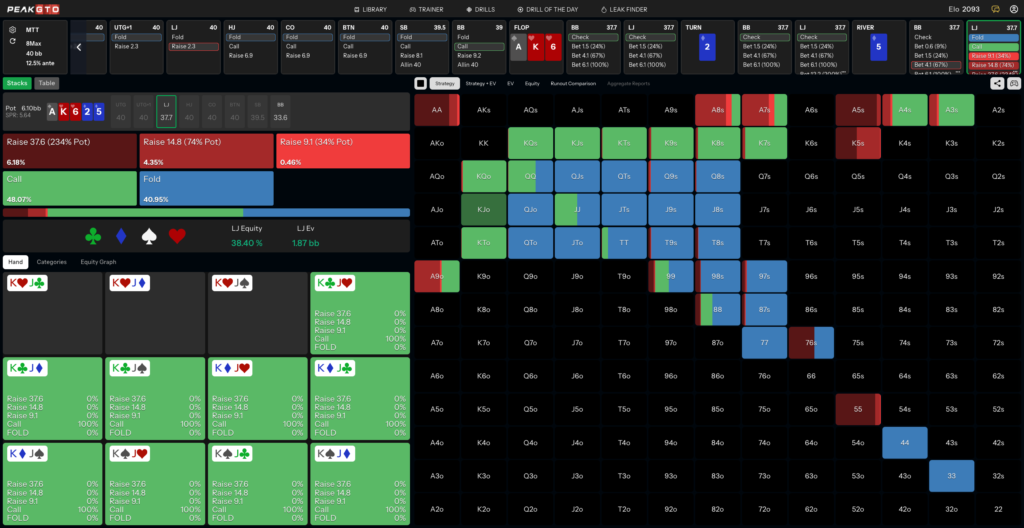
The 5♦ changes nothing. No flush completes, since only two hearts ever appeared, and the board reads A♠K♥6♥2♦5♦. The big blind now leads for 4.1bb into the 6.1bb pot, about two-thirds of the pot. Getting the opponent to stab after Hero has checked twice is a great result. Now the bluff catching begins.
This is the payoff for all that earlier discipline. Because Hero arrives at the river having checked the flop and the turn, the big blind may assume Hero is capped, that Hero can never hold better than a weak pair after passing twice. That assumption is wrong. Hero’s check-back-twice range still contains slow-played aces and the occasional trap, so it is genuinely uncapped. A balanced big blind has very few natural bluffs in this exact spot, checking the large majority of its river range, which means a real player who fires here is almost always over-bluffing relative to the solver. KJ, sitting near the top of Hero’s checking range, is an easy call against that tendency.
The math reinforces it. Hero calls 4.1bb to win 10.2bb, so the pot odds require only about 29% equity to break even. Across Hero’s entire range the solver calls 48.1%, folds 41.0%, and raises the remaining 11% as the value hands that beat a bet. KJ is firmly in the calling group, defending at a near-pure rate, because second pair comfortably clears the equity threshold against the big blind’s betting range. The air in Hero’s range, hands like missed suited connectors, are the part that folds. This is the core of GTO bluff catching: you call with the top of your bluff-catcher range and fold the bottom, and the passive flop and turn are what put a hand this strong into that bluff-catching range in the first place. Hero calls.
Key Takeaways
- Flop: Even on an A♠K♥6♥ flop that crushes the in-position range, the solver checks back about 40% of the time. Betting a medium hand like second-pair KJ only folds out the air it beats and bloats the pot against better, so Hero checks to control the pot and protect an uncapped range.
- Turn: The 2♦ brick keeps the range checking 63.6% of the time. KJ will rarely earn two streets of value, so keeping the big blind’s weak hands in the pot is worth more than a turn bet that isolates Hero against stronger holdings.
- River: Facing a 4.1bb stab, Hero only needs about 29% equity, and KJ defends at a near-pure rate. The double check-back leaves Hero’s range uncapped, while a balanced opponent has almost no natural bluffs here, so a river stab is usually over-bluffed and an easy call.
- Overall: Strong bluff catching is built on earlier streets. Passing up thin, range-bloating bets on the flop and turn keeps Hero uncapped and pot-controlled, which is exactly what converts a marginal second pair into a confident river call.