Some players literally never bet into the preflop raiser in multiway pots, and that is a mistake that costs them chips on some of the most favorable boards they will ever see.
Betting into the raiser from the blinds is called leading, and the rule for when to do it is simple. You lead when you have a big range advantage or a big nut advantage, and multiway pots create those advantages in specific, predictable spots that most players walk right past.
This guide explains how range advantage in multiway pots actually works, when the small blind and big blind should lead the flop in Texas Hold’em, which hands to bet, and how to follow through on later streets.

Lead When You Have the Range or the Nut Advantage
Range advantage means your collection of possible hands connects with the board better than your opponent’s does. Nut advantage means you hold more of the strongest possible hands than they do. When either advantage is big, betting into the raiser stops being a wild move and becomes the correct one.
The reason most players never find these leads is that they focus on their own two cards rather than comparing entire ranges. Modern poker solvers show leading frequencies in some multiway spots above 50 percent, numbers almost nobody approaches in real games.
The rest of this article breaks down where those spots live. For the small blind, they appear on middle-connected boards against late-position raisers. For the big blind, they appear on low connected boards, with a very different bet size.
Why the Small Blind Can Lead Into Late Position Raisers

The small blind’s calling range has a special shape. Since you would use a 3-bet with your best hands before the flop, your flatting range lacks the premiums, but it is packed with hands that connect around the jack, ten, nine, and eight.
Now consider who raised. A cutoff or button player opens 30 to 50 percent of hands, full of junk that misses those middle boards completely.
An early position raiser is different, holding proportionally far more overpairs, and you do not want to lead into a range full of overpairs.
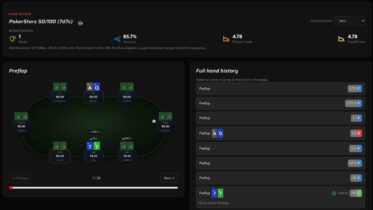
The solver numbers make the point loud and clear. On a ten-nine-four flop after calling in the small blind, you lead 54 percent of the time against a button raiser and only 14 percent against a lojack raiser.
Same hand, same board, and the entire difference comes from whose range is weaker. Understanding poker positions at this level, as ranges rather than seats, is what unlocks the play.
Even knowing all this, I lead less often in these spots than the solver says to, and every time I study them I find money I have been leaving on the table. This is a genuine leak at every level of the game.
Which Hands to Lead From the Small Blind
On those middle connected boards, the leading range has three parts.
The core is top pair hands that are almost always good but vulnerable. On ten-nine-four, that means ace-ten, king-ten, queen-ten, and jack-ten, poker hands that want to grow the pot now and deny equity to overcards.
With a hand like king-ten, you can lead big, keep betting good turns, and get the money in by the river without apology, even against players who only continue with strong hands.
The second part is draws, led by the gutshots. Queen-eight and king-jack lead on ten-nine-four, and on a jack-ten-six flop the gutshots do a huge amount of the leading. Open-enders lead somewhat less, because a hand like queen-nine hates betting and then facing a raise.
The third part is the leads nobody finds, backdoor bluffs like ace-eight suited and king-seven suited, plus surprising hands like bottom pair and random small pocket pairs. You do not need to nail every combo.
You need to know the shape, strong top pairs, gutshots, and a sprinkle of backdoor hands, bet at around two-thirds pot on these dynamic boards.
The Big Blind Leads Small on Low Connected Boards

The big blind’s version of this play looks completely different. Your leading boards are the low connected ones like six-five-four, and your size is tiny, at or near the minimum.
The reason sits in the equity distribution. On six-five-four after a lojack raise and a button call, the big blind holds around 37 percent equity with no meaningful nut advantage, but a huge advantage in the middle of the range, all the pairs, pairs with draws, and live overcards the raisers simply do not have.
When your advantage lives in medium strength hands rather than nutted ones, the correct response is to bet frequently and small.
In practice that means leading the minimum with sevens, eights, threes, any pair, and pairs with draws, around 44 percent of the time in this exact spot. The hands that check are the ones with nothing at all, like offsuit overcards without a backdoor draw.
Following Through on the Turn and River
A wide, small leading range has to know its plan for later streets, and the plan is to polarize.
Take the six-five-four board where you min-led and got called. On a turn ten, a card that misses your leading range, you shift to two-thirds pot with a tighter range, the sevens and threes that kept their draws, flush draws with overcards, and pairs that picked up extra equity.
The naked low pairs without a kicker or draw slow down and check.
On the river, the range splits fully. Straights and strong top pairs jam, and your best bluffs are the missed sevens, because they block the straights your opponent could be slow-playing. Meanwhile, the checking range stays protected with plenty of medium pairs, so opponents cannot attack your checks for free.
That is the whole architecture. Lead small and wide, polarize as the streets progress, and arrive at the river with jams, blocker bluffs, and a checking range that can defend itself.
Adjusting to Real Opponents
The solver assumes opponents who punish mistakes, and yours mostly will not.
Most players do not raise flop leads anywhere near often enough. Against them you should lead even more than the charts suggest, especially with overcards and backdoor draws, because you keep all your equity while adding fold equity on top. Not getting blown off your hand is worth a lot, and passive opponents hand you that guarantee.
If a specific player attacks small leads relentlessly, flip the adjustment and lead a range weighted toward value. And remember what your opponents’ leads mean too.
Almost nobody leads the creative bluffs, so a typical player who leads into the field in a multiway pot has exactly what they are representing. Reviewing these spots in a training tool like PeakGTO builds pattern recognition faster than memorizing charts.
Conclusion
The single idea to carry to the table is that leading is earned by range comparison, not by hand strength. When the raiser’s range is wide, and the board smashes your calling range, the lead is yours to take, and refusing it surrenders pots you were favored to win.
Keep the two patterns straight. Small blind leads happen on middle-connected boards against cutoff and button raisers, sized at around two-thirds of the pot with top pairs, gutshots, and backdoor bluffs. Big blind leads happen on low-connected boards, sized tiny, with your whole medium-strength arsenal.
Start finding even half of these leads, and you will win more multiway pots without showdown, protect your vulnerable hands, and become dramatically harder to play against from the blinds.