
Picking the proper bet sizing is not an easy task, so we will go over common scenarios for c-betting on ace-high boards to see when we should be c-betting big and when we should stick to a smaller sizing after raising preflop.
In this article, we will cover different board textures and see what sizing we should be using when c-betting both in and out of position on ace-high boards.
C-Betting On Ace-High Boards In Position – As7c2h vs. AsTh9h
We will start with an in-position example. This is a spot where our poker table positions have us open from the BTN and get a call from BB, who checks to us on the flop.
Key assumptions:
- The hand is played 100 bb deep
- We are opening from the button
- Big blind calls and checks to us
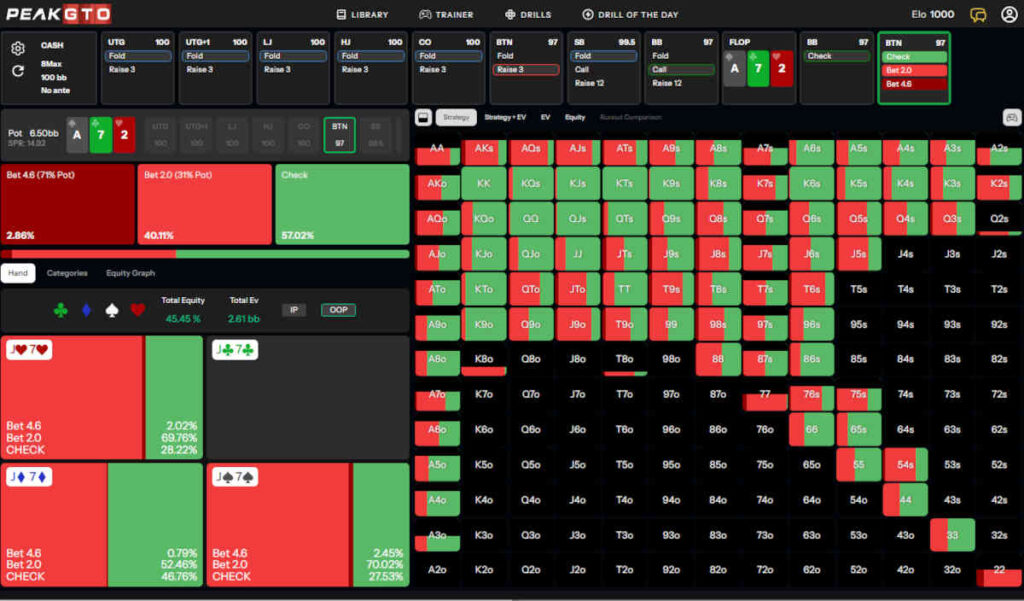
Playing these dry ace-high boards is relatively easy since the solver almost universally picks small bet sizing across the board. You should be c-betting around 43% of the time and can stick to a one-third pot size bet in these situations.
However, things become a bit more complicated on connected boards. Let’s look at an example of AsTh9h.
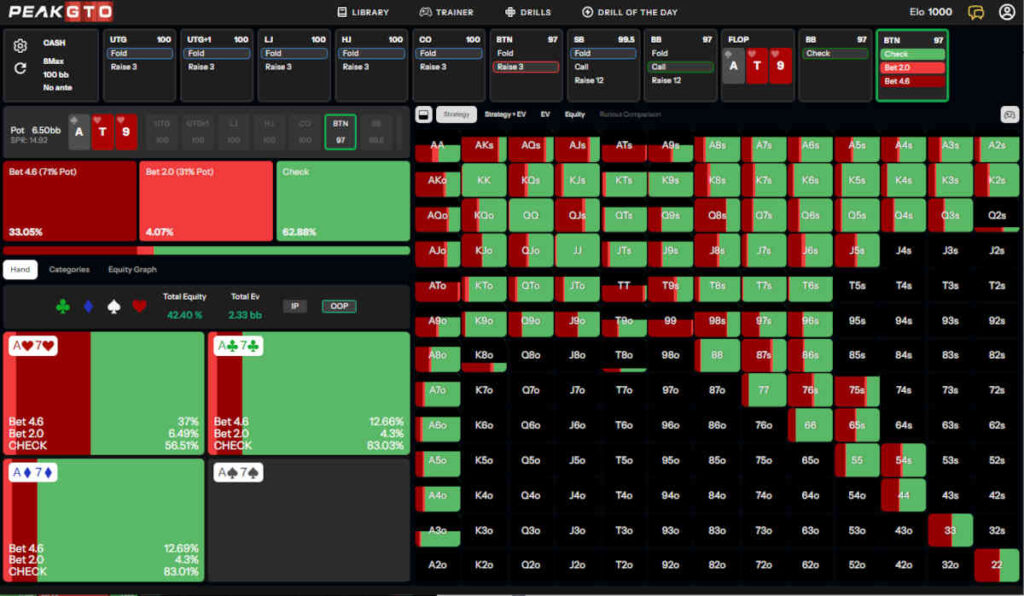
Contrary to dry flops, PeakGTO suggests sticking to a bigger bet sizing of two-thirds of the pot.
We are betting less often on coordinated board textures, and in this situation, we c-bet around 37% of the time. Since this is a spot where our opponent is more likely to have various draws, we need to protect our equity, and bigger bet sizing works well for that.
Key takeaways
- Bet small on dry boards when you have the position and stick to one-third pot size bets.
- Stick to two-thirds pot size c-bets on coordinated boards to protect your equity.
C-Betting On Ace-High Boards OOP – As7c2h vs. AsTh9h
Let’s take the same board textures and see how our poker strategy changes when we’re out of position and have to pick the optimal bet sizing.
Assumptions:
- We are playing 100bb deep
- We are opening from the CO
- BTN calls and the blinds fold
Let’s first look at a dry board of As7c2h.
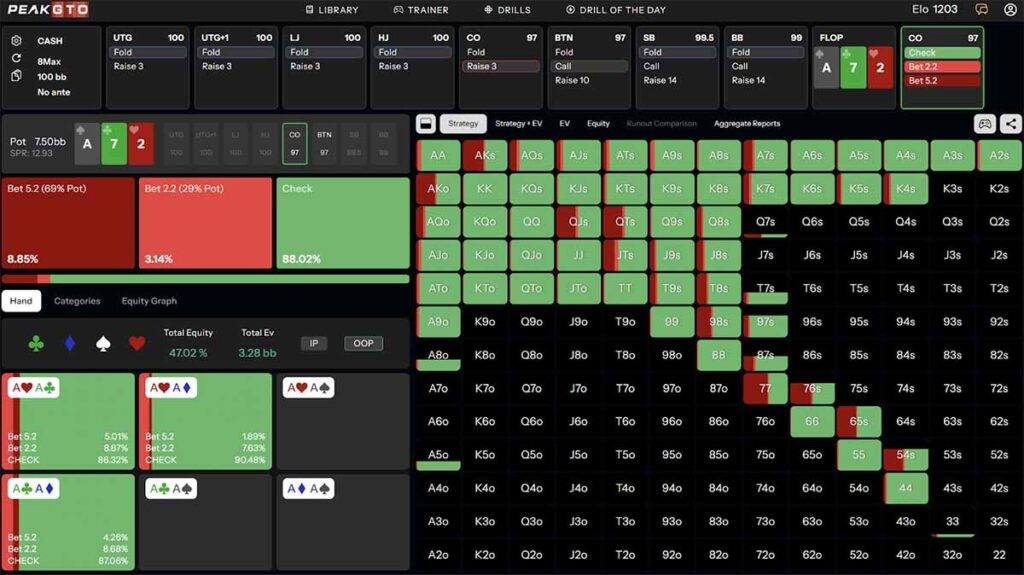
Our c-betting frequency naturally goes down when we are OOP, and game theory optimal strategy means we are only betting around 12% of the time. While we usually stick with a bigger bet sizing of two-thirds of the pot, we also mix in smaller bets some of the time.
To be more precise, we bet big 3 out of 4 times and stick to a smaller c-bet the rest of the time.
On a connected flop such as AsTh9h, we flip to an opposite strategy.
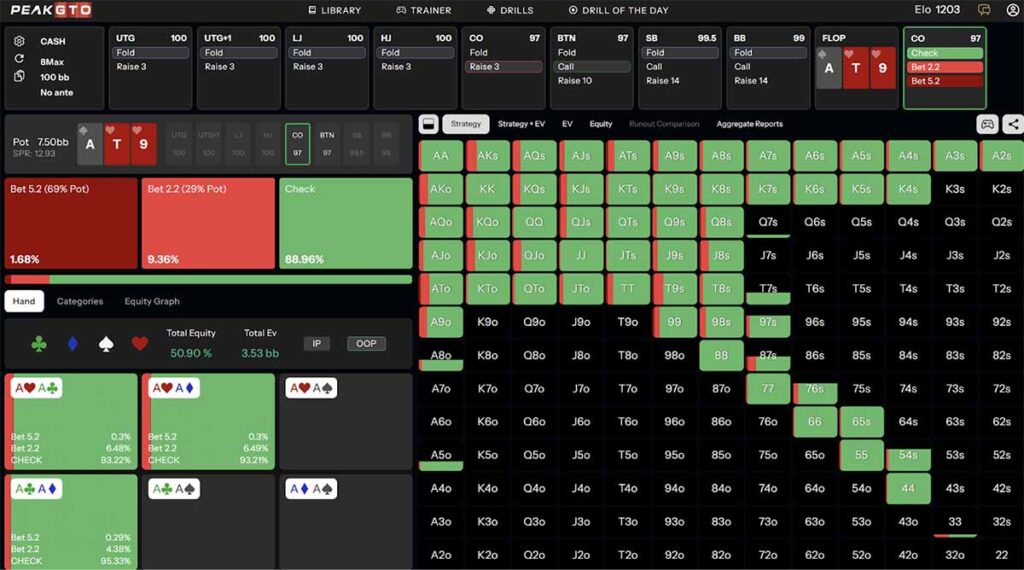
As you can see from this example, while we are still c-betting around 12% on connected board, now we choose small bet sizing of one-third of the pot in most situations.
Of course, your default play in a deep stack cash game spot like this is checking on both dry and connected boards out of position, but this article should have answered some of your questions about how to pick between small and big bets when you need to fire a c-bet.
Key takeaways
- C-bet significantly less often when OOP.
- Mix between big and small bets on dry boards, leaning towards a bigger sizing more often.
- Choose small bets on connected flops when you decide to continue your aggression.