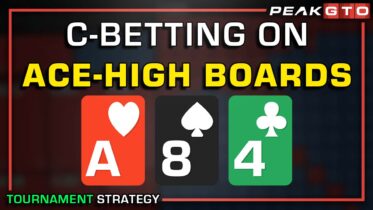

We already covered how to c-bet on ace-high boards with a full 100bb stack, so today we will dive deeper into a tournament environment and look into 40bb MTT dry ace-high board c-betting strategies.
Additionally, we will examine how to adjust our play with even shorter stacks and utilize PeakGTO to analyze both in-position and out-of-position spots on these dry ace-high boards.
C-Betting On Ace High Boards In Position – Ah8s4c
Here are the assumptions we will be using:
- The hand is played 40 bb deep
- We are opening from the button to 2.3bb
- Big blind calls and checks to us on the flop
Let’s take an example of an Ah8s4c to see our c-bet frequencies and bet sizing.
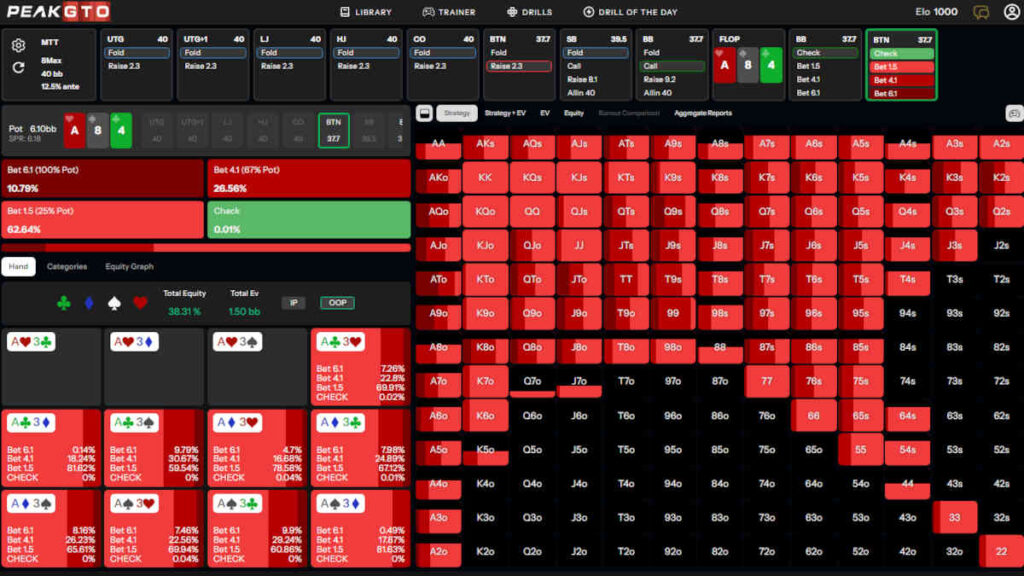
In this scenario, we will be c-betting 100% of our range with 40 big blind stack sizes on a dry ace-high flop. Since the BB will be defending a lot of his hands preflop, we have a significant range advantage on this type of board and need to capitalize on it.
As for sizing, things are a bit more complicated, as we will need to mix in three different options according to the PeakGTO solver. This is how it breaks down:
- One-fourth of the pot – around 63% of the time
- Two-thirds of the pot – around 26% of the time
- Pot size bet – around 11% of the time
We mostly use bigger sizing for off-suite aces, gutshots, backdoor draws, and pocket pairs that we want to protect the most, such as 99 or TT.
While our strategy does not change much as we go deeper, we do need to adjust with shorter stacks, so let’s look at how our play changes at the 20bb level.
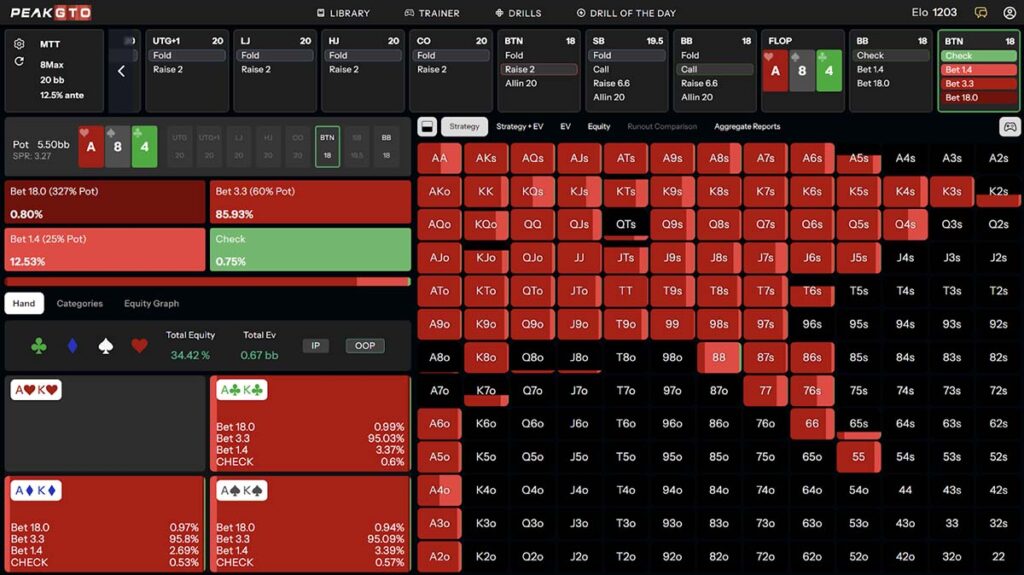
As you see, we are still c-betting almost our entire range, but the biggest difference comes from bet sizing. With a shorter stack, game theory optimal strategy sticks with 60% pot size bets in the vast majority of cases, occasionally mixing in 25% pot size bets.
Key takeaways
- C-bet 100% of the time with 40bb or less IP
- Mix in big and small bets with a 40bb stack
- Bet 60% of the pot as a default when you stack gets shorter
C-Betting on Ace-high Boards OOP – Ah8s4c
Of course, your poker strategy changes significantly when you are out of position, so let’s look at similar examples for both dry and wet boards. Now, we will analyze the situation using these core assumptions:
- We are playing 40bb deep
- We are opening from the CO
- BTN calls, and both of the blinds fold
Let’s look at the same example of Ah8s4c to see how our strategy changes when we are OOP.
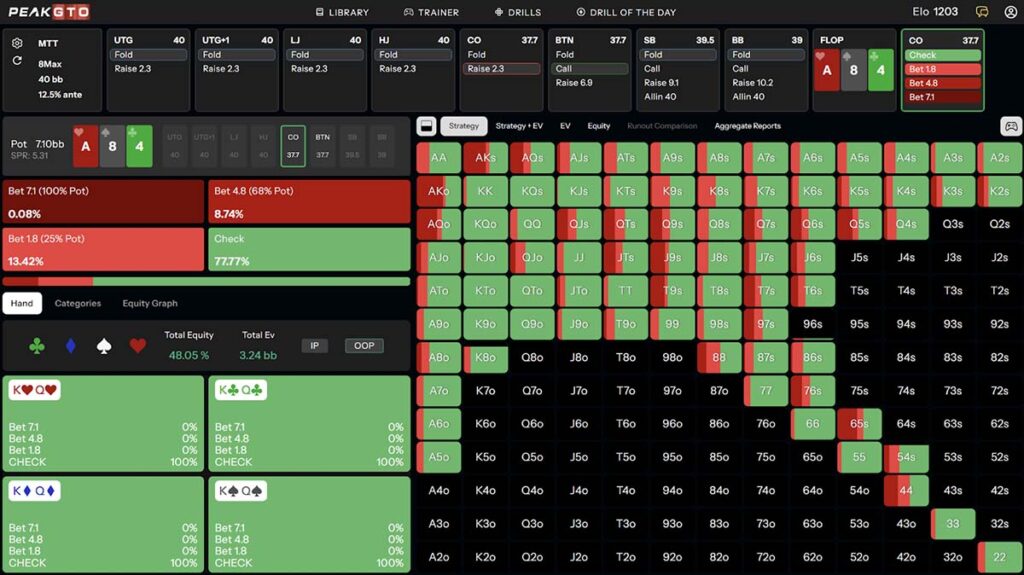
In this scenario, we bet only around 22% of the time and check 78% of the hands, which is almost the opposite strategy to being in position.
We are mixing our bets throughout our entire range at different frequencies, with hands like high-highs being the exception and mostly checking in this situation.
This lets us have strong hands in our checking range with a goal of being able to defend versus a bet, which is something we need to consider every time when we are OOP.
As for the sizing, we will use one-fourth pot size bet 13% of the time and stick to a bigger sizing of two-thirds of the pot with around 9% of our hands.
When the stacks get shallower and we reach 20bb, we will be c-betting more often.
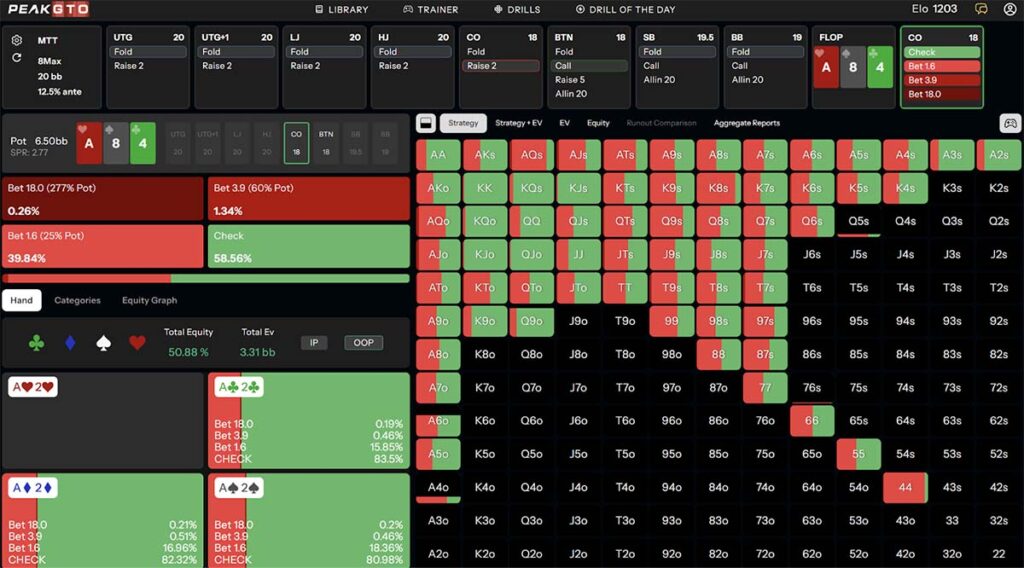
In this scenario, we are betting 41% of the time compared to only 22% with 40 big blinds. Our poker range distribution doesn’t change much. We just bet more often with the same hands, and this time, almost universally stick with a small bet size of 25% of the pot.
Key takeaways:
- Bet around 22% of the time when OOP with a 40bb stack size
- Mix it between small and big bets when c-betting with 40bb
- Bet over 41% of the time with a 20 bb stack and stick to a small bet sizing