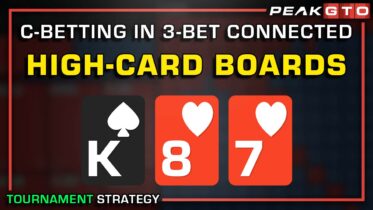

We already covered c-betting on dry high-card boards in 3-bet pots, so now we will concentrate on connected high-card board textures.
Today, we will examine strategy differences when playing IP and OOP in these situations and summarize key takeaways for each section.
C-Betting On High-Card Boards In Position – Ks8h7h
Key assumptions:
- The hand is played 40 bb deep with 12.5% ante
- Our opponent opens from the cutoff
- We 3-bet from the button
- CO calls to see the flop and checks to us
Let’s dive deeper into an example on a connected board of Ks8h7h to see how to play it.
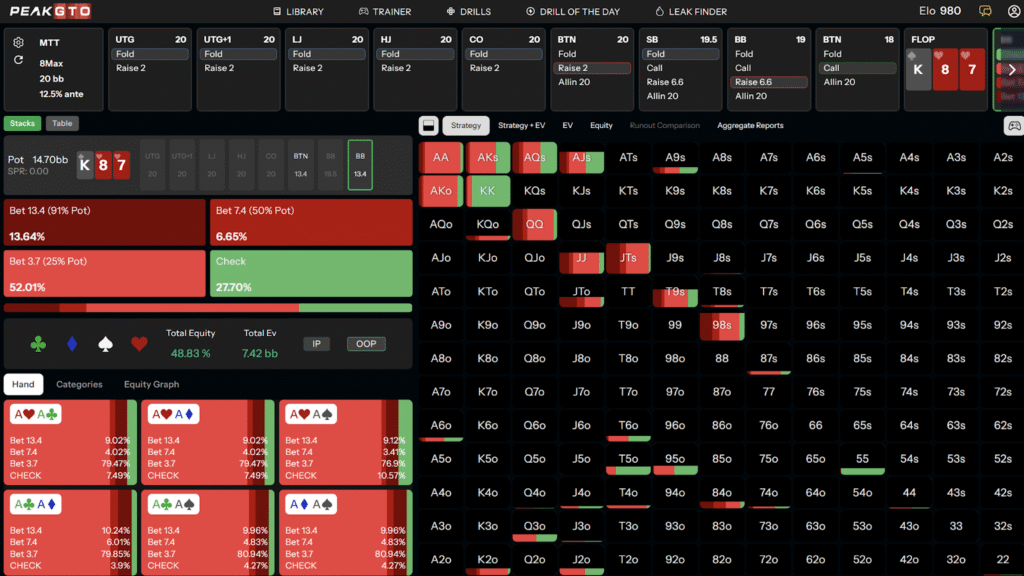
In this spot, we will be c-betting 72% of the time and using a small 25% pot size bet in all cases.
Since we have a significant range advantage versus the preflop caller, we can get away with betting aggressively and using small sizing across our entire range.
Our betting and checking are distributed throughout the entire range. According to the GTO strategy, we almost always bet AA, two pair hands, and our top pair top kicker combinations while mixing checks and bets with other hands.
When our stacks drop to 20bb, we either fold, call, or move all-in preflop without having a regular 3-betting range.
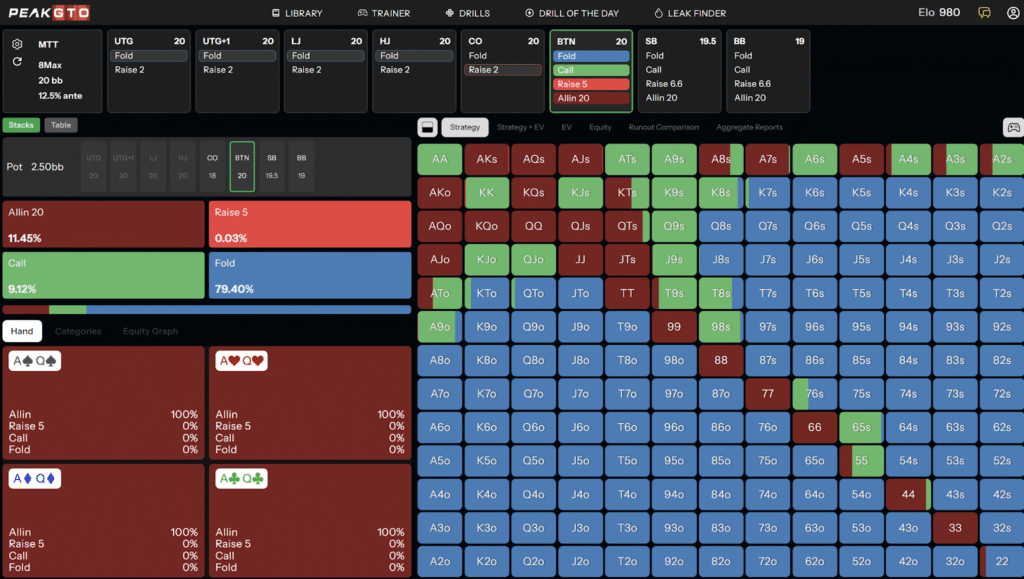
Our range becomes very polarized, meaning we call with top hands like AA or KK and the bottom part of our range, and shove everything in the middle, including most pocket pairs, some strong Ax combinations, and broadways.
In this spot, we call 9%, move all in with around 11%, and fold close to 80% of all hands.
Key takeaways
- C-bet very aggressively on connected boards with over 72% of hands
- Always pick a small bet sizing of 25% pot when continuing
- Mostly shove, call or fold preflop when stacks move down to 20bb
C-Betting On High-Card Boards OOP – Ks8h7h
Let’s see how we adjust with the same hand out of position. In this case, we face an open from the BTN and we 3-bet from the BB.
Key assumptions:
- The hand is played 40bb deep with 12.5% ante
- Our opponent is opening from the button
- We 3-bet from the big blind
- The button calls
The flop comes Ks8h7h.
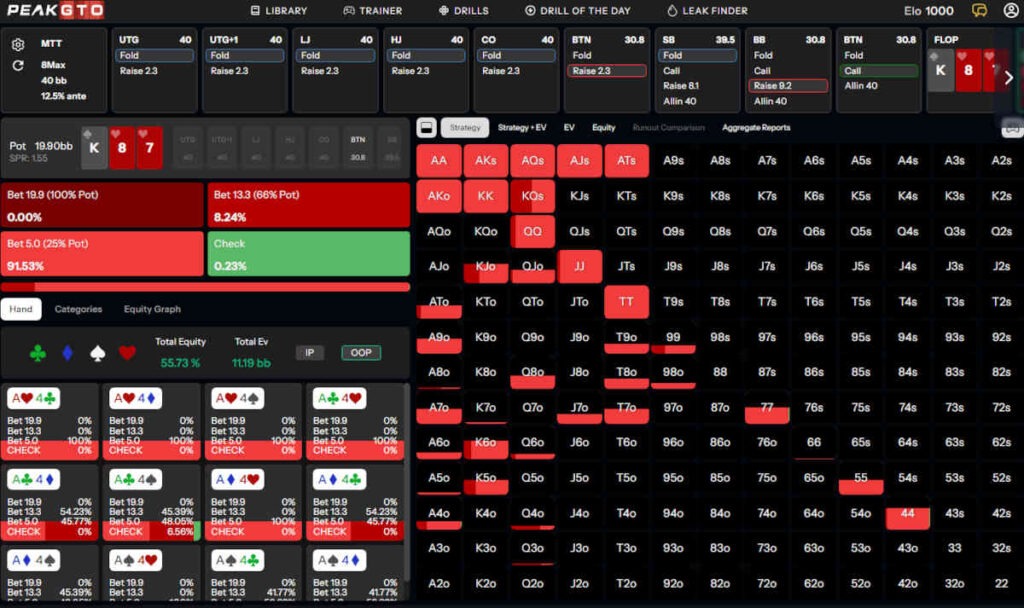
In this situation, PeakGTO suggests c-betting our entire range.
As for sizing, we are still sticking to 25% pot size bets as the standard option 92% of the time, while betting 66% of the pot with 8% of our hands.
The bigger sizing is reserved for top pair hands, such as KQs and KJs, followed by some bluffs to balance things out.
When the stacks get down to 20bb, our strategy changes significantly.
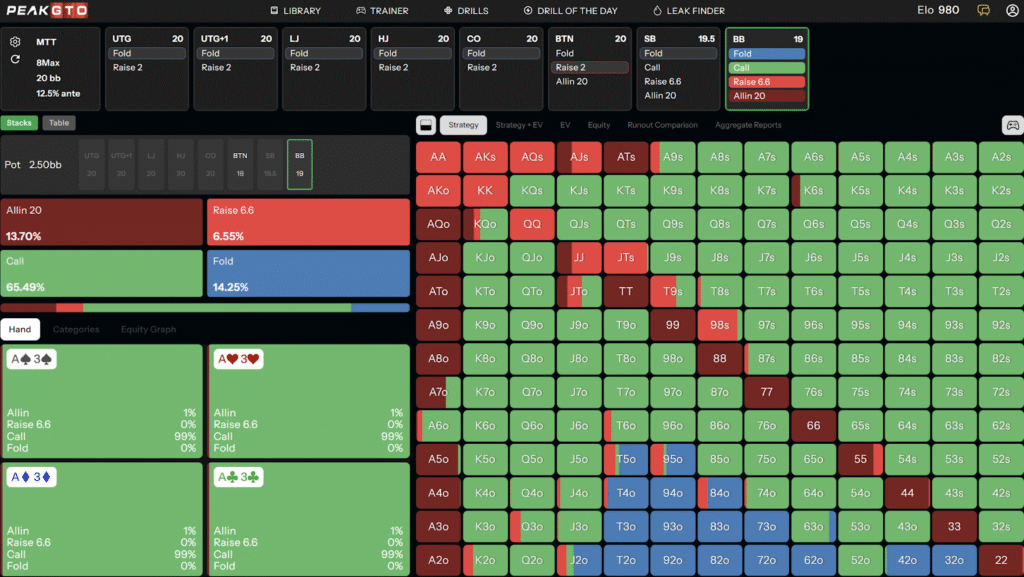
In this spot, we will be calling with 65% of the hands preflop, moving all-in with 14% holdings, and 3-betting just with 6.5% of the range.
When we do 3-bet, we will continue with a very wide c-bet again.
In this case, we are c-betting 83% of the time, and varying our bet sizing quite a bit. We use:
- 25% pot size bet with 52% of our hands
- 50% pot size bet with 7% of the holdings
- All-in with 14% of the hands
These sizes a distributed throughout our entire range, so we use a mixed strategy when picking our bets.
Key takeaways
- C-bet your entire range when out of position
- Stick to a small sizing of 25% of the pot in most cases, and mix in bigger bets around 8% of the time
- When stacks drop to 20bb, mostly call preflop and 3-bet shove with pocket pairs and Ax hands
- If you 3-bet with 20bb stacks, c-bet with 73% of the hands, and vary between smaller and bigger bets