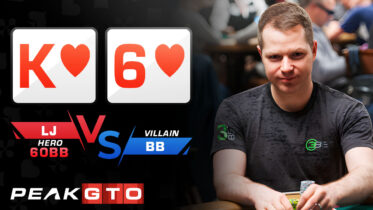
Knowing when to give up a missed draw is a skill, but so is knowing when it is correct to be going for it. The same blocker logic that tells you to check down some busted hands tells you to fire others with maximum aggression. The difference comes down to which cards your hand removes from your opponent’s range. The best triple-barrel bluffs are the hands that block your opponent’s value while leaving their folding hands alive, and king-high can be exactly that hand. This is the aggressive companion to the give-up spots, and it shows why a weak-looking holding can be a perfect jam.
Today we will analyze a 60bb 8-handed tournament hand where the lojack opens K♥6♥, the big blind calls, and the flop comes J♠9♠3♥. Hero bets the flop with a backdoor flush draw, barrels the turn, and then jams the river as a pure bluff when the queen arrives. This king-high is one of the best hands for going for it.
Assumptions
- Stacks: 60bb effective
- Format: 8-handed MTT, 12.5% ante
- Positions: LJ (Hero) vs BB (Villain)
- Action: LJ opens, BB calls
- Flop: J♠9♠3♥ (Pot: 6.1bb), Hero bets 4.1bb
- Turn: 7♦ (Pot: 14.3bb), Hero bets 9.6bb
- River: Q♣ (Pot: 33.5bb), Hero jams ~44bb
Preflop
From the lojack at 60bb, K6s is a fine open, a suited king that sits inside Hero’s range from this position. The big blind calls, and we take a flop heads-up and in position. This hand completes a trio of spots from the same seat: two where the missed draw gives up, and this one, where the missed hand fires all three barrels.
Flop: J♠9♠3♥
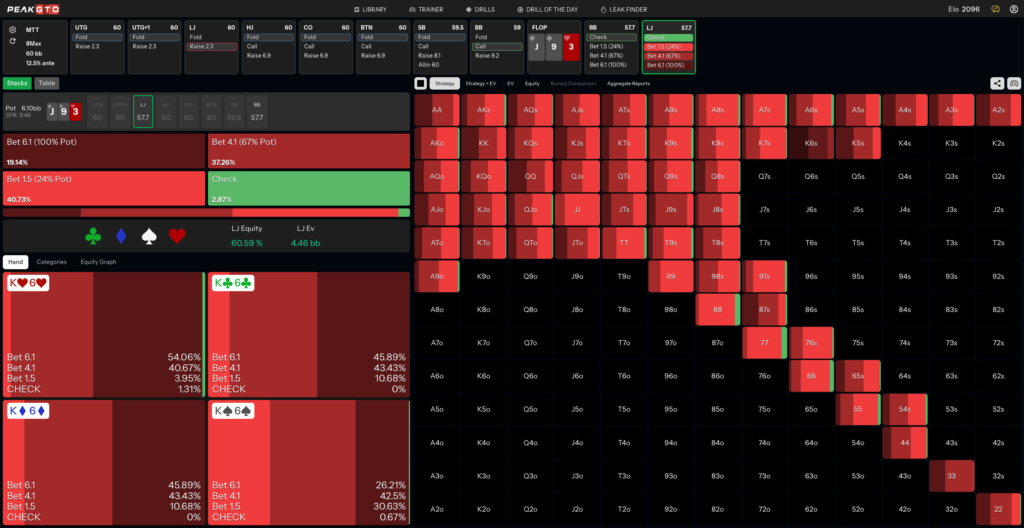
Hero has a king overcard and a backdoor heart flush draw. The big blind checks, and essentially Hero’s entire range gets to continuation bet. Because this board is a little less dynamic than the connected, two-tone boards where every card matters, the solver mixes in some slightly smaller sizes, but still leans on bigger bets in general, especially with the high-equity and low-equity draws. A hand with a backdoor straight or flush draw, even a weak one like K♥6♥, often takes the bigger size. PeakGTO bets the pot of 6.1bb about 54% of the time and 4.1bb about 41% of the time. Hero mixes it up and bets 4.1bb, getting called.
The reason a backdoor draw justifies betting bigger is that it gives the hand a way to keep applying pressure profitably. A king-high with a backdoor flush draw is not betting purely to fold the opponent out now; it is also setting up the turns and rivers where it picks up more equity or a scare card it can credibly represent. Betting larger builds the pot for the times Hero improves, and it charges the opponent’s marginal hands more to continue. On a board like this, where Hero holds plenty of strong jacks, nines, and overpairs, a confident bet leans on that range advantage rather than letting the big blind see free cards with their wide, capped defending range.
Turn: 7♦
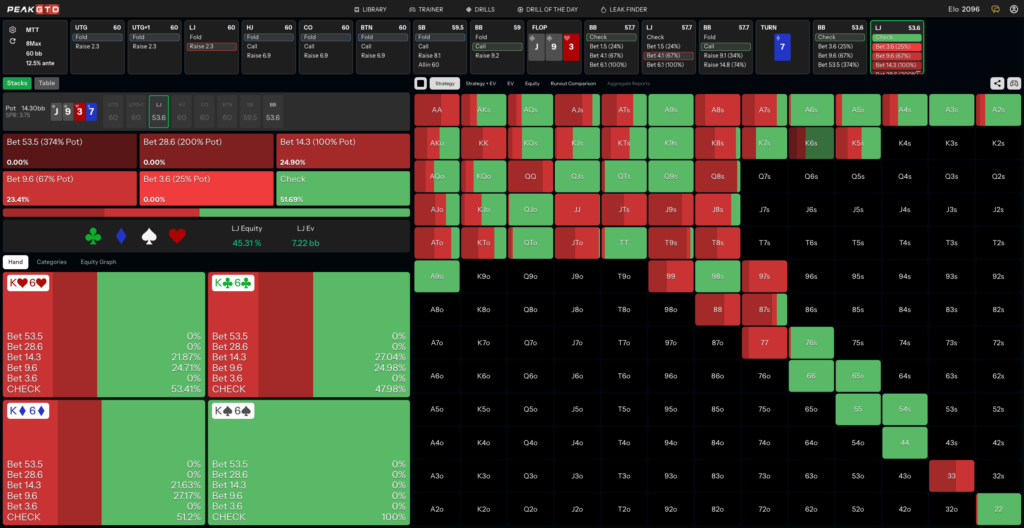
The 7♦ is a brick, and the big blind checks. The general rule is that you do not want to keep blasting backdoor draws that have little equity too often, but there is an important exception: overcards with the lowest unpaired kicker make good bluffs a meaningful chunk of the time. K♥6♥ is exactly the lowest unpaired-kicker overcard in Hero’s range, so it bluffs about half the time. Notably, Hero should be careful betting the spade versions of these king-high hands, because they can get raised on this turn, which would be a disaster. The non-spade K6 does not have that problem and is happy to fire.
This is a spot where players give up constantly, and that is a mistake. In the real world you should probably bluff even more often than the solver, for two reasons. First, the board can get scarier on the river and hand you a great bluffing opportunity. Second, a lot of opponents float the flop with hands like middle pair, call the turn, and then fold to a river jam. Hero bets 9.6bb and gets called, setting up the decisive river.
It is worth being precise about which hands keep barreling and which shut down, because the line between them is not about how the hand looks. A made pair like A9 never bluffs here; it has showdown value and would rather get to a cheap showdown than blow up the pot. The hands that fire are the ones with no showdown value but a useful overcard, like K6 and the various ace-low combinations such as A2, A4, and A5. They cannot win by checking, they retain a card that can pair into the best hand, and they apply maximum pressure to an opponent who has called twice with a capped range. That is what a polarized barreling strategy looks like: strong value plus the right no-showdown bluffs, with the medium hands checking.
River: Q♣
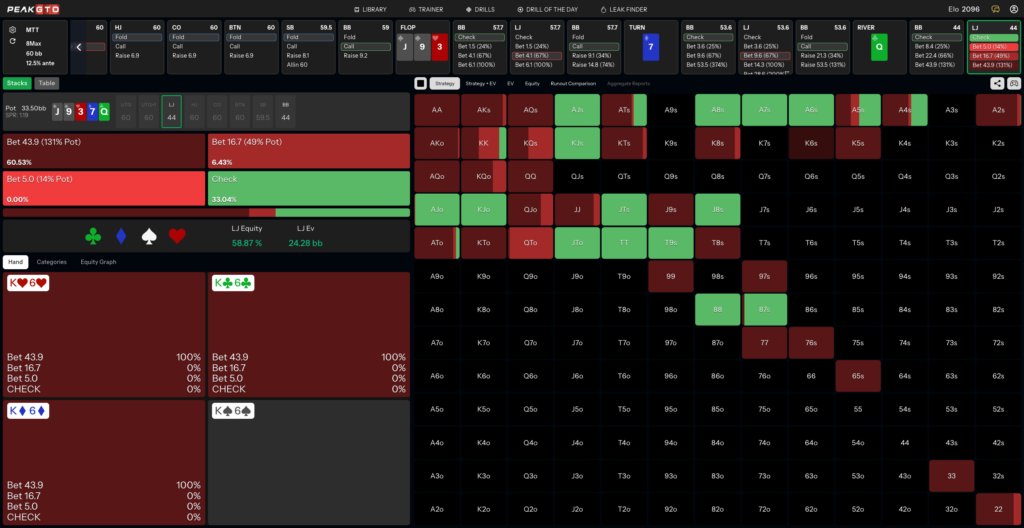
The Q♣ arrives and the big blind checks. Hero’s range has a real set of value jams here: QJ or stronger, including KQ, AQ, AA, and KT for the straight, all of which want to get the money in. Because Hero has those value hands, the range gets to find bluffs, and the best bluffs follow a clear rule: they block the opponent’s auto-calls or, just as importantly, they do not block the opponent’s auto-folds. K♥6♥ is a textbook fit. It does not hold a spade, so it does not block the busted spade flush draws that make up the opponent’s folding range, and it blocks KT, removing a chunk of the straights the opponent could call with. Compare that to a hand like A♠T♠, which blocks some calls but also blocks the busted flush draws you want the opponent to have, making it a worse bluff.
Sizing matters as much as hand selection. When Hero bets here, the play is to rip it all in for about 44bb, roughly 1.3 times the pot, not to bet half pot. A half-pot bet invites hero-calls, while the all-in jam folds out a ton of the opponent’s range. The instinct that says you would never overbet jam with a value hand is wrong; you should, and once you are willing to do it with value, you get to do it with bluffs too. Hero goes all in, the big blind folds top pair with AJ, and the triple barrel takes a big pot down. Do not be a chicken: when the river is good for your range and your hand blocks value while unblocking folds, that is the time to go for it. This is the aggressive side of the same GTO blocker logic that tells you to give up elsewhere.
Key Takeaways
- Flop: Bet your whole range on a king-high-friendly board, leaning on larger sizes with your draws. A backdoor flush draw like K♥6♥ is happy to take the bigger bet.
- Turn: Do not auto-give-up. Overcards with the lowest unpaired kicker, like K6, make good half-frequency bluffs, and against opponents who float and fold later you should fire even more. Avoid barreling the spade versions that can get raised.
- River: Pick bluffs that block value and unblock folds. K♥6♥ blocks the KT straight while leaving the busted flush draws in the opponent’s range, making it a far better jam than a two-spade hand.
- Overall: Going for it is the flip side of giving up. Use the overbet jam, not a timid half-pot, and let your blockers tell you when king-high is a fold and when it is a fearless triple barrel. Sizing up when the run-out favors your range gives the opponent a worse price to call and folds out a ton of busted hands.