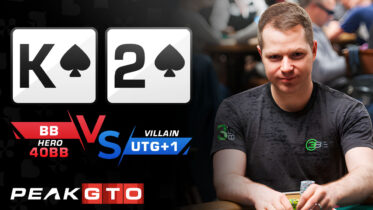
Deep in a tournament, most players are protecting their stack or trying to secure a pay jump, which opens many profitable opportunities to bluff.
That fear hands you more fold equity than almost any other spot in poker, which is why big bluffs that would be reckless in a cash game become the engine of deep tournament runs. When you risk seven or eight big blinds in a way that makes your opponent feel like their whole stack is at risk, you buy pots at a massive discount.
They have to be right to continue. You just have to be plausible.
The catch is that none of this works as a formula. Bluffing in tournaments deep is an exploitative art, so here are four tips covering who to target, how to abuse the bubble, and the test every big bluff must pass in Texas Hold’em.

Tip #1. Bluff the Players Who Can Fold
The most important bluffing decision is target selection, and the spectrum is wide.
Tight, careful players are your best customers. So are the aggressive regulars who open too many pots and then play honestly, the ones who raise, c-bet the flop, and check-fold every turn their hand missed.
Against that pattern, calling flops with position and taking the pot away on the turn wins far more than your cards deserve.
At the other end sit the maniacs and calling stations, and against them the big bluff is a donation. Players who barrel with wide ranges are not folding to your aggression, so you beat them the opposite way, by calling down with decent made poker hands and letting them bluff into you.
The same discipline applies to entering pots against the tightest players. When a rock raises, even attractive hands become folds, and small pairs need the full ten-to-one implied odds against their stack before set mining makes sense. You beat the rocks by stealing their blinds and refusing to pay them off, no bluffing required.
Tip #2. Treat the Bubble as Bluffing Season
Nothing concentrates fold equity like the approach of the money. When 120 players remain, and 100 get paid, a huge chunk of the field shifts into survival mode, and every one of them becomes a target.
The simplest play is opening more pots, because the sneaking-in crowd surrenders their blinds without a fight.
The more powerful play attacks the medium stacks. Say a 35 big blind player raises to 2.5 on the bubble. Make your 3-bet around seven big blinds, then continuation bet on almost any flop. You have now made them feel like their entire tournament is at risk, and even some strong hands will melt under that pressure.
Shorter stacks get their own version. Jamming around 20 big blinds over a medium stack’s open puts them in the identical bind, and your shove ranges can widen well beyond normal, because calling off on the bubble with a marginal hand is exactly what they refuse to do.
Tip #3. Attack the Runouts That Get Ugly
Between the bubble and the final table, the biggest bluffs come from board runouts, not positions.
When the river completes three to a flush, four to a straight, or any card that towers over your opponent’s likely range, a substantial bet folds out almost everything that is not the nuts.
This works because most players bet the flop with a one-street plan, then play the rest of the hand honestly. If the runout got scarier and they kept checking, their hand is what it looks like, usually a decent pair that cannot handle real pressure.
The key word is substantial. Small bets at scary boards get looked up by curiosity. Big bets force your opponent to imagine calling off a meaningful chunk of their deep-run stack with one pair, and that image does the folding for you.
Tip #4. Only Rep Hands You Can Actually Have
Before any big bluff, ask one question. Could I conceivably have the nuts here? If the answer is no, your bluff is a prayer, not a play.
I once raised eight-three offsuit from the small blind into a tight player’s big blind, flopped a gutshot, turned an open-ender, and fired three streets with eight high.
It worked, and it was not a wild gamble, because on that runout my range was full of straights I would play exactly the same way. The bluff told a story my whole range backed up.
Compare that with jamming a river to represent a straight you would have bet on the turn. Your opponent does not need to read your soul, they just need to notice your line makes no sense. And keep your volume honest too. On the river, you want roughly two value combinations for every bluff, so count what you are repping.
When your range holds sixteen combos of straights and barely any air, blast away with all of it. When your range is stuffed with junk, most of it has to give up. The players who bluff big and survive are the ones whose stories check out.
Conclusion
Fire at the players that are in survival mode and medium stacks, protecting their pay jumps, and the ugly runouts nobody wants to call through.
Leave the maniacs and stations alone, and make every big bluff pass the story test before the chips go in. If you could not plausibly hold the hand you are representing, check instead.
Play it this way, and you stop needing cards to build a stack. The pressure of the payout structure does the work, and you arrive at the final table with the chips that decide who actually wins.