Two of the most underrated skills in poker are refusing to fold too much and knowing how to squeeze value out of a marginal made hand. They show up in the same kind of spot: you defend the big blind with a weak-looking hand, take an uncomfortable line, and arrive at the river with a pair you are not sure is even good. Folding the flop is the lazy mistake. Checking the river and giving up is the quieter one. This hand is about fighting harder than feels natural on the flop, and then extracting thin value on the river with a holding most players would check and pray with. The theme is simple: fight harder, and mean it literally.
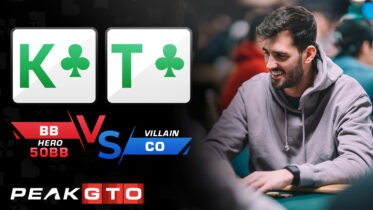
Today we will analyze a 50bb 8-handed tournament hand where the big blind defends K♣T♣ against a cutoff open, calls a big continuation bet on J♣6♦5♦ with nothing but king-high, then rivers a pair of tens and bets for thin value. We will cover why playability matters more than equity when defending out of position, and how the ten in our hand shapes the exact river size. The result is a hand that turns an uncomfortable flop call into a profitable river bet, plus a clear framework for when to deviate from the solver against real opponents.
Assumptions
- Stacks: 50bb effective
- Format: 8-handed MTT
- Positions: BB (Hero) vs CO (Villain)
- Action: CO opens, BB calls
- Flop: J♣6♦5♦ two-tone (Pot: 5.9bb)
- Turn: 3♠ (Pot: 13.7bb)
- River: T♠ (Pot: 13.7bb)
Preflop
The cutoff opens and the big blind calls with K♣T♣. A suited KT is an easy defend, and like every big blind defend it commits Hero to playing the hand out of position. That positional reality is the lens for everything that follows, because it shifts the question from “how much equity do I have” to “how much of that equity can I actually realize.”
Flop: J♣6♦5♦
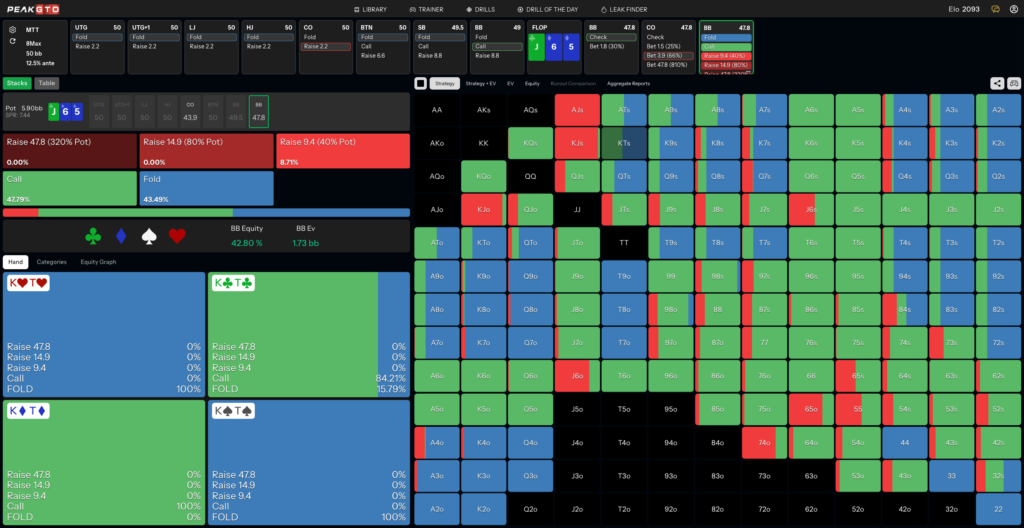
The big blind checks and the cutoff fires a big 3.9bb continuation bet, about two-thirds pot. K♣T♣ has only king-high, a backdoor club flush draw, and a backdoor straight draw. Facing a large bet, folding feels reasonable, and that is exactly the instinct you need to override. The solver already continues this exact hand about 84% of the time, well above its 48% range-wide call rate, and you should push it even further. Even though you are uncomfortable, you need to continue this hand almost every single time, and ideally you want to continue it every single time.
The reasoning is a principle worth tattooing on your forearm. When defending the big blind, playability matters more than raw equity, because all that matters is how much equity you can realize. A hand like 22 or 33 has more equity than KT with backdoors, but it will be miserable to realize that equity from out of position against a competent opponent. A small pair is essentially drawing to make a set, and otherwise has to check and hope across two more streets while a competent opponent barrels and prices it out, so most of that raw equity never makes it to showdown. KT, by contrast, has clean turns, backdoor draws that can develop, and the high-card strength to make a pair that beats bluffs. The J65 board also runs out well for the big blind’s range: low cards and non-diamond turns are friendly, which is part of why the cutoff bets big now while it still holds the nut advantage. Hero check-calls.
There is a confidence component here that is easy to miss. The reason the solver can continue these hands at all is that it plays perfect turns and rivers, and a strong human can actually do better than the solver against most opponents, because real players do not bluff turns and rivers aggressively enough to punish a big blind that continues wide. In other words, the more your opponent under-bluffs later streets, the more flop calls become profitable, not less. The fold that feels disciplined is often just surrendering equity you were fully capable of realizing. Against weaker players especially, the instruction is simple: take the uncomfortable call and trust yourself to navigate what comes next.
Turn: 3♠
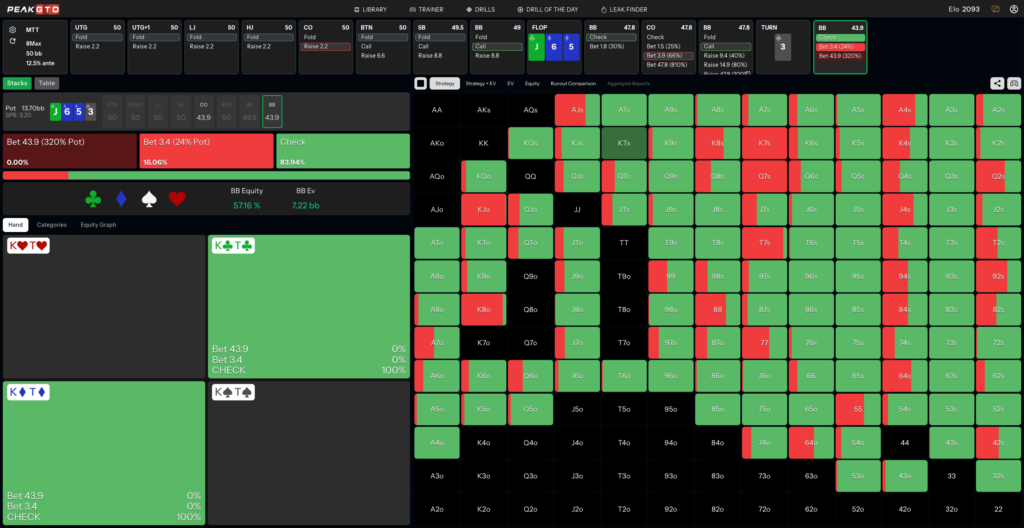
The 3♠ is a blank that misses everything. PeakGTO checks its overall range about 84% of the time here, and king-high in particular is a clear check. There is nothing to bet for: no made hand to protect, no fold equity worth chasing against a range that just bet big and called itself into a strong shape. Checking keeps the pot small and preserves the plan of navigating the river well. It also keeps a wide set of helpful rivers live: any king or ten pairs Hero up into a value bet, while the low and middling cards that pair the big blind’s range tend to favor Hero as well, so giving up here would throw away the upside of cards that are coming. The cutoff checks back, and that check-back is the tell that unlocks the river, because a player who bet big on the flop and then gives up the turn is missing a lot of the strong hands they were representing.
River: T♠
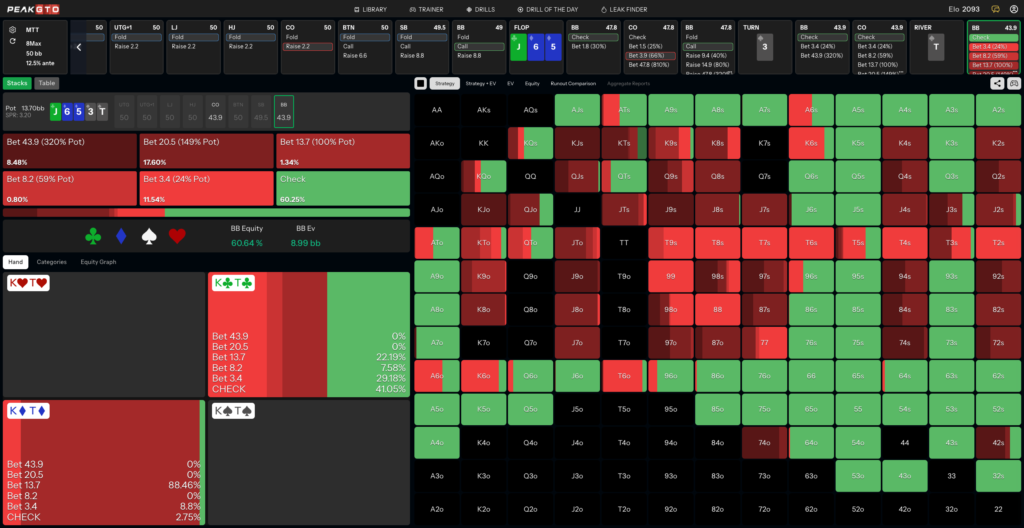
The T♠ gives K♣T♣ a pair of tens with a king kicker and solid equity, and now the value question opens up. This is a two-range river. The big blind wants to overbet its very best hands, the jacks, which are close to the nuts after the cutoff checks back, and it wants a separate smaller “block bet” range for the medium hands. The interesting part is where a ten fits. When you overbet with jacks, you are targeting the opponent’s offsuit ten-x that checked back the turn. But K♣T♣ holds a ten, which blocks those exact calling hands. So even though it has solid equity, K♣T♣ avoids the overbet sizes entirely: it often just checks, and when it bets, the small block is its most common size, though it still mixes in a pot-sized bet about a fifth of the time. Firing the biggest sizes would only blast into a range whose calls you just removed.
That is the clean theoretical answer for this thin value bet: small, because your card blocks the hands that pay a big one. It is also the line Hero takes here, a block bet of about 3.4bb, roughly a quarter of the pot, which the cutoff calls with a worse pair of tens. The real-world adjustment is the lesson worth carrying, though. Against an opponent who will not bluff enough when checked to, and who will pay off with a wide set of worse pairs and ace-highs, you can abandon the block and size up, toward 8.2bb or about 60% of the pot. It does not matter that the computer does not call that a real strategy, it is going to work better in game, because the opponent can show up with sevens through nines, so you target those pairs plus a lot of their high cards with the bigger size. The principle is general: when your opponent under-bluffs and over-calls, the GTO block bet leaves money on the table.
The block-bet framework is worth keeping as a general tool. A reliable rule of thumb is to map your bet size to your blockers: hands that block the opponent’s calling range, or bluffs with bad blockers, belong in the small size, while hands that unblock the folds, or bluffs with great blockers, belong in the big size. A rivered pair of tens that blocks the opponent’s ten-x is a textbook small-size value bet, sitting in the same bucket as your weaker bluffs so the whole range stays balanced. Understanding why a hand goes small is what lets you recognize when an opponent’s tendencies justify abandoning the structure entirely and just betting the size that prints.
Key Takeaways
- Flop: Defend king-high against a big c-bet. Playability beats raw equity from out of position, so K♣T♣ calls almost every time rather than folding.
- Turn: The 3♠ blank is a pure check. The cutoff’s check-back caps its range and sets up a river value bet.
- River: A rivered pair of tens is a thin value bet. In theory it mostly checks or block-bets small and avoids the overbet, mixing in a pot-sized bet about a fifth of the time, because the ten blocks the opponent’s calling ten-x; in practice, size up against players who under-bluff and over-call.
- Overall: Fighting harder on the flop is what gives you the chance to value bet thin on the river. Refuse to over-fold out of position, then let blockers and opponent tendencies dictate your exact river size.