When a marginal pair suddenly improves to two pair, the instinct is to raise and “get the money in before I get outdrawn.” Most of the time that instinct is right, but there is an important exception that separates strong players from the field: when your two pair contains the very card your opponent is betting and calling with, raising can be a mistake. The card that made your hand also removes those same cards from your opponent’s range, which means a raise folds out the bluffs you want to keep and only gets action from the hands that beat or tie you. Sometimes the most powerful play with a big hand is the quiet one. This hand shows exactly when to call with two pair, when sets should raise, and when to let it rip on the river.
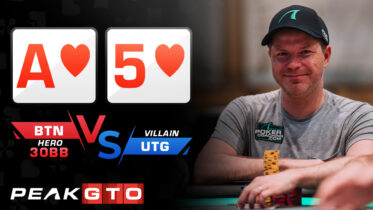
Today we will analyze a 30bb 8-handed tournament hand where the button calls an under-the-gun open with A♥5♥, flops middle pair on 9♠5♠3♣, and turns two pair when the A♦ pairs the ace. We will break down the counterintuitive turn decision, why this two pair calls a small bet rather than raising, and why the river becomes a clear value shove. The lesson is all about blockers: the same ace that made your hand is the reason you slow down.
Assumptions
- Stacks: 30bb effective
- Format: 8-handed MTT
- Positions: BTN (Hero, in position) vs UTG (Villain)
- Action: UTG opens, BTN calls
- Flop: 9♠5♠3♣ two-tone (Pot: 7.1bb)
- Turn: A♦ (Pot: 16.7bb)
- River: 2♥ (Pot: 25bb)
Preflop
UTG opens and the button calls A♥5♥, a routine flat from a range that wants to flop well and play in position. Position is what lets the button call down with marginal hands and, when one improves, extract maximum value with information the opponent does not have. UTG opens, the button calls, and the blinds fold.
Flop: 9♠5♠3♣
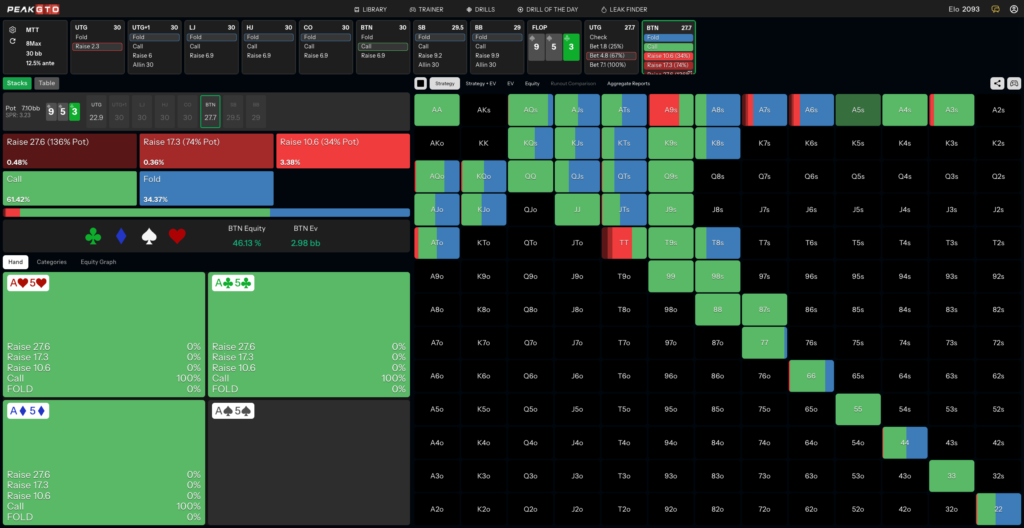
The button flops middle pair with an ace kicker, and UTG fires a sizable, polarized 4.8bb continuation bet (about two-thirds pot) on this dynamic board. As in the companion hands from this spot, facing a big, polarized size, the button just calls and does almost no raising. A♥5♥ is a simple call with second pair and a good kicker. Hero calls and sees a turn that changes everything.
It is worth pausing on why the flop call sets up everything that follows. By flatting rather than raising, the button keeps its range wide and disguised, which means an ace or a five on the turn turns this hand into a monster the opponent will never see coming, while other turn cards improve the rest of the button’s wide flatting range. A raise on the flop would have bloated the pot with a marginal hand and announced strength, narrowing the button’s range and removing the trap. The whole plan depends on staying patient with second pair, exactly the kind of hand that recreational players over-defend by raising. Calling preserves both the implied odds and the deception that pay off two streets later.
Turn: A♦
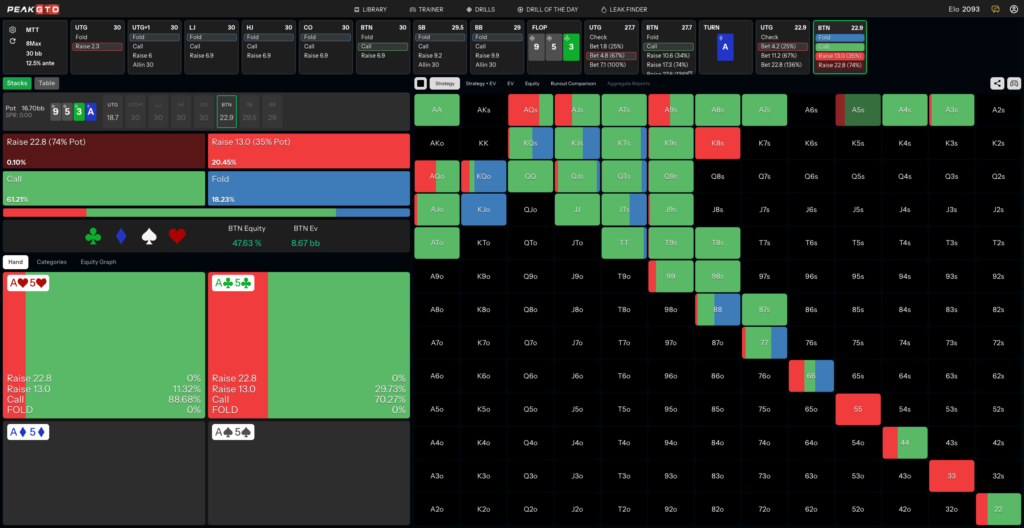
The A♦ gives the button two pair, aces and fives. UTG now bets small, around a quarter of the pot, and here is where the hand gets interesting. Because much of UTG’s flop betting range is worse than an ace, by the turn it is forced to check those hands often, so when it does bet small it is mostly ace-x plus a smattering of draws. The small sizing is itself a useful clue: a quarter-pot bet on a card that smashed UTG’s perceived range often leans toward an ace-x-heavy holding rather than a set or better, since the strongest hands would tend to size up to build a pot before the river. The reflex is to jam two pair and protect, but PeakGTO mostly calls.
The reason is the ace in your hand. With two pair type hands that contain an ace, you are usually going to just call, because your ace removes most of the aces from the opponent’s range, the exact hands that would pay a raise. Raising therefore folds out the bluffs and draws you dominate and only gets called by hands that beat you. Calling keeps that weak, dominated range in the pot. Crucially, the hands that most often raise here are sets, 55 and 33, which raise every time precisely because they do not block the opponent’s aces. Hero calls.
Picture the two ranges. When you call, you let the opponent keep firing or showing down a flood of worse aces and busted draws, all of which you crush. When you raise, those hands fold and you are left getting action from better two pairs, sets, and the occasional chop. That contrast is genuinely hard to act on in real time, since the reflex is to raise a big hand for protection. Distinguishing the hands that should call (your ace-x two pairs) from the hands that should raise (sets that unblock the ace) is the kind of detail that quietly separates great players from good ones.
River: 2♥
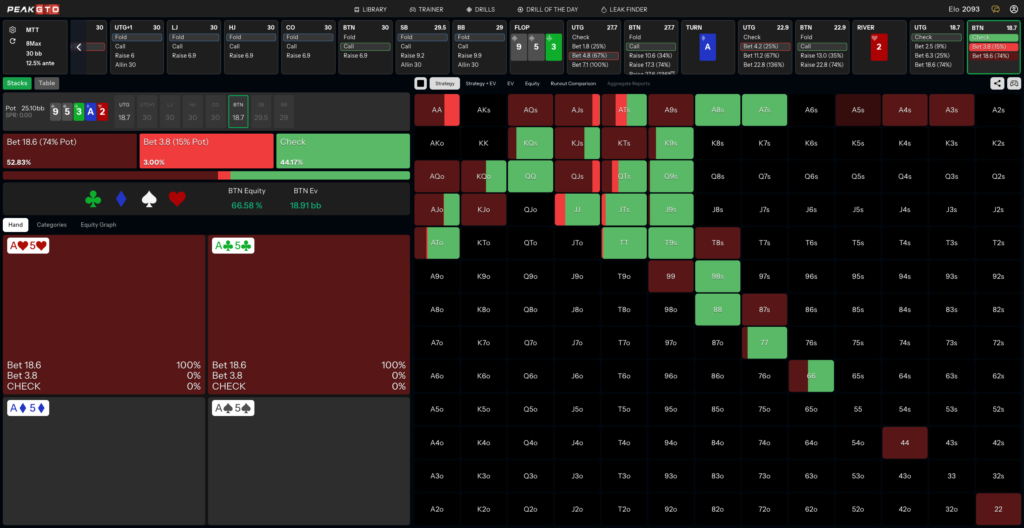
The 2♥ changes little. It is worth noting that an A4 would now have a wheel, but UTG does not have fours in its range, so there is no straight to fear when value betting. UTG checks, and the button has an easy decision: with a made hand strong enough to bet for value and stacks shallow enough that a less-than-pot bet commits you, you shove. The solver bets a 74% pot all-in, which with these stacks is the rest of the chips, and A♥5♥ takes that line 100% of the time.
The value targets are clear. After checking, UTG still has plenty of one-pair aces and worse that cannot fold, and the patient turn call is what kept those hands in the range to pay you off now. The value-shoving range extends all the way down to hands like AJ, and the bluffs that join the jam are busted draws such as T8 and 8♠7♠. Pairing those busted spade combos with the genuine value hands is what keeps the shove balanced, so a thinking opponent cannot simply fold every non-set and exploit a one-dimensional range. Against a real opponent, you tighten the value shoves if they will only call with AQ and better, but you never check a hand this strong when they have shown weakness. This is a textbook GTO value bet, and the price a shove lays still gets plenty of worse aces to call. Hero shoves, and UTG calls with a pair of aces and loses to the two pair.
None of this works out of position. Acting last let the button see UTG surrender the betting lead on the river before committing a single chip, which is the information that turns a tricky bluff-catch into a confident value shove. A hand played from the blinds has to guess at the river, while the button gets to confirm weakness first and then size up. That positional edge is the quiet engine behind the whole line, and it is why the same A5s that is a fold from early position becomes a profitable flat-and-extract on the button.
Key Takeaways
- Flop: Second pair with an ace kicker calls a big c-bet and does not raise, the same discipline that applies to any one pair against a polarized size.
- Turn: The A♦ makes two pair, but A♥5♥ calls rather than raises. Your ace blocks the opponent’s aces, so raising folds out the bluffs you beat. Sets, which do not block aces, are the hands that raise.
- River: Once the opponent checks, two pair is a clear value shove for about 74% pot. The turn call is what kept the worse aces in their range to pay you off.
- Overall: Turning two pair does not always mean raising. When your hand blocks the opponent’s continuing range, call to keep their weak hands in, then collect value on the river.