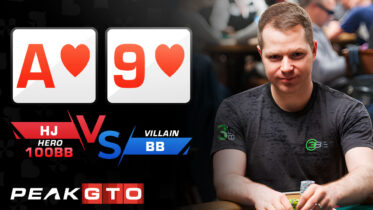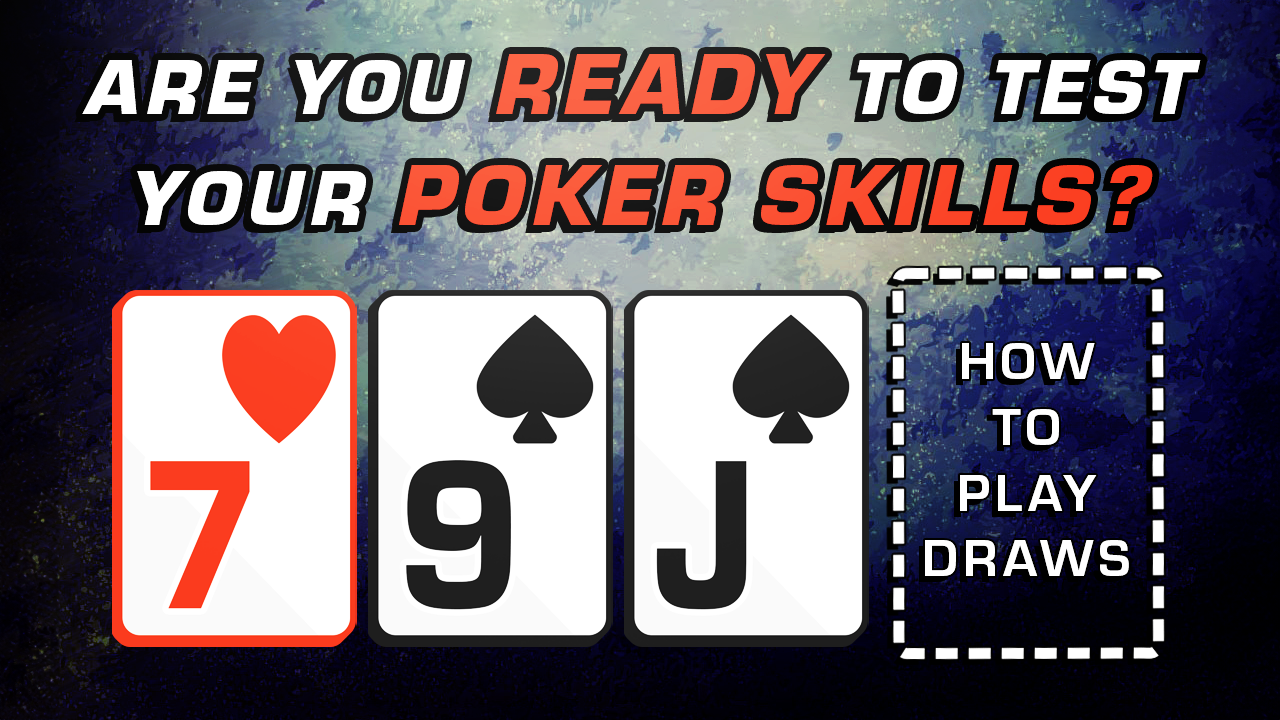

We already covered how to defend in position versus c-bets on ace-high boards in single raised pots , so today we will dive deeper into 3-bet scenarios.
In this article, we will cover different board textures and see how to proceed both in position and out of position when you call a 3-bet preflop and then face a bet.
Defending On Ace-High Boards In Position – As8h3d vs. As9h8h
We will start with an in-position example, firstly going over the dry ace-high flop and then analyzing connected board texture. This is a spot where we open from the BTN, face BB 3-bet, and decide to call preflop.
Key assumptions:
- The hand is played 100 bb deep
- We are opening from the button
- Big blind 3-bets
- We call a 3-bet
- Our opponent c-bets on the flop
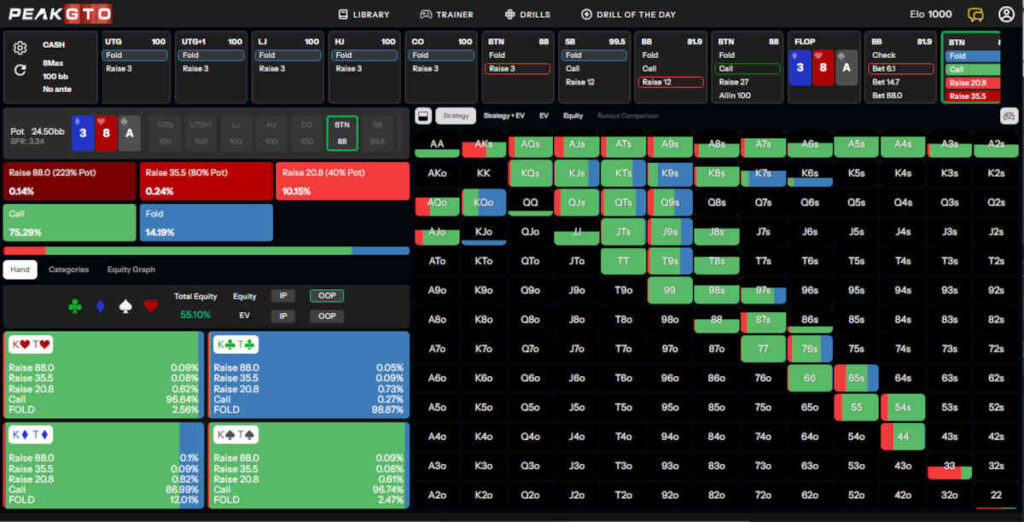
Let’s firstly look at an example of As8h3d. In these situations with a very dry flop, your opponent will be betting around 60% of the time and usually pick a small sizing because of the range advantage.
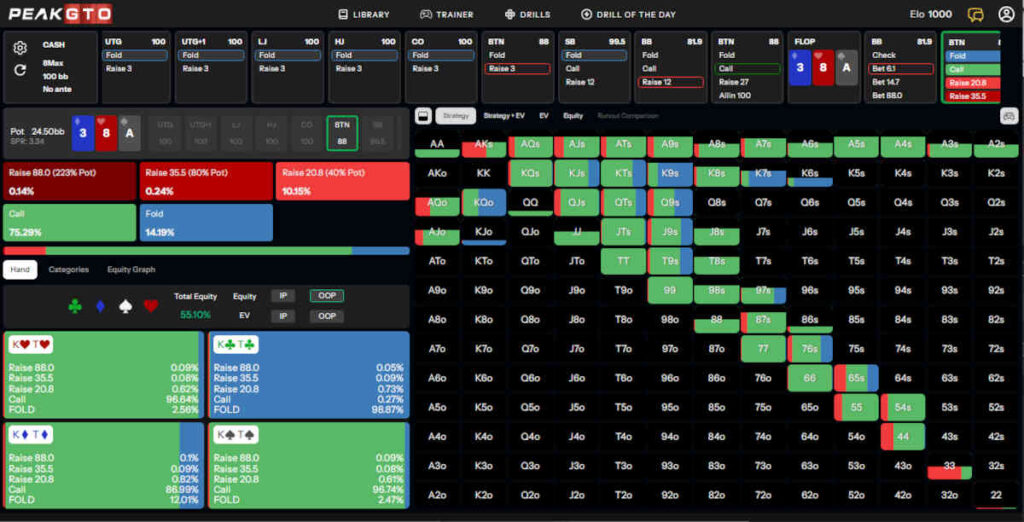
While our defense strategy depends on the actual sizing, we need to defend around 85% of the hands due to the MDF (Minimum Defense Frequency) when facing a small bet of around 25% of the pot.
In this situation, we will be calling the vast majority of the hands, but we still have a 10% raising range, which is mostly comprised of bottom sets, strong top pairs, and a few gutshots or runner-runner draws to balance things out.
If your opponent chooses a bigger bet sizing for a c-bet, then we apply only a calling strategy and continue with a narrower range, dropping it down to around 60% of the hands.
The same logic applies to wet boards as well. Let’s look at As9h8h as an example.
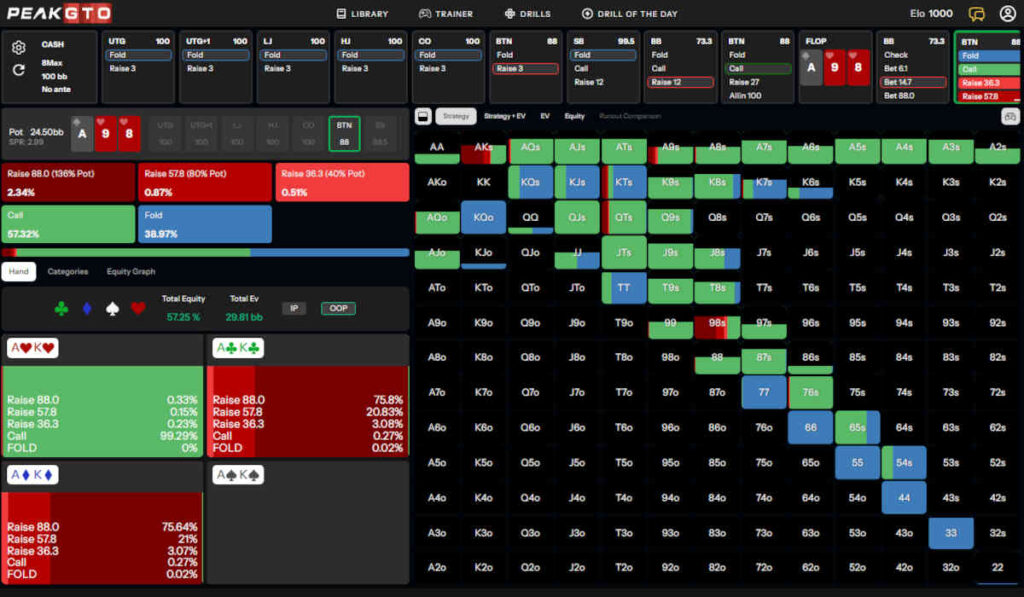
Just as on a dry board, we stick around 80% of the time against a small c-bet and continue with 60% of the hands when facing a bigger bet.
As you can see in the example above, we will once again be calling most of the time, with around 62% of the hands. This includes any pair, open-enders, and even guthosts.
Regarding the 15% raise range, we mostly select our strongest hands, such as top pairs, two-pair combos, and sets. In this spot, we are only folding naked combos that pretty much have no value.
If we face a larger c-bet in this exact situation, we pretty much drop our raising range and defend all the hands we continue with by calling, with a few exceptions of our strongest hands.
Key takeaways
- Defend over 80% of the time against small c-bets and have a raising range.
- Defend around 60% of the time against big c-bets and have only a calling range.
- Stick to a similar strategy for both dry and connected boards.
Defending On Ace-High Boards OOP – As9h4c vs. As9h8h
Now, let’s look at the hands when we are opening from the CO, face a 3-bet from the BTN, call out of position, and face a bet after checking to our opponent.
Assumptions:
- We are playing 100bb deep
- We are opening from the CO
- BTN 3-bets
- We call a 3-bet
- We check to the BTN on the flop
Let’s firstly look at a dry board of As9h4c.
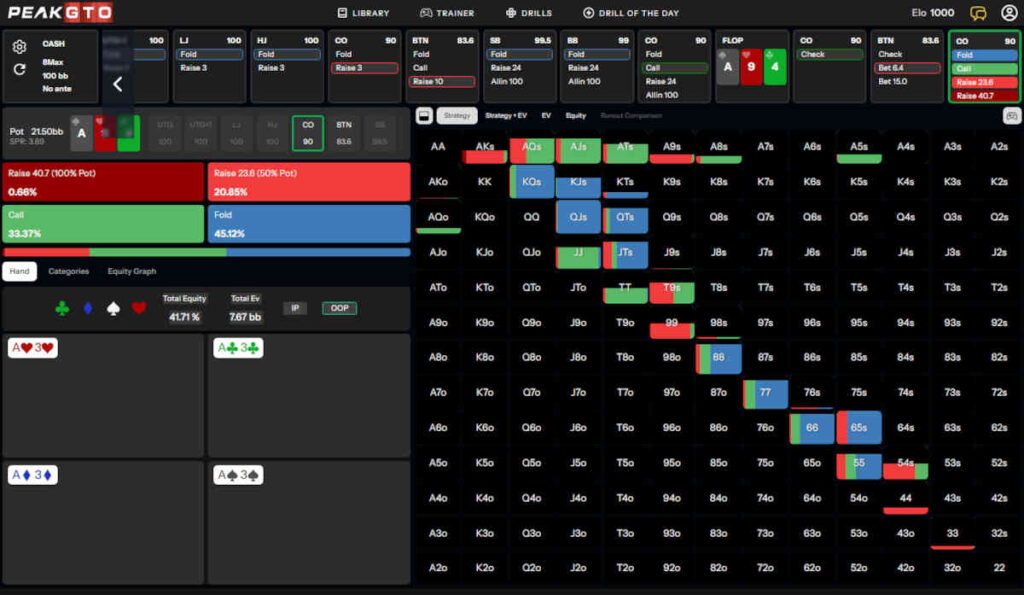
After we check the flop, our opponent will c-bet using almost exclusively a small bet sizing, making this much easier to counter.
When we face a c-bet, GTO poker says we should defend around 55% of the hands. This includes calling with 33% of the range and raising aggressively with around 22% of the time.
Our raising range consists of strong hands such as sets, two pairs, AKs, and AQs, followed by weaker hands with runner-runner draws and smallest pocket pairs.
As for calling, we do that with other Ax hands and pocket pairs. This gives us a nice balance between raising and calling hands, allowing us to proceed on various turn cards and defend enough hands on future streets to avoid being exploited.
When it comes to a connected board, the biggest difference is that your opponent will be c-betting these less often. For example, he will only be firing a c-bet around 25% of the time on As9h8h.
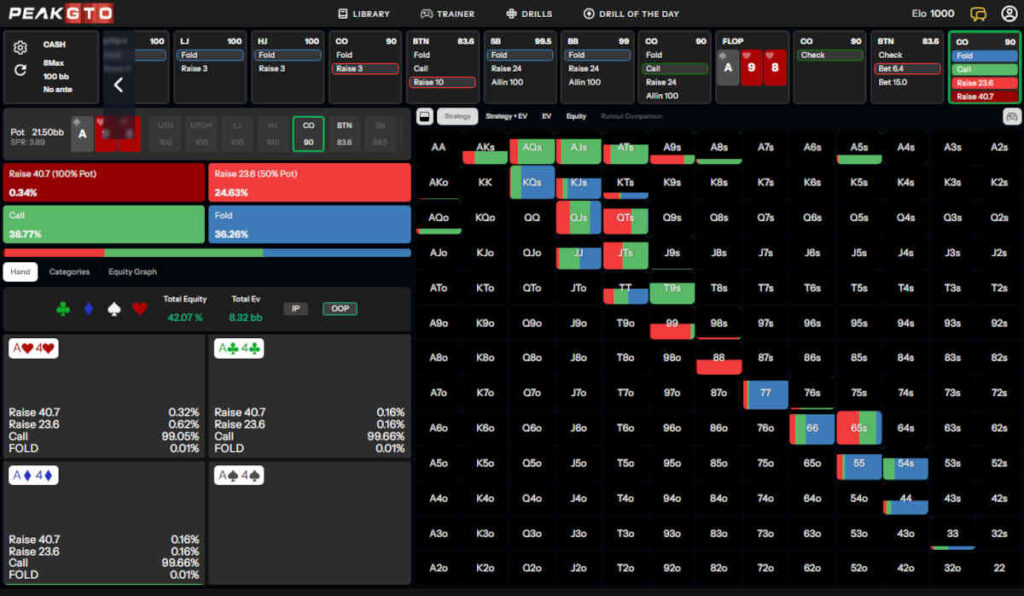
Against this strategy, you should still be defending 64% of the time. Surprisingly, we will be raising almost 25% of the hands, which includes sets, two-pair combos, various open-enders, and gutshots.
The rest of the hands that have any equity leans towards just calling a c-bet. Even your strongest top-pair hands will just check-call as a default option.
Key takeaways
- Always check on the flop after calling a 3-bet OOP.
- Have an aggressive raising range versus a c-bet with the strongest holdings and weak draws.
- Call all of the middling hands that has showdown value and equity.