

The easiest poker games for beginners are Five Card Draw, No-Limit Texas Hold’em, Pot-Limit Omaha, Seven Card Stud, and Pineapple Poker.
Each one is simpler in structure than advanced variants and designed to help new players build fundamentals without getting overwhelmed. I’ve spent years coaching new players at PokerCoaching, and the game you start with matters more than most beginners realize.
Choose the right entry point, and you’ll build confidence faster, stay at the table longer, and transition into games with more complex poker rules with a real foundation under you.
How the 5 Games Compare
| Game | Difficulty | Best For | Where to Play |
|---|---|---|---|
| Five Card Draw | Very Easy | Complete beginners, home games | Home games, select online sites |
| No-Limit Texas Hold’em | Easy to Medium | All beginners, long-term focus | Everywhere online and live |
| Pot-Limit Omaha | Medium | Players with Hold’em experience | Most major poker sites |
| Seven Card Stud | Easy to Medium | Beginners who prefer limit betting | Some casinos, mixed game events |
| Pineapple Poker | Easy (if you know Hold’em) | Home game players | Home games, select online sites |
If you are completely new to poker, use this table as your shortcut: Five Card Draw to learn the basics, No-Limit Hold’em to learn the game you will actually play for the rest of your poker life.
1. Five Card Draw
Perhaps the simplest form of poker to learn, Five Card Draw is a very easy poker game that does not include any community cards or up-cards at all.
I always recommend Five Card Draw to complete beginners because it strips poker down to its core mechanics: you see only your own cards, and every decision is isolated and clear.
When I coach players who are completely new to the game, this is often where I suggest starting, because there is no flood of community card textures or multi-street bet sizing to worry about. You learn to read hand strength, practice betting decisions, and build pattern recognition without the noise that comes with Texas Hold’em.

After the initial cards are dealt in Five Card Draw, you will get a chance to act on your hand. The betting structure is no limit, which means you can raise to any amount you want if you like your cards.
Once the betting round is completed, you will get a chance to draw, meaning you can discard any of the cards you have and get new ones to replace them.
The purpose of the draw is to improve your hand or bluff by keeping cards you don’t really need in order to represent a stronger hand than you actually have.
After the draw, you will get one more opportunity to act. This second betting round is also the last in Five Card Draw, as the hand goes to showdown after it.
The rules of Five Card Draw are very straightforward, making it an easy poker game to learn and play even if you don’t have much previous experience.
The downside of this game is the fact it’s rarely spread in casinos and poker rooms, which means you will probably have to play it in a home game environment with your friends and colleagues instead.
2. No Limit Texas Hold’em
By far the most popular poker game around, No Limit Texas Hold’em is likely the first game you will get introduced to these days.
In my experience coaching new players, the overwhelming majority start their poker journey with Texas Hold’em, and there is a very good reason for that. The sheer volume of training content, hand history breakdowns, and coaching material available for Hold’em means your learning curve is supported at every step.
When I review hands with beginners, Texas Hold’em gives me the most structured framework to teach from: position, equity, pot odds, and bet sizing all have clear, teachable foundations in this game that transfer directly to every other variant you will ever play.
If you want to learn how to play poker from scratch, you can easily find almost limitless teachable material on the topic of Texas Hold’em online, which can be very helpful when you are just starting.
The rules of No Limit Texas Hold’em are pretty simple. You receive two hole cards to start with, followed by five more community cards. You use any combination of the seven cards to create the best possible five-card poker hand.

Before you can start playing, you should learn the basic rules, such as the order of action and poker hand rankings. This should not take more than a couple of hours.
Once you get the basics down, all that’s left is to get involved in your first No Limit Texas Hold’em game, and you can do this either live or online.
If you want to be confident in a live setting, you should spend some hours playing the game online and practicing the basic skills needed to play the game.
After some hours playing online, you should be very confident of the basic rules and ready to jump into any live game without feeling completely lost.
But be warned! The first time you sit down at a real live poker table, you will feel overwhelmed and even start panicking. If this happens, don’t worry too much, as every poker player went through this at one point or another when they were starting their poker careers.
3. Pot Limit Omaha
If you have already played Texas Hold’em at some point, Pot Limit Omaha is one of the easiest poker games to transition into.
If you are completely new to poker and want to learn how to play, Pot Limit Omaha can also be a good choice, as it is a very fun game that will keep you engaged at all times.
From my coaching experience, PLO consistently trips up players who transition from Hold’em without adjusting their hand-reading fundamentals first. With four hole cards, the number of strong hand combinations on any given board increases sharply, which means hands that look strong in Hold’em are often dominated in PLO.
I tell every Hold’em player considering the switch: take your time with this transition. PLO rewards structural patience, not just action.
Starting out with PLO, you will need to understand a few basic differences between it and NLH, which start with the number of cards dealt.
In PLO, you will get four hole cards each hand, while the same five community cards will be dealt on the table as in NLH.
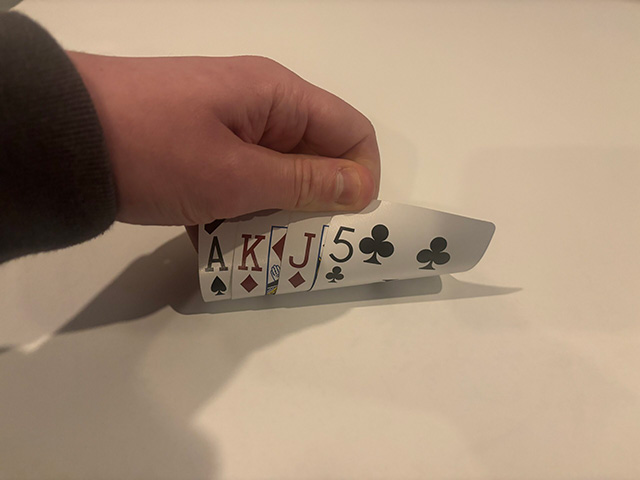
You must use exactly two hole cards and three community cards to make your poker hand in PLO, which is significantly different than in NLH, where you can combine in any way.
What’s even more, the betting in PLO is limited by the size of the pot. You cannot make a bet or raise that’s bigger than the pot size, which means you must always remain aware of the pot size if you want to make the right decisions.
With a few extra elements to think about, Pot Limit Omaha is a significantly more taxing game than No Limit Hold’em, which makes it less ideal for complete beginners.
However, if you have some experience with NLH already, you may be ready to make the transition into PLO without too much trouble.
4. Seven Card Stud
One of the best “old-school” poker games, Seven Card is an easy poker game to learn, although not the most interesting one to play.
I have a lot of respect for Seven Card Stud as a teaching game, even if its heyday has passed. What I find particularly valuable for beginners is the limit betting structure: it removes the pressure of facing an all-in shove with a marginal hand and lets newer players focus purely on learning hand rankings and observation skills in a controlled environment.
The face-up cards also teach you to track what your opponents hold, which is a skill that transfers directly into reading ranges in Texas Hold’em.
Seven Card Stud used to be the most popular poker game in the world before the days of the Poker Boom, which saw Texas Hold’em rise to the surface.
The game is played with each player receiving a total of seven unique cards, three of which remain hidden, while the remaining four are shown to the rest of the table.

Seven Card Stud follows a limited betting structure, which means you can only make bets and raises in predetermined increments (small and big bets).
The limit betting structure makes Seven Card Stud very friendly to novice players who may have a hard time adjusting to the big bets in no-limit games like Texas Hold’em.
Once you have learned the rules of Seven Card Stud, which should not take too long, your real problem will be finding the games to play.
The popularity of Seven Card Stud has diminished significantly in recent years, and you will only find the game spread in some casinos and poker rooms in the United States.
Yet, if you have a nice group of players who enjoy trying new games, Seven Card Stud is a great game to introduce and play, as it does not produce massive swings or huge pots too often.
5. Pineapple Poker
Another variation on the game of Texas Hold’em Poker, Pineapple Poker, is a game that adds a bit of extra flavor to an already fun activity.
If you already know how to play Texas Hold’em, Pineapple Poker will be an easy poker game to pick up, as it only requires you to understand one extra rule.
Pineapple is one of those games I recommend specifically for home game environments where the goal is entertainment while still playing real poker.
In my experience, it generates noticeably more action and table drama than standard Hold’em because everyone is seeing flops with strong hands more frequently. For a beginner who already knows the basics of Hold’em, the extra complexity is minimal and the entertainment value is high.
In Pineapple Poker, you are dealt three hole cards instead of two. Once the flop is dealt, you must discard one of the cards, giving you a chance to land more strong combinations after the flop.
Pineapple Poker is ideal for players who find regular Texas Hold’em games a bit too mundane and who like seeing many flops.
With three cards dealt instead of two, you will get a lot more hands that have at least one playable component, allowing you to play looser if the stakes are not too high.
As a novice poker player, you should focus on playing Pineapple Poker for fun instead of profit, as the game is quite complicated if you want to play it perfectly.
All new poker players should give Pineapple Poker a shot, as it generally creates a lot more entertainment and drama while still being similar enough that you won’t need to learn a whole new skill set.
What Game Should I Play?
My recommendation for most complete beginners is to start with No-Limit Texas Hold’em. After coaching thousands of players at every experience level, the students who develop the strongest foundational skills almost always spent their first months immersed in Hold’em.
The game’s popularity means you will never struggle to find opponents, and the training resources available are unmatched by any other variant.
If you enjoy home games with friends and want something lighter and more casual, Five Card Draw is the easiest game to introduce to a group that has never played poker before. The rules are immediately intuitive, the action is simple, and nobody needs a strategy guide to have a good time.
For players who have a few months of Hold’em experience and want to expand their game, Pot-Limit Omaha is the natural next step. Just do not rush this transition.
PLO requires a genuine reset of how you think about hand values, and the players who make the switch too early often develop bad habits that take a long time to correct.
Whatever game you choose, start at stakes where a bad session costs you nothing more than a small lesson. Building your fundamentals in a low-pressure environment is the fastest path to becoming a consistent, confident player.