

Suited connectors are two consecutive hole cards of the same suit, such as JTs, T9s, or 87s. They can flop straights, flushes, and straight flushes, giving them a draw-heavy equity profile unlike most other starting hand categories in Texas Hold’em.
I have played suited connectors at the highest levels of tournament poker for years, and the mistake I see most often is players treating them as passive calling hands. Suited connectors only become profitable when played with initiative.
Without aggression, you are paying to see flops with hands that rarely make top pair, and you will bleed chips every time you play them that way.
- What Are Suited Connectors?
- How to Play Suited Connectors from Early Position
- How to Play Suited Connectors from Late Position
- How to Play Suited Connectors Against a Raise
- How to Play Suited Connectors on the Flop
- Top 5 Tips for Playing Suited Connectors
- Are Suited Connectors Worth It?
- Suited Connectors FAQs
What Are Suited Connectors?
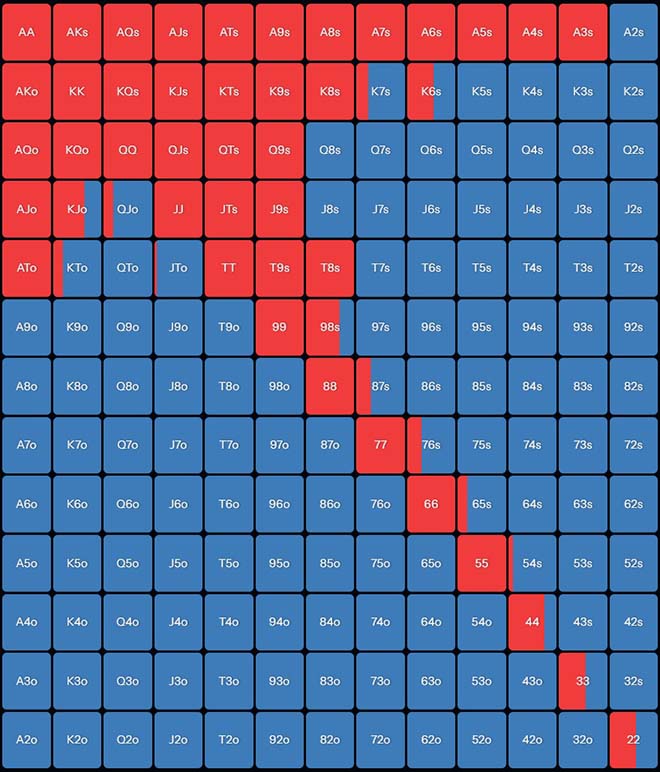
The definition matters more than most players realize. Suited connectors are connected cards of the same suit: T9s, 87s, and 54s qualify.
Hands like T8s or 64s are suited gappers, not suited connectors, and this distinction changes everything about how you should play them.
In my experience coaching players, confusing suited gappers with suited connectors is one of the most common range construction errors I see.
Players who open T8s from UTG the same way they open T9s are playing a significantly looser range than they think.
For example, opening a hand like 98s with a 100bb stack from an early position is acceptable in terms of theory, but opening 97s in the same spot is too loose.
If you take a look at the optimal preflop charts, you will notice that suited connectors are some of the first hands added into various opening and 3-betting ranges, while suited gappers only come into play when the ranges are significantly wider.
Keep in mind that when discussing suited connectors throughout this article, the term refers only to hands with no gaps between the cards. That is a condensed group of combos, and treating wider hands as equivalent is a direct path to playing too loosely.
High vs. Low Suited Connectors
I spent years watching students play 54s in spots where it simply does not work: cold-calling a raise from early position, missing the flop, and paying a continuation bet before folding.
The problem is not that the hand is bad in isolation. The problem is that when 54s makes a pair, it is nearly always the worst pair on the board. When it makes a draw, it is on the low end of draws that can get coolered. High suited connectors do not have these problems at the same frequency.
There are many reasons that high suited connectors are better to play in almost all scenarios than low ones, and this is clearly reflected in the optimal ranges across the board.
When you run suited connectors through PokerCoaching’s solver, PeakGTO, you will see this pattern clearly: higher suited connectors appear in opening, 3-betting, and calling ranges across all positions. Lower suited connectors are either absent or used in narrow, specific spots.
Some of the reasons higher suited connectors are preferred include:
- Higher equity against opponents’ ranges
- Flop top pair more often
- Flop overcards more often
- Flop the high end of straight draws more often
- Flop a bigger flush draw more often
Small suited connectors like 65s or 54s may have the same chance to flop a pair or draw as higher pairs or draws, but the hands they make are much weaker.
For example, 54s has only a 1% chance of flopping top pair. On most boards, flopping a pair with such a hand means very little, as such a pair is rarely the best hand by showdown.
What’s more, straight and flush draws that low suited connectors sometimes make run into higher draws, which can lead to costly coolers.
Higher suited connectors like JTs and T9s, on the other hand, flop top pair a portion of the time and make straights and flushes that can end up being on the winning side of those same coolers.
Low-suited connectors are not very valuable, especially when playing loose and splashy games. They lose much of their fold equity and can put you in difficult situations.
How to Play Suited Connectors from Early Position
The leak I see most often in early position play is students defending small suited connectors because “they were suited.” At 100 big blinds, opening 65s from UTG means you will face 3-bets at a high frequency, and you will have almost no good flop to continue from.
My rule is simple: from early position, play the top of your suited connector range (QJs, JTs, T9s, and 98s at most depths) and fold the rest.
One of the most common mistakes poker players make is that they treat their suited connectors the same, regardless of table position.
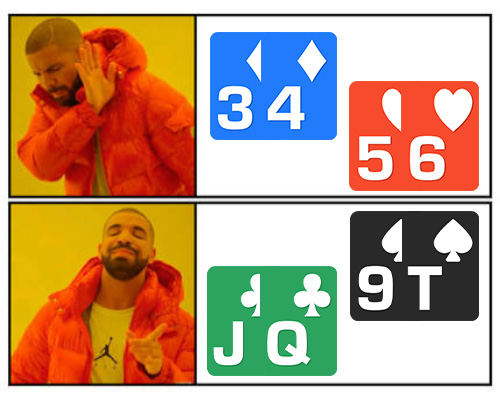
However, there is a significant difference in your ability to play suited connectors profitably from early position versus late position.
In fact, only the best suited connectors are fit to be played from the early position, almost regardless of stack depth and game type.
You will still want to open your QJs, JTs, T9s, and perhaps 98s from UTG and UTG+1 at almost all stack depths, but all lower suited connectors should be discarded.
The chances of getting 3-bet and being forced to fold your hand or play it out of position are too high with baby suited connectors, which is why the safest course of action is to simply fold them and only play when your hand has a reasonable potential to flop top pair, along with all the drawing possibilities.
How to Play Suited Connectors from Late Position
Late position is where suited connectors become genuinely powerful, and it is where I actively look for spots to build pots with them. As your position improves, so do the prospects of playing suited connectors profitably, particularly when you are the first player to enter the pot.
A look at the deeper stack tournament preflop opening charts will show you that the optimal course of action is to raise nearly all suited connectors from the button and very close to all of them from the cutoff and hijack.
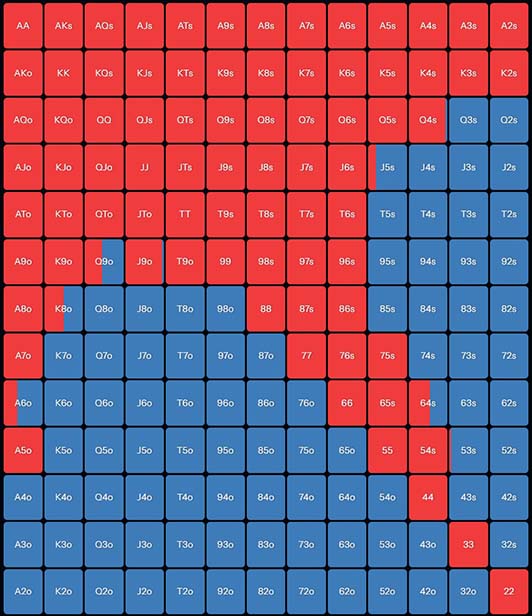
When raising first from a late position, you have a strong chance of winning the blinds outright or getting heads-up with the big blind, both of which are favorable scenarios for your suited connectors.
Even hands as weak as 54s can perform well in these spots. Your preflop raise allows you to represent a big hand on a wide range of flop textures, and you will pick up the pot without a showdown at a meaningful rate.
PokerCoaching’s GTO poker solver, PeakGTO, confirms that suited gappers are also included in late position opening ranges for the same reasons. If you want to see exactly which hands to open from each position and at each stack depth, PeakGTO’s preflop charts are the most practical way to study these spots.
If your cards are suited and reasonably well-connected, they are good enough to open for a raise from the button or the cutoff, as long as you have some chips left behind to work with.
Try PeakGTO for FREE and up your game!
How to Play Suited Connectors Against a Raise
Facing a raise with suited connectors is where most players make their most expensive errors. The decision to call, 3-bet, or fold depends on three variables: your position relative to the raiser, the effective stack depth, and whether you are in a tournament or a cash game.
In my experience coaching players at both live tournaments and online cash games, this is the spot where suited connectors cost the most chips. Players call raises out of position with 76s because “it has good implied odds,” then face a continuation bet on an overcard-heavy board with no hand and no draw.
When you study this decision in PeakGTO, PokerCoaching’s native solver, the difference between tournament and cash game strategy becomes clear. Tournament strategy recommends calling with a wider range of suited connectors against raises because chip conservation means you cannot 3-bet and fold as freely.
Cash game strategy, by contrast, tends to prefer 3-betting or folding most suited connectors, since calling and playing out of position is a losing long-run line.
Low suited connectors such as 65s or 54s are almost always to be folded in cash games, while some of the higher ones like JTs and T9s act as great bluffing candidates in some spots.
Playing from the small blind, cash game strategy recommends only playing T9s+ in terms of suited connectors and always 3-betting when you decide to continue with these hands.
In tournament poker, lower and middling suited connectors can act as good bluffing candidates, while higher suited connectors can be called against early position raises.
The strategy changes completely in the big blind, regardless of the game type, as suited connectors become obligatory continuation bets, with your only decision being whether to call or raise.
For a detailed breakdown of how calling and 3-betting ranges shift based on position and stack depth, studying the preflop charts for your game type is the most efficient next step. PeakGTO has preflop charts covering both tournament and cash game scenarios.
How to Play Suited Connectors on the Flop
Getting to the flop with a suited connector is only the beginning. Most of the decisions that determine whether you profit or leak chips come after the flop.
When you flop a draw
Flopping a flush draw, straight draw, or combo draw with a suited connector is one of the best scenarios in poker. You have equity against made hands, you can semi-bluff to build the pot, and your aggression forces opponents off hands they would otherwise call with on the turn.
My default when flopping a strong draw in position is to bet. This denies equity to hands like top pair, charges draws that are behind you, and sometimes wins the pot outright. Checking your draws to trap is usually a mistake with suited connectors: your equity advantage is real now, and you want to charge opponents to see the next card.
When you flop a pair
High suited connectors like JTs or T9s flop top pair at a meaningful rate. When you do flop a strong pair, treat it like any other top pair hand: bet for value, protect against draws, and reassess on the turn.
Low suited connectors rarely flop useful pairs. If 65s flops a six on a board of J-9-6, you have bottom pair against a board that connects heavily with your opponent’s range. Playing this as a value hand is usually a mistake. In most cases, you are better off folding to continuation bets or taking a free card if the action allows it.
When you completely miss
When your suited connector misses the flop entirely and you face a bet, folding is most often correct. The mistake is continuing as a pure bluff-catcher with no pair and no draw, hoping your opponent also missed. Suited connectors get their edge from semi-bluffing with equity, not from calling with nothing.
If you miss and the action checks through, take the free turn card and reassess. Sometimes a backdoor draw develops, or you pick up a pair that gives you a reason to continue.
Top 5 Tips for Playing Suited Connectors

The sections above cover the major preflop decisions: how to play as the original raiser and what to do against a raise. But there are additional principles that cut across all of these scenarios.
If you want to master suited connectors fully, studying the preflop charts for your game type is the most efficient path. But even before you have those ranges memorized, the five tips below will cover the most important principles and help you make better decisions right away:
Tip #1 – Position Is a Key Factor
Position is crucial in any poker situation, but it becomes even more so when playing suited connectors.
A significant portion of the value of suited connectors comes from their ability to flop draws and implied odds. Both of these things are best utilized in a position.
Playing suited connectors out of position too often will cause you to bleed chips and fall into many uncomfortable situations that you simply can’t make profitable, no matter how hard you try.
For that reason, you should avoid getting too involved with such hands when out of position, and even fold them until you feel comfortable with your ranges and understand how you will proceed postflop on various boards.
Tip #2 – Keep Fold Equity in Mind

Whenever you raise or 3-bet with suited connectors, remember that part of your goal is to leverage your fold equity to get players to fold better hands.
This means it is essential to play suited connectors in spots where your opponents are capable of folding their cards, and this is especially true when you choose to 3-bet.
If you are playing against particularly splashy opponents who don’t like to fold to 3-bets, re-raising with suited connectors makes little sense, as you won’t be able to make them fold, and you won’t have the best hand going to the flop.
If you want to get aggressive with suited connectors, do so against players who are capable of folding a better hand to your raise, as well as those who will not continue enough on the flop.
Tip #3 – High Suited Connectors Are Better Than Low
Making a low straight or trips in a 3-bet pot may sound like the optimal scenario to stack your opponents, but the truth is, it simply doesn’t happen that often.
What’s even more, even when you do make a big hand with low suited connectors, your opponent will often simply not have a big hand and decide to give up on the flop or the turn, and you won’t be getting all of their chips.
Instead of dreaming of the perfect cooler setup where you win all the chips, you should be thinking about how your hand plays over the long term across different boards that could come.
For this reason, high suited connectors with the potential to flop top pairs, overcards, and high straight and flush draws are much better hands to play before the flop.
The next time you look down at 54s UTG in a splashy cash game, fold your cards and wait for a better spot to come along.
Tip #4 – Be Careful Against 3-Bets
Depending on position and stack sizes, you will want to raise at least some suited connectors in almost all situations. However, that does not mean you have to get married to them.
If you face a 3-bet after opening the pot with your suited connectors, it is perfectly acceptable to fold and move on to the next hand.
It can be very tempting to take your suited connectors to the flop against a 3-bettor and try to win a big pot, but the truth is, you won’t get that chance often enough.

Your opponent will usually continue with a c-bet after a preflop 3-bet, and you will not hit the board often enough with your connectors to be able to continue past the flop.
If facing an extremely small re-raise, you may be priced into a call, but unless the stacks are very deep and you know your opponent is extremely likely to pay you off when you make a big hand, try not to get too involved with suited connectors when you face resistance.
Tip #5 – Use Aggression to Increase Your Equity
When you play a pot with suited connectors and get action, you are usually not a favorite against your opponent’s range.
However, by playing your suited connectors aggressively, you will be able to make players fold better cards before the flop and continue to fold their cards on flops and turns even when you don’t improve.
Suited connectors have a high chance of flopping various draws, which makes them just good enough to keep barreling on many flops and turns.
If you are not ready to be aggressive and make those bigger bets on later streets, don’t bother opening suited connectors in the first place, as you simply won’t be able to make a big hand often enough.
Are Suited Connectors Worth It?
Playing suited connectors may seem simple enough, but the truth is, they are one of the most complex hand groups in all of poker.
While you will definitely have to include suited connectors into your ranges across the board, knowing which of them to use in which spots is a whole science in itself.
You will learn how to improve your selection of suited connectors as you advance in your poker strategy, but for the time being, remember that high suited connectors are almost always worth playing, while the lower ones only work when you can maximize your fold equity with them.
If suited connectors sound a bit scary right now, ease into them, play only the best combinations, and expand your range to include weaker ones as your comfort rises. This way, you will learn how to maneuver the streets like the pros.