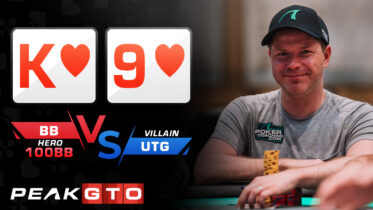
When a tight player raises from early position, most opponents play scared and only continue when they hit. That instinct leaves a fortune on the table. Finding bluffs against a tight range is one of the highest-value skills in poker, because a range full of strong hands is also full of hands that have to fold when the board and the betting tell a scary story. In the hand below, a humble K9s becomes a three-street bluff that forces a nitty opponent to fold.
Today we will analyze a 100 big blind cash game hand where we defend the big blind with K♥9♥ against an under-the-gun open. The flop comes T♣8♦6♠, giving us a gutshot and an overcard, and we check-raise. The turn is the 5♦ and we keep barreling. The river is the Q♠, our draw bricks, and we move all in with king-high. We will walk every street and explain why turning a weak hand into a bluff is the winning play against a tight opener.
Assumptions
- Format: 8-max cash game, 100bb effective stacks
- Positions: Hero is in the big blind (caller, out of position); Villain is under the gun (preflop raiser, in position)
- Hero’s hand: K♥9♥
- Preflop: UTG raises to 3bb, Hero calls in the big blind. Single-raised pot.
- Flop: T♣8♦6♠. Hero checks, UTG bets 2bb, Hero raises to 12.5bb, UTG calls.
- Turn: 5♦. Hero bets 18.9bb, UTG calls.
- River: Q♠. Hero jams all in, UTG folds.
Preflop
We defend the big blind with K♥9♥ against an under-the-gun raise. Because UTG opens a tight, strong range, we defend somewhat carefully, but a suited king is comfortably a call getting this price. The crucial fact to file away is that the opener’s range is loaded with big cards and pairs, which means it will whiff plenty of low, connected boards, exactly the textures where we can apply pressure.
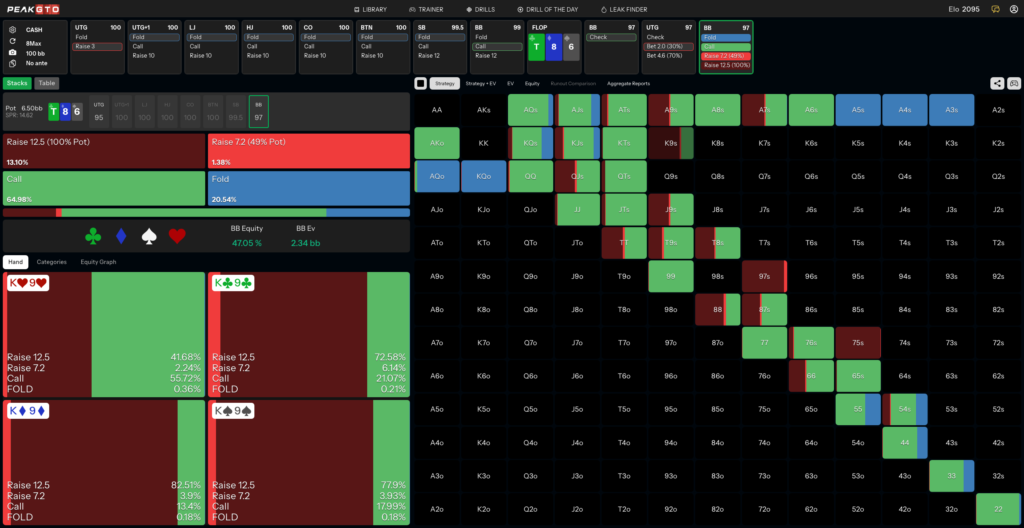
Flop: T♣8♦6♠
On T♣8♦6♠ we hold a gutshot to the seven plus a king overcard, and we check. UTG continuation bets a small 2bb, and now we get to be aggressive. With K9s we should be either calling or check-raising, never folding such a useful hand. We choose the check-raise to 12.5bb, which is about how often the range check-raises in this spot, roughly 15 percent.
The reason this aggression works is range construction. We defend against the continuation bet by check-raising a polarized range here, anchored by all the nut hands the tight opener does not hold, like sets, two pairs, and the rare made straight (97). Because a low board like this hits our wide defending range and misses much of UTG’s high-card range, a gutshot with an overcard is a perfect semi-bluff to pair with those value hands. UTG calls and should almost never re-raise, since we are repping the nuts.
It is worth understanding why we choose the check-raise rather than a call. Calling is fine and keeps our range wide, but raising does two valuable things: it builds a pot now while our nut hands are ahead, and it puts immediate pressure on the parts of the opener’s range that cannot stand heat, like overcards and weak pairs. Forcing those marginal holdings to make a tough decision on the flop, rather than letting them see cheap cards, is how we turn the texture they missed into chips.
Turn: 5♦
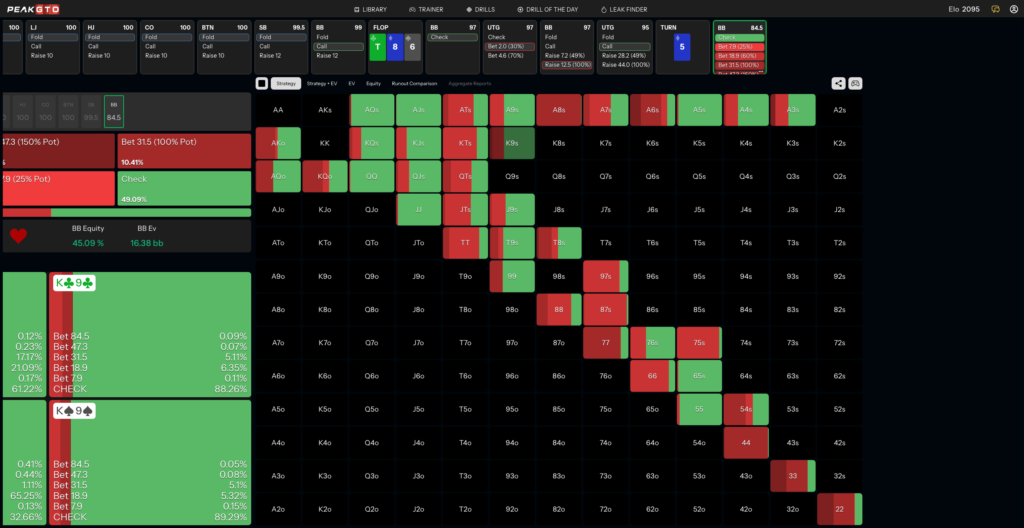
The 5♦ is not a great card for us, but it is a card we keep betting. Whenever the turn fails to help your opponent and your range was polarized on the flop, you continue applying pressure, and here the whole range barrels around half the time. Our K9 stays in as one of those bluffs, with a real gutshot behind it, and we fire 18.9bb. The hands that tend to check are the medium-strength holdings and some of the very strong ones we slow-play, which keeps our betting range polarized into value and bluffs.
The logic of the second barrel is that we are representing a relentless, nutted story while still holding a real gutshot to back it up. We are not bluffing with nothing, we have outs to a straight, and we are charging the opponent’s marginal made hands. Studying which turns favor a second barrel and at what frequency is straightforward inside PeakGTO. UTG calls again, and we head to the river with a decision to make.
It also matters which exact hands keep barreling. The hands with the most equity and the strongest blockers fire most often, but even a plain K9 continues a healthy share of the time. The point is to keep our betting range balanced between value and bluffs so the opponent cannot simply call us down with bluff-catchers. If we only bet our made hands here, a thinking opponent would fold everything weak and snap off our value, so the bluffs are exactly what make the whole line profitable.
River: Q♠
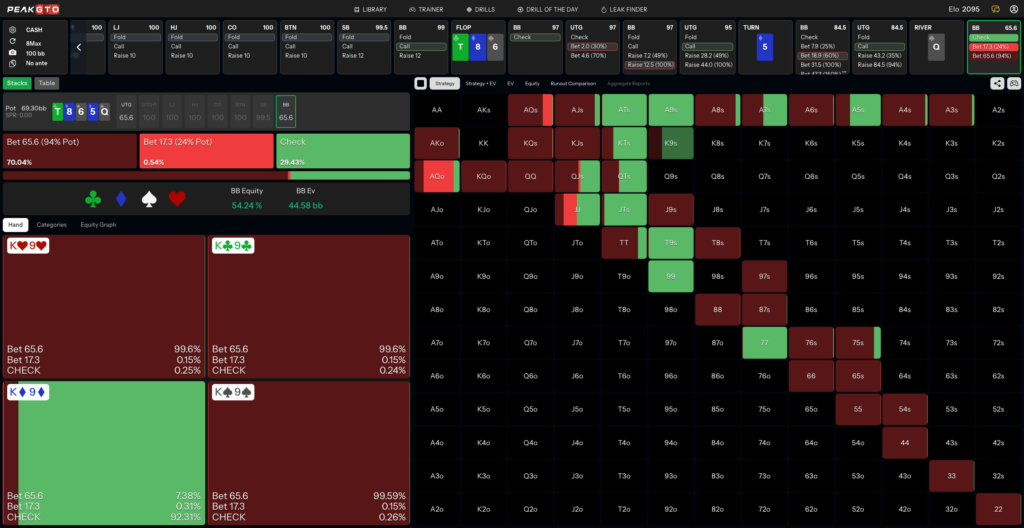
The Q♠ bricks our draw, leaving us with king-high that cannot win at showdown. This is precisely the situation where jamming is the only play that makes sense. We arrive on the river with a strong overall range, full of top pairs, two pairs, and sets that want value, plus a healthy number of bluffs, so a hand that can only win by betting becomes an automatic shove. The whole range jams about 70 percent of the time here.
There is an important blocker note. Our K9s holds no diamond, so it does not block the busted diamond draws the opponent may have given up with, which makes it a perfect always-bluff. If instead we held a K9 with a diamond, we would bluff less, because we would block some of the hands meant to fold. As GTO theory shows, you cannot fire every busted draw on the river, but a non-blocker like this one is a clear jam. Against a tight opener, especially in live cash, this line gets even a hand as strong as a ten or AA to fold, because the check-raise, barrel, and shove scream value. We rip it in, and UTG lets it go.
The exploit against typical opponents is even stronger than the solver’s baseline. A tight player who calls a check-raise and a turn barrel, then faces an all-in on a brick river, has to ask what they can possibly beat. Most of them talk themselves into folding strong one-pair hands and even sets, reasoning that we simply must have it after three streets of aggression. That tendency to over-fold is why over-bluffing this exact line is so profitable in practice, and why king-high, played this way, makes money far more often than it has any right to.
Key Takeaways
- Flop: A tight opener whiffs low, connected boards. Check-raise a polarized range anchored by your nut hands, and add semi-bluffs like a gutshot with an overcard.
- Turn: When the turn misses the opponent and your range is polarized, keep barreling. A gutshot has real outs to back up the pressure.
- River: A busted draw that cannot win at showdown is a prime jam, especially when it blocks none of the opponent’s folding hands. Choose your no-blocker bluffs.
- Overall: Finding bluffs against a tight range means attacking the boards they miss and following through. A nutted-looking line makes even strong hands fold.