When the preflop raiser checks back a paired flop, the big blind inherits a powerful weapon, and probing paired boards well is one of the most underused edges in tournament poker. The check-back tells you the in-position player gave up on a board where you can hold all the trips and the occasional full house they often cannot, which means the turn is yours to attack. The key is building the right kind of betting range and choosing a size that maximizes value when you are strong and fold equity when you are bluffing. This hand shows the whole structure, from flopped trip fours to a river overbet jam, in a 40bb tournament.
Today we will analyze a hand where Hero defends the big blind with J♣4♠, flops trip fours on Q♠4♥4♦, probes the 7♣ turn after the button checks back, and jams the 9♦ river. We will look at why the probing range should be polarized rather than linear, why a big geometric size is correct, and why the river is a maximum-value overbet shove even though it folds out the hands you might wish would call. It is a textbook probing spot of the kind PokerCoaching drills again and again.
Assumptions
- Format: 8-max MTT, 40bb effective stacks
- Positions: Hero is in the big blind (caller, out of position); Villain is on the button (preflop raiser, in position)
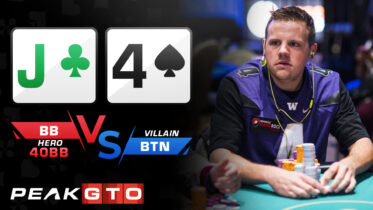
- Hero’s hand: J♣4♠
- Preflop: Button raises, Hero defends the big blind. Single-raised pot of 6.1bb.
- Flop: Q♠4♥4♦ (pot 6.1bb). Hero checks, button checks back.
- Turn: 7♣ (pot 6.1bb). Hero bets pot, button calls.
- River: 9♦ (pot 18.3bb). Hero jams all in, button folds.
Preflop
The button raises and Hero defends the big blind with J♣4♠, a routine call getting a great price. The hand is unremarkable preflop, but the four is about to matter enormously, because pairing the board is exactly the kind of disguised connection that the big blind can have far more often than the button. Hero takes the flop out of position with a hand that is about to flop trips.
Flop: Q♠4♥4♦
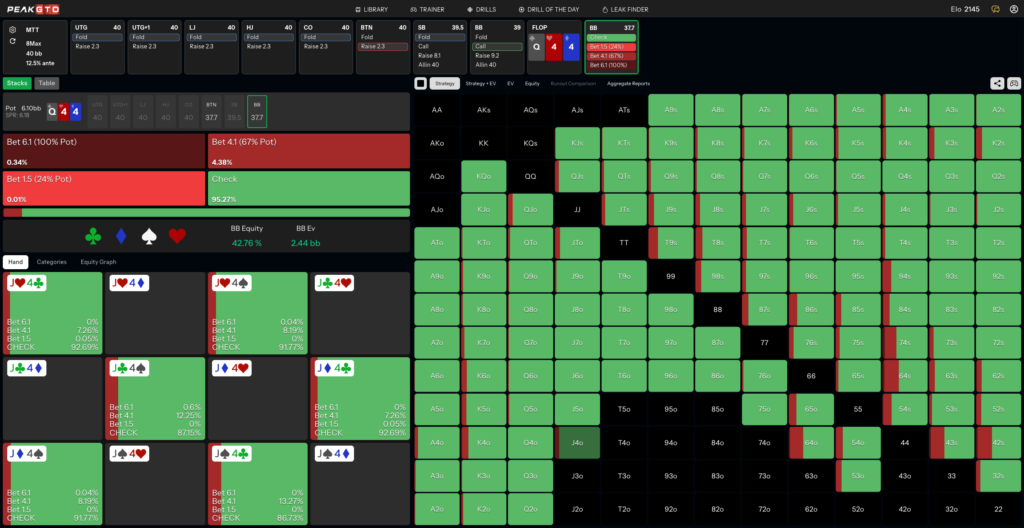
The flop comes Q♠4♥4♦, giving Hero trip fours, and the action checks through. The button declines to fire a continuation bet, which is the moment that creates the probe. A paired, queen-high board is one where the big blind defends all the four-x that makes trips, while the button would usually bet its strong queens and overpairs, so a check-back caps their range and leaves the big blind with a clear claim on the turn. Hero has one of the strongest hands in the big blind’s range and a green light to start betting.
It is worth understanding why paired boards favor the checking-and-calling player so heavily once the flop goes check-check. The button opens a wide range and would normally bet its queens and overpairs on the flop, so when it checks back, it has told you it mostly holds the medium and weak hands that did not want to commit. The big blind, meanwhile, calls preflop with a wide range of suited and offsuit fours, which means it arrives on the turn with a thick slice of trips and the occasional full house that the button can almost never have. Hands like Q4 make fours full of queens, and 44 make quads, holdings the button almost never arrives with. That asymmetry is the engine of the whole probe: you are betting into a range that is structurally weaker than yours and cannot credibly fight back.
Turn: 7♣
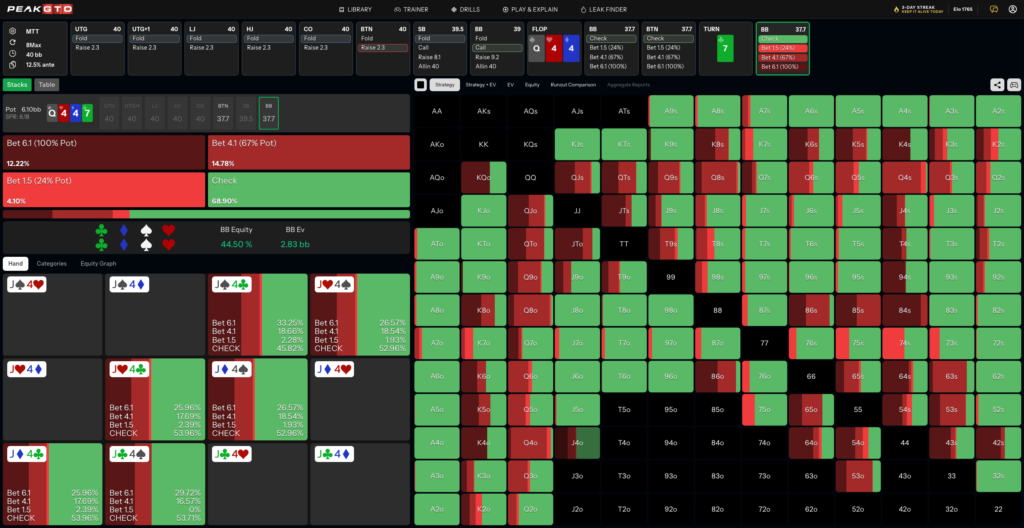
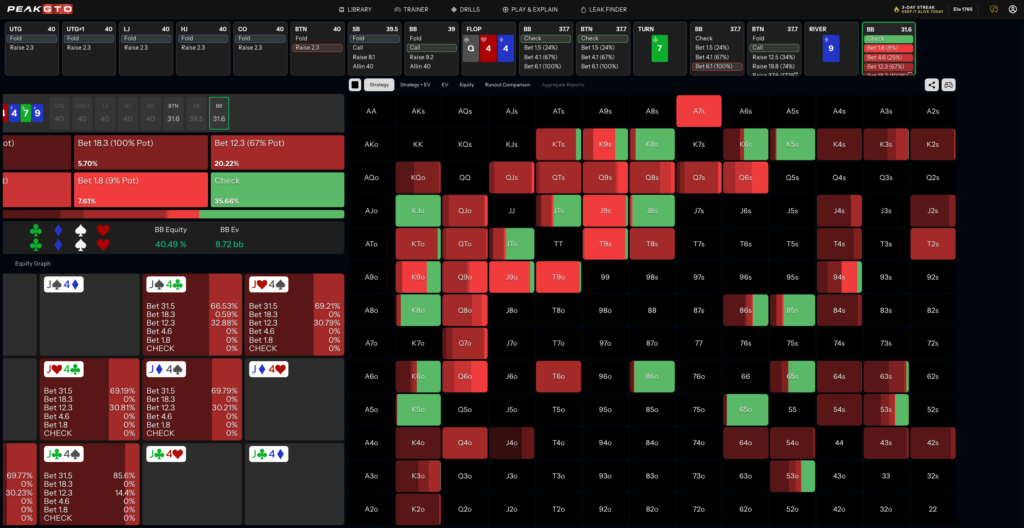
On the 7♣, the first question is whether to build the probing range as polar or linear, and the answer here is polar. You do not want to bet a hand that simply pairs the turn, such as a seven, which makes two pair with the board but cannot stack off, and even much of your queen-x stays back; only the strongest top-pair queens, roughly Q8 or better, bet, because the very weak queens like Q6 only chop against the Q2 holdings still in the pot, since the board’s seven plays as the fifth card for both and kills the kicker, so they check instead of betting. PeakGTO bets a minority of the range, but the hands it does bet want to play for stacks, which is exactly where the trips belong.
The sizing is where most of the value comes from. Rather than mixing many sizes, the cleanest approach is one big geometric bet, the size that divides the remaining stack into equal portions on the turn and river so that the last chip goes in naturally by the end of the hand. At this stack depth that is a large bet, with the ideal geometric size landing around 7.5bb, in the 6 to 9bb range that runs from about pot up to roughly 1.5 times pot. That theoretical target is a bit larger than the pot-sized bet shown in this particular solve. Just as important is what fills out the bluffs: the obvious straight draws like 86 and 65 are easy to find, but a probing range built only from straight draws is predictable, so it needs overcard bluffs with outs against the queen, king-high holdings like K8. In this hand Hero fires a pot-sized probe of 6.1bb, slightly smaller than the full geometric size, and the button calls, continuing with an ace-high hand that is not going anywhere yet.
A few practical points sharpen this. The more chips you have behind, the larger those bets have to be, which is why a deeper effective stack pushes you toward an overbet. The theoretically clean line is an even, geometric sizing of roughly 125 percent on both the turn and the river, so the whole stack goes in across two equal fractions rather than escalating from one street to the next. This particular solve only offered a pot-sized turn bet and an all-in river of about 172 percent, so the executed line ends up uneven, but the principle is to keep the fractions equal, not to ramp them up on purpose. The payoff is that every street keeps the maximum amount of money in play behind your strongest hands, and your opponent never gets a cheap look. Choosing the value hands first, then attaching the bluffs that can comfortably barrel the same way, makes the range coherent across all three streets rather than something you have to improvise.
River: 9♦
The 9♦ completes the board at Q♠4♥4♦7♣9♦, and with trip fours this is a very easy all-in. The previous street put the pot at 18.3bb, and jamming the remaining stack is roughly a 172 percent overbet. Whenever you hold a polarization advantage, strong hands that your opponent rarely has, the best size is almost always the biggest one, and trips anchor that range perfectly. In GTO terms the trips simply shove for maximum value.
Two ideas make this river work. First is the temptation to size down to get called: if your opponent will never call a 172 percent jam, the answer is not to bet smaller with your value, it is to shove every bluff, because a player who folds that often hands you the pot for free. Filter a database and you will often find that the people who insist they never get paid on overbets are not actually jamming their bluffs either, which is why their big bets feel unprofitable. Second is bluff selection. Because all of the straight draws bricked on the nine, the 86 and 65 type hands have to give up, and the only natural bluffs left are the busted king-high probes from the turn, like KQ or K4, which is exactly why you included overcard probes earlier. Hero jams, and the button folds ace-high, unable to continue against a line that screams a full house or trips. The pot odds of calling an overbet with a busted ace are simply not there.
Key Takeaways
- Flop: When the button checks back a paired board, the button’s range is capped, and the big blind earns the right to probe. You can hold all the trips and boats the in-position player gave up on.
- Turn: Build the probe as a polar range, betting the trips and only the strongest queens, with a big geometric size. Round out the bluffs with overcards that have outs, not just straight draws, so you stay unpredictable.
- River: With a polarization advantage, the best size is the biggest one, so trips jam for max value. If the opponent never calls an overbet, shove your bluffs too rather than shrinking your value bets.
- Overall: Probing paired boards turns a checked-through flop into a profit center. Attack the turn with a polar range and the right bluffs, then maximize value on the river by betting big with the hands your opponent cannot have.