

Floating in poker means calling a flop bet with a weak hand, little to no showdown value, and the intention of bluffing on a later street after your opponent slows down. In my experience coaching players, floating is one of the most misunderstood parts of the poker strategy.
Players either avoid it entirely, giving up on far too many winnable pots, or float so loosely that they burn money calling bets with hands that have no meaningful path to winning. Done correctly, floating is a disciplined weapon that takes advantage of opponents who c-bet the flop frequently but surrender the turn when called.
What Is Floating in Poker?
A float is a call made on the flop with a hand that has little or no showdown value, made with the explicit plan of taking the pot on the turn or river after your opponent checks. When I coach students on floating, the first thing I teach them is how to identify the right opponent type.
The float works because many players c-bet the flop automatically, regardless of whether they connected, and then give up on the turn when called. In my experience, any opponent who continues on the turn less than 50 percent of the time after c-betting the flop is a profitable float target, because their tendency to surrender gives you enough turn stealing opportunities to make the flop call profitable with a wide range of hands.
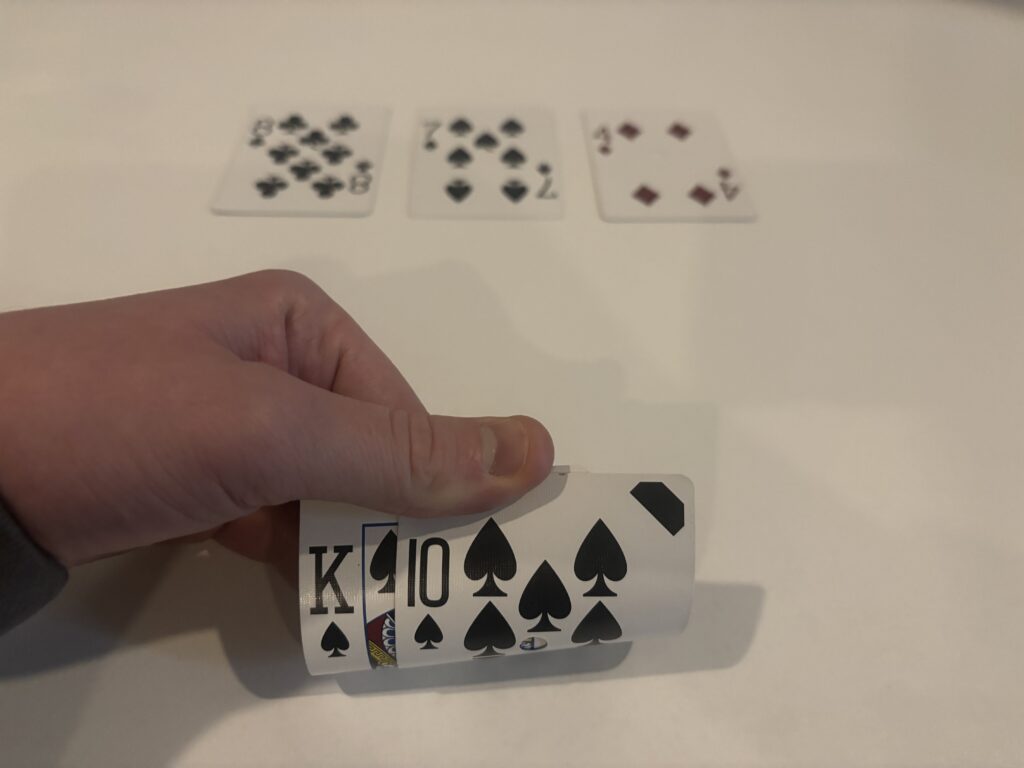
For example, imagine holding K♠T♠ in a single raised pot, in position, against a single opponent on a board of 8♣7♠4♦.
Looking at this board, your hand doesn’t have much going for it, as you have not connected in any meaningful way. Overcards and backdoor draws are all you have.
Yet, by calling your opponent’s continuation bet, you will get a chance to improve to top pair some of the time, as well as turn a number of strong draws that you can use to bluff the turn.
What’s even more, many cards like a 6 or a 5 can change the board and allow you to bluff your opponent off a hand like Ace-high or even some one-pair hands, depending on player type and tendencies.
In very short terms, anytime you decide to call on the flop with a hand that does not have a proper draw yet and has not connected with the board, you are floating.
By introducing floats into your poker game, you will allow yourself more opportunities to win pots that many other players would relinquish to their opponents, and you will make your ranges even more complex for your opponents to read as betting streets go by.
Even when you are sure you are behind,
there are some hands you should float with on certain flops.
When Should I Float in Poker?
Knowing when to float is what separates a disciplined play from a leak. I use six questions with students to evaluate every potential float: Am I in position? Do I have a strong draw already?
FHow does my opponent’s range interact with this board? What backdoor draw opportunities does my hand have? Which turn cards let me bluff? How would I play the nuts in this spot? If the answers push toward floating, I proceed. If the board is dangerous for my range or my opponent has a high likelihood of continuing, I fold and wait for a better opportunity.
When looking for opportunities to float, you should consider the following factors:
- Am I in a position?
- Do I have a strong draw already?
- How does my opponent’s range do on this board?
- What are my backdoor draw opportunities?
- Which turn cards will allow me to bluff?
- How would I play my nuts?
Answers to each of these questions are of critical importance when deciding on whether or not to float against a continuation bet, so let’s look for the kind of answers we want in order to make for a good bluffing opportunity.
Am I in a Position?
Your position is very important when considering floats in poker. While it is possible to float out of position as well, floating in position works a lot better.
The reason, of course, is that being in position allows you to see your opponent’s action on the turn and adjust accordingly.
For the most part, when looking for good floating opportunities, you should be looking for spots when you are in position and facing a bet from your opponent.
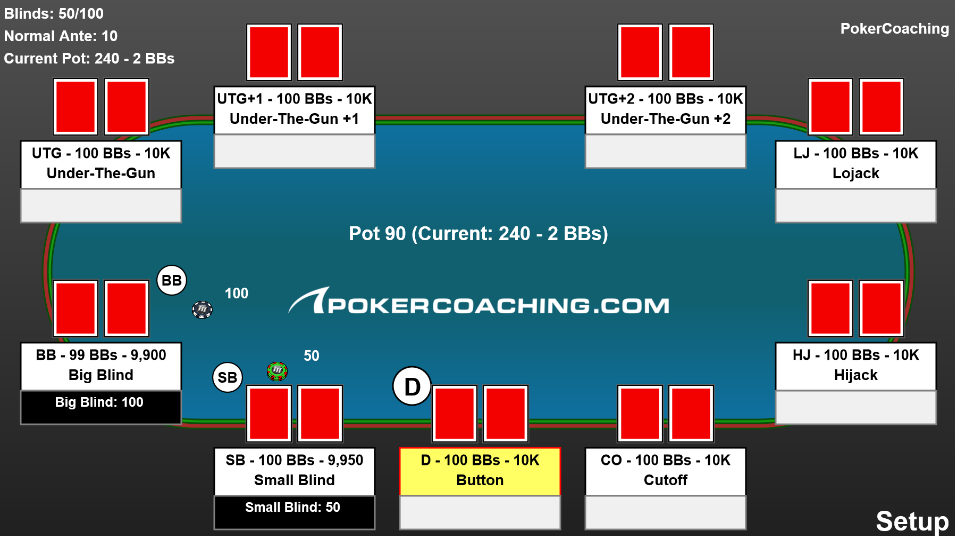
Use this guide to memorize player positions at the poker table!
Do I have a strong draw already?
This is another interesting question to ask yourself when thinking about floating, and the answer you want is no!
If you already have a strong draw, you are not really floating. Your hand has enough equity against your opponent’s range to profitably call or raise already, so floating is not a strategy you will be able to employ.
Instead, ideal hands for floating are hands that have some backdoor potential but have little equity against the strongest parts of your opponent’s range.
How does my opponent’s range do on this board?
The next thing to think about is your opponent’s range and how it interacts with the flop that has been dealt.
The last thing you want to do is to float in situations in which your opponent is likely to have a lot of good hands.
For example, a flop like A♠K♥T♦ is not a good one to float on, as the original opener, and even more so the 3-bettor will have all the very strong hands like AA, KK, TT, QJ, AK, AT, and KT in their range.
So, whenever the flop favors the opponent’s range, and you have not connected with the board, the prudent course of action will be to simply fold your cards, while floating should be reserved for boards that favor your perceived range.
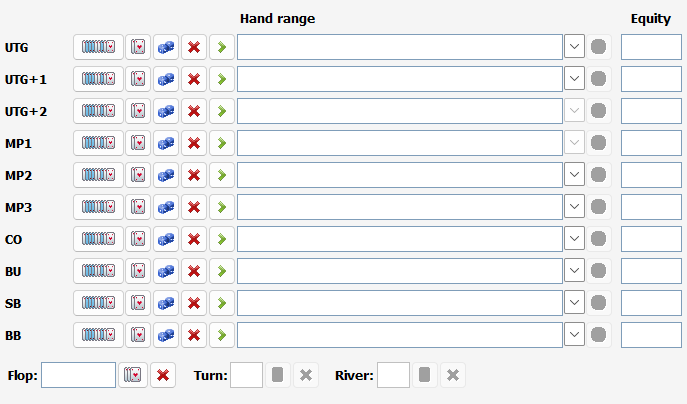
Programs like Equilab can help you practice assigning
opponent’s ranges and evaluating your equity.
What are my backdoor draw opportunities?
It can be very easy for players to get carried away and start floating way too much on boards that appear to favor their range.
However, you don’t want to float with poker hands that have little potential to improve on the turn, as bluffing without equity is not the way true poker masters play the game.
Instead, you should look to float with hands that have a lot of backdoor potential. Backdoor flush draws, backdoor straight draws, and overcards are all great floating candidates.
Ideally, you want to have a hand that has at least one overcard and at least one draw on the board in order to float.
For example, on a board of T♥8♠6♦, hands like A♠J♠, K♥7♥, or even just A♦5♦ are all solid candidates to float the flop bet, while a hand like K♣4♣ is not really the kind of floating candidate you are looking for.
Which turn cards will allow me to bluff?
Another great question to ask yourself when considering a float is which turn cards will let you bluff if your opponent checks the turn.
On dynamic boards with low and middling cards, there will often be plenty of scare cards that your opponent will not want to see if they are holding a range made up of a lot of strong hands.
As the aggressor, your opponent will always have more hands like AK, AQ, AJ, and AA-TT, so you will want to float on lower boards that allow you to have many straights, two pairs, and trips.
You should factor all the scare cards into your decision and proceed with a float when it is reasonably likely your opponent will have a difficult time playing the turn.
Don’t be afraid to bluff aggressively when the turn favors your range.
(Photo courtesy of Katerina Lukina)
How would I play my nuts?
Finally, ask yourself, “What would I do if I had the nuts here? “What if I flopped a straight or a set? How would I play that hand? “
In many cases, the answer will be that you would flat-call the flop and allow your opponent to potentially improve on the turn or keep on bluffing into you.
So, when you float the flop, your turn bets and raises will appear as if you could potentially have one of the strongest possible hands on the given board, which is another reason floats work so well in so many situations.
Executing a Float: Turn Bet, Turn Raise, and Double Float
The float itself is just the setup. Where the real decision-making happens is on the turn. In my experience, most of the value from floating comes from reading your opponent’s turn action correctly and choosing the right response.
When your opponent checks to you on the turn, that check is usually a white flag from a player who c-bet the flop with air. The correct move is to bet, and the bet size does not need to be large. A bet of 50 to 60 percent of the pot on the turn is typically enough to take down the hand against a player who was bluffing the flop.
The first scenario following a float is one in which your opponent checks the turn, allowing you to make a bet and potentially win the pot outright.
In many cases, players will c-bet the flop with a hand like AQ that’s completely missed the board and then check/fold the turn when another bad card for them comes.
For example, on a board of 8♠7♥4♥, your opponent may decide to c-bet the flop with their AK or AQ. When the 5♣ rolls off on the turn, most players will check to you and then fold.
In such situations, your turn bet size does not even need to be that big to get your opponent to fold, which is another great advantage of a float.
If your opponent decides to bet again on the turn, you have the option to raise the turn if you picked up additional equity or if the card that came off on the turn is one that particularly benefits your range.
Your exact hand won’t matter too much when you do this, although you always prefer to have a hand that can actually get there on the river.
This is why turned straight draws and flush draws make for ideal raising candidates on the turn, as they have the ability to make a very strong hand on the river if called.
Finally, the option of a double float opens up in some situations as well, allowing you to call the turn bet as well and represent a very strong hand by betting the river when checked.
When double floating in Texas Hold’em, you should remember to have at least some equity to lean back on and be able to make the nuts or close to it on at least a few cards. On the other hand, you are also going to fire many bluff bets on the river if checked to, and your line will look very strong to your opponents.
By mixing between betting turn and raising turn when bet into, and double floating on occasion, you will make yourself incredibly unpredictable and hard to play against, which is exactly what you are aiming for when playing poker against competent opponents.
Think you’re ready to move up stakes? Let Lee Jones tell you the signs to look for!
When to Give Up On Your Floats
One of the most important disciplines in floating is recognizing when to abandon the play entirely. I see students make this mistake constantly: they float the flop with a reasonable plan, but then when the turn produces a bad card and the opponent bets again, they call again out of stubbornness rather than strategy. Calling two streets with no equity and no plan is not floating. It is just losing money in two installments.
In some scenarios, you are going to float the flop, the turn will produce a card that’s better for your opponent’s range than yours, and they will continue to bet. In such situations, giving up is the way to go.
For example, let us imagine you floated the flop on a 7♠6♥6♦ flop with J♠T♠. The turn is the A♥, and your opponent fires a bet into you. At this point, doing anything other than giving up would be a big mistake, as your opponent can have all the very strong hands, and their range is much stronger than yours.
Start Introducing Floats in Your Game
Every strong poker player uses floating as a routine part of their game, but it takes time to calibrate correctly. My recommendation to students just starting to add floats is this: start with one clear situation.
Pick a player at your table who you know gives up on the turn frequently, wait for a spot where you have position and at least one backdoor draw, and execute the float with a specific plan for the turn. Do not float in general. Float that opponent in that spot.
As you grow more comfortable with the mechanics, you can expand to more complex situations: floating out of position, planning double floats, and raising the turn when improved equity warrants it. But the foundation is always the same: play within your bankroll and have a plan for the next street before you call.
Floating Out of Position
In-position floating is the baseline. However, floating out of position is also possible in the right spots, and understanding when to do it will make you significantly harder to play against from the blinds.
The most common spot for an out-of-position float is when you call a preflop raise from the big blind and the flop comes low and disconnected, a board like 7-6-3 or 9-5-2. These boards connect poorly with the opener’s preflop range, which is weighted toward Broadway hands, high pocket pairs, and big suited aces. Conversely, your big blind calling range contains many suited connectors and low pairs that can represent a wide variety of made hands and draws on this texture.
When a player c-bets into you on a board like this, calling with hands like ace-high backdoor flush draws and king-high with a backdoor straight draw allows you to represent a much stronger range on the turn and river. What I tell students in this spot is simple: check almost every time on the turn after you float the flop out of position, just as you would with your strongest made hands.
If your opponent checks back, you have a clean stealing opportunity on the river. If they fire again, you can evaluate your equity and either give up or apply pressure with a check-raise on boards where your range is credible.
The key constraint is to avoid leading out on the turn after floating the flop out of position. Donk-betting the turn removes the information advantage you built by calling the flop and makes your range transparent. Check first, read the turn action, and then decide.