
Omaha Hi-Lo is a split-pot poker variant where players use exactly two of their four hole cards and three community cards to build two separate hands: the best high hand and the best low hand, both competing for half the pot.
I have spent years coaching players who are new to split-pot games, and the biggest adjustment they need to make coming from Hold’em or regular Omaha is understanding that scooping (winning both sides simultaneously) is where the real money is made.
A hand that only wins one side of the pot often earns you very little after the other half is paid out. Learning which starting hands give you a realistic path to both sides is the most important skill in Omaha Hi-Lo.
If you have only ever played Texas Hold’em Poker before, jumping straight into PLO 8 may be a bit of a challenge, but if you have played the classic PLO game, you should not have too much trouble adjusting to the nuances of PLO Hi/Lo.
In both cases, it is worth looking over the rules of Omaha Hi/Lo from the ground up and making sure that you are not missing anything before you play.
In this guide to PLO 8 rules, we are going to cover everything from the basics of card dealing in the game to the way pots get split between high and low hands in this exciting poker variation, so let’s start at the very beginning.

Basics Rules of Omaha Hi/Lo Poker
Before we jump into any of the more intricate PLO Hi/Lo rules, it is important to understand the poker basics, so we will start by explaining how the game is played and what your objective is.
The game of PLO 8 is played with a standard card deck of 52 cards and anywhere between two and nine players at the table.
At the start of each hand, all players are dealt four hole cards face down, with a further five community cards dealt across the table in three separate dealing “streets” called flop, turn, and river.
In all PLO games, players must use exactly two hole cards and three community cards to make up the best five card hand.
However, in PLO 8, you are allowed to use a different combination of hole and community cards for your Hi and your Lo hand as long as you can find the appropriate combinations from the cards at your disposal.
We are going to demonstrate how you can build your Hi and Lo hand in the same PLO 8 hand using different cards in an example later on, but for the time being, let’s go over the betting rounds and your playing options on each of the betting streets in the game.

Poker greats like Daniel Negreanu work to master all poker games, including Omaha Hi/Lo.
Best Omaha Hi-Lo Starting Hands
In my experience coaching PLO8 players, the most consistent mistake I see at lower stakes is playing hands that can only win one side of the pot. The hands that win the most money in PLO8 are those with a realistic path to both the high and the low. Here is how I categorize starting hands:
| Hand Category | Example Hands | Why It Works |
|---|---|---|
| Scoop candidates (strongest) | A-A-2-3, A-A-2-4, A-K-2-3 (double-suited preferred) | Pairs or sets for high; A-2 for nut low draw |
| Strong high-focused | A-A-K-K, A-A-Q-Q (double-suited) | Dominant high hands; low side is secondary |
| Strong low-focused | A-2-3-4, A-2-3-5 | Build toward nut low; most profitable in multiway pots |
| Weak for PLO8 | K-K-J-T (no low cards) | Can only contest the high half; leaves money on the table |
The rule of thumb I teach every new PLO8 student is this: do not play without an ace in your hand. An ace works double duty as the strongest possible low card and a premium high card in made hands. Hands without an ace are far less flexible and far more likely to lose a full half of the pot before the hand even reaches showdown.
Double-suited hands (where two pairs of hole cards share suits) are significantly stronger than rainbow hands of the same rank because they carry flush draw equity in addition to their high and low potential. A hand like A♥2♥K♦3♦ is stronger than A♥2♦K♣3♠ for exactly this reason.
PLO 8 Betting Streets
Before a game of PLO 8 can start, the dealer must pick one player to assign to the dealer button. Once this is done, the players to their left post the small blind and big blind, the two forced bets that drive all further action.
Once the blinds are posted, the dealer deals out four hole cards to each player, which remain hidden for the remainder of the hand.
PLO Hi/Lo rules then dictate that each player at the table is allowed to act on their hand, starting with the player to the left of the big blind and ending with the big blind.
In total, there are four betting streets in PLO 8, and players get to act on their hands on each of these. The PLO 8 betting streets are:
- Preflop: First betting street played after the players receive their hole cards. Players can fold their cards, call the value of the blind, or raise the bet. The maximum bet and raise size depends on the betting limit in play (Omaha 8 can be played as a limit, pot-limit, or no-limit game).
- Flop: After the dealer deals the first three community cards called “the flop,” players get to act on their hands again. Players can check, giving action to the next player, make a bet up to the size of the pot, or raise any existing bet.
- Turn: The fourth community card is dealt, and once again, all players at the table get to act on their hands. On flop, turn, and river, the action starts from the small blind and ends with the dealer button.
- River: The final fifth community card is dealt, and there is no more dealing. Players take one last turn acting on their hand in the same manner as they would on flop or turn.
Once all the betting is done and the bets have been settled, the dealer announces the showdown, with players taking turns showing their hands. The last player who made aggressive action on the river is required to show their hand first.
The dealer will compare hands and look for both hi and lo hands. If at least one player qualifies for the lo, the pot will be split into two. If no one qualifies for the lo, the best high hand will win the entire pot.
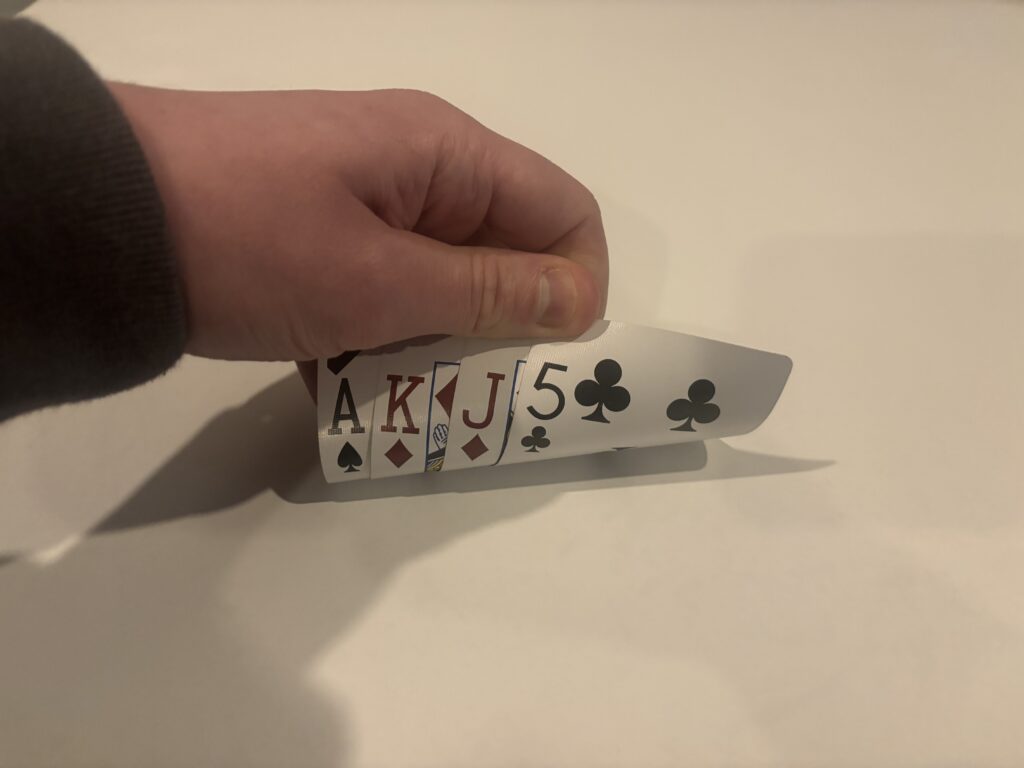
The main difference between Omaha Hi/Lo and Hold’em is the number of cards you are dealt.
Player Actions in Omaha Hi/Lo
With each betting street in Omaha 8, players get to act on their hands in a number of different ways. While comparing hands at showdown is one part of Omaha Hi/Lo poker, the actions that precede showdown give room for poker players of all types to demonstrate their skills.
In order to be able to play Omaha 8, you will first need to understand all the different betting options you get to take in hand. So, here is a quick look at every option you have and a short description of how and when you can use it:
- Fold: This option allows you to throw away your hole cards and exit the hand. Once you have folded, you will not be given any further options and will not have a chance to win the pot.
- Bet: If there is no active bet in front of you, you may decide to bet. The minimum bet size depends on the betting limit. In limit Omaha 8, you will be able to bet one bet at a time, while in PLO 8 or NLO 8, you will be able to bet up to the size of the pot or up to the size of your entire stack, respectively.
- Raise: If there is an existing bet in front of you, you may decide to raise the size of the bet. In Limit Omaha 8, you will have to raise one bet at a time. In PLO 8 and NLO 8, you will be able to raise up to the size of the pot or up to the size of your stack respectively.
- Check: If there is no active bet in front of you, you may decide to check, passing the action to the next active player and not making any bets.
- Call: If there is an active bet or a raise in front of you, you may decide to call the bet. To call, you will need to match the size of the bet, and you will close the action if you are the last player to act.
- All In: If you make a bet or raise of sufficient size, you will be considered “all in.” You are all in when you have no more chips to make bets or call bets with. In such a case, your hand will always be active at showdown, but you will not be able to make further bets or play for any further chips that other players put into the pot subsequently.
Note that the order in which players take action on their hand in different Omaha 8 formats does not change, but the betting limit can.
Limit Omaha Hi/Lo uses preset betting limits that players have to use on each street. In this case, you can only make a fixed bet and raise this bet up to three times, in increments of one bet at a time.
In Pot Limit Omaha Hi/Lo, you will always be allowed to make bets or raises up to the size of the pot. So, if there is $100 in the pot, you will be able to bet $100. The next player, should they decide to raise, will be able to raise it up to $400, which is the size of the pot following your bet.
In No Limit Omaha Hi/Lo, there is no limit to the size of your bet. The only limiting factor, in this case, is the amount of chips you have on the table, as table stakes are the norm in modern day poker games.

Before putting your whole stack at risk,
make sure you have a hand that can win the Hi and the Lo.
Determining the Lo Hand in Omaha Hi/Lo
The lo-hand rules in PLO8 trip up more beginners than any other part of the game. The key rule to memorize is this: a qualifying low hand requires five different unpaired cards ranked 8 or lower, and you must use exactly two from your hole cards and three from the board.
Straights and flushes do not count against your low hand, which is why the wheel (A-2-3-4-5) is the nut low AND a straight at the same time. In my coaching sessions, I make students repeat that sentence until it is automatic, because missing a low qualification or misreading a low hand is an expensive mistake that happens far too often at the table.
One more thing I emphasize with every new PLO8 student: when there are only two low cards on the flop, you do not yet have a qualifying low hand.
You have a low draw. A low is not made until five different qualifying cards are confirmed across your hole cards and the board. Playing as though a partial draw is a made low is one of the fastest ways to miscount the pot.
For the HI portion of the pot, the game uses typical poker hand rankings, with hands like royal flushes, straight flushes, and four of a kind being the best. If you are not familiar with these, you can check out our guide to Pot Limit Omaha poker and find the exact hand rankings there.
For the lo portion of the pot, however, the game uses the Ace to Five hand rankings, which are not used in too many games these days and which take some getting used to.
For starters, you need to understand that only cards 8 or lower count towards the lo, and any higher card can never be part of the lo hand.
This means that you will need at least three unpaired community cards to be 8 or lower for lo to even be possible, as each Omaha hand must use three community cards and two hole cards.
Furthermore, you will need at least two hole cards to be 8 or lower, and those cards cannot be paired with the board cards, as pairs don’t count for a low.
If you do have a five card combination that qualifies for a lo (straights and flushes don’t matter), your hand will be compared against other lo hands.
The two hands will be compared from the highest card down, with the player whose highest card is lower always winning.
For instance, if you have 7♥6♣5♦4♣3♥, you will win against 8♦5♣4♥3♦2♠, as your 7 lo beats your opponent’s 8 lo regardless of the other cards.
If the highest card in two Lo hands is the same, the next highest card is compared until one player has a lower card and wins.

Have you seen my list of the Top Ten Poker Players To Watch in 2024!?
Omaha Hi-Lo in Action: A Hand Where Scooping Was the Plan from the Start
Here is a hand from a $2/$5 PLO8 cash game that illustrates why starting hand selection matters so much in this game.
I held A♥2♦K♣K♠, a hand built to attack both sides of the pot. My kings were the dominant high-hand candidate, and my A-2 combination gave me the best possible low draw on any board with three low cards below 9.
The flop came K♦5♠3♥. I flopped top set (three kings) for the high side and a strong low draw: A-2 combined with the board cards 5 and 3, needing one more low card to complete. I bet two-thirds of the pot. One player called.
The turn was 6♣. My low completed: A-2-3-5-6, which was the nut low on this board (no 4 on the board meant no wheel was possible). My three kings remained the best high hand available. I made a pot-sized bet on the turn. My opponent called again.
The river fell J♠. I scooped the entire pot, winning the high side with trip kings and the low side with A-2-3-5-6.
That hand shows the PLO8 blueprint: enter with a hand that threatens both sides from the first card dealt, charge the draws when you are ahead, and collect the full pot when the board cooperates. The starting hand made the scoop possible long before the river.
3 Key Omaha Hi-Lo Strategy Rules
After reviewing hundreds of PLO8 hands from students at all stake levels, I see the same three mistakes costing them money repeatedly.
1. Playing hands that cannot scoop. If your starting hand can only realistically win one side of the pot, you need multiway action and perfect runouts to profit. I fold far more single-directional hands in PLO8 than most players do, because even when you win, you often earn very little after the pot splits. A hand that scoops once earns you what a pot-splitting hand earns over two or three pots. That difference compounds quickly over a session.
2. Overvaluing a non-nut low. When the board has three or four low cards and multiple players are in the hand, a weak low like an 8-7 low is often drawing dead against someone holding A-2. I have seen players call large river bets with a qualifying low, only to discover their half of the pot was already claimed by the nut low. Before calling a large bet on the river, always ask yourself: is my low likely to be the best low, or am I about to be quartered by a player with A-2?
3. Ignoring the high side on low-heavy boards. With several low cards on the board, the high side of the pot often goes to the best made hand available rather than a premium holding. I have won the high side in PLO8 with nothing better than two pair many times, because every other player was focused entirely on the low. Do not abandon the high side just because the board looks low-heavy. Two pair or even top pair with top kicker can scoop the high when opponents are all chasing lows.
Omaha Hi-Lo Frequently Asked Questions
What is the low hand qualifier in Omaha Hi-Lo?
A qualifying low hand requires five different unpaired cards ranked 8 or lower. You must use exactly two cards from your hole cards and three cards from the board. If no player holds a qualifying low hand by showdown, the high hand wins the entire pot.
What is the best starting hand in Omaha Hi-Lo?
A-A-2-3 double-suited is the strongest starting hand in PLO8. It gives you a premium pair for the high side, the nut low draw with A-2, and two flush draws for additional equity. Hands built around A-A-2-x or A-2-K-K are the most consistent money-makers in my experience, because they can attack both sides of the pot from the first card.
What is the wheel in Omaha Hi-Lo?
The wheel is A-2-3-4-5, the best possible low hand in Omaha Hi-Lo. It cannot be beaten for the low side of the pot. The wheel is also a straight, which means a player holding the wheel can simultaneously win both the low (A-2-3-4-5 as the nut low) and the high (A-2-3-4-5 as a straight) in the right situation.
Can you win both the high and low pots in Omaha Hi-Lo?
Yes. Winning both halves of the pot is called scooping, and it is the most profitable outcome in PLO8. When a player holds both the best high hand and the best qualifying low hand at showdown, they collect the entire pot rather than splitting it. Starting hands that can realistically scoop, such as A-A-2-3 or A-K-2-3, are far more valuable than hands that can only contest one side.
What happens if there is no qualifying low hand?
If no player holds five unpaired cards ranked 8 or lower at showdown, there is no low hand awarded. The entire pot goes to the player with the best high hand. This outcome is common on boards with fewer than three low cards (8 or below) by the river.
Is Omaha Hi-Lo played with pot-limit or fixed-limit betting?
Both formats are common. Pot-Limit Omaha Hi-Lo (PLO8) is the most popular format online and in many card rooms. Fixed-Limit Omaha Hi-Lo (Limit O8) is the traditional format and is frequently spread in live casino mixed games. The rules for hand construction and the low qualifier are identical in both formats; only the betting structure differs.