Most players approach hand reading the wrong way. They try to put their opponent on one specific hand, decide that is probably what they have, and play accordingly. The problem is that they are wrong most of the time, and the mistakes add up over thousands of hands.
The better approach is to think in ranges. Instead of deciding your opponent has ace-king, you build a picture of all the hands they could plausibly hold given how they have played. That range narrows as the hand progresses and more information becomes available.
In this guide, I want to walk through how Texas Hold’em players think at different levels, why range thinking separates the good from the excellent, and the practical steps to start building more accurate ranges at the table.

Why Putting an Opponent on a Specific Hand Fails
There are many hands an opponent could hold in any given spot. If you commit to one, you are making decisions based on information you do not actually have. Even when your read feels strong, there are almost always multiple holdings that explain the same sequence of actions.
Good players know this. Instead of locking onto one hand, they build a probability-weighted picture of what the opponent is likely to hold. That picture gets updated street by street as new information arrives. The range narrows the more the opponent acts.
The result is that decisions are based on how your hand performs against the range as a whole, not against one imagined holding. That is a fundamentally more accurate way to play.
The Five Player Types and How They Actually Think
Before you can build a reliable range for an opponent, you need to understand how that player thinks about the game. The category they fall into shapes everything.
Beginners
Beginning players barely know the rules. They make unusual plays for no logical reason and will sometimes show up with random holdings that follow no pattern. Trying to assign them a sensible range does not work because there is no underlying logic to replicate. The best approach against these players is simple: play poker hands that are better than average and let the cards do the work. There is no edge in overanalyzing what they are doing.
One thing to watch for: some beginners limp with premium hands because they want to see the flop before committing chips. They rise with nothing, and they limp with aces. If a tight-looking beginner limps from an early position, their range may actually be stronger than it appears.
Amateur players
Amateur players are the most common type you will face in small-stakes games. They can have been playing for years and still think almost entirely about their own cards. They look at their hand, decide if it is good, and play it or fold it. What you are holding does not factor into their decisions much. These players often develop a personal system and stick to it regardless of context.
Decent players
Decent players are capable of thinking about what you might have. They try to put you on a hand. The problem is that guessing one specific holding is still the wrong framework. They are thinking, which makes them more dangerous than amateurs, but they are thinking in an imprecise way.
Strong players
Strong players think in ranges. They ask what range of hands you could have given your position, preflop action, and bet sizing. That broader thinking lets them make much more accurate decisions.
Excellent players
Excellent players take it one step further. They think about what their own range looks like from your perspective, how the two ranges interact on the board, and what that means for both players’ strategies. They are aware not just of your range but of the picture they are projecting.
How to Spot Which Type You Are Playing Against
Categorizing opponents does not require many hands. Clear signals appear quickly.
At a live table, watch how players handle their chips. Beginners fumble, stack unevenly, and play without confidence. Listen to the words they use. Players who do not know the difference between a set and trips, or who ask whether they won at showdown, are almost certainly beginners. Amateurs tend to play predictably and with little awareness of what is happening around them at the table.
Online, bet sizing patterns are very reliable. A player who raises preflop and then bets one big blind on every street has no framework for what they are doing. If you use a HUD, a very high VPIP combined with almost no preflop raises, something like 50% VPIP and 3% PFR, is a strong signal of a player who limps almost everything and raises only the very strongest hands.
Knowing which category your opponent falls into is the starting point. It determines how much logic you can read into their actions.
Range Advantage: Reading the Board Through Both Ranges
Once you are thinking in ranges, the next concept that transforms how you play is range advantage.
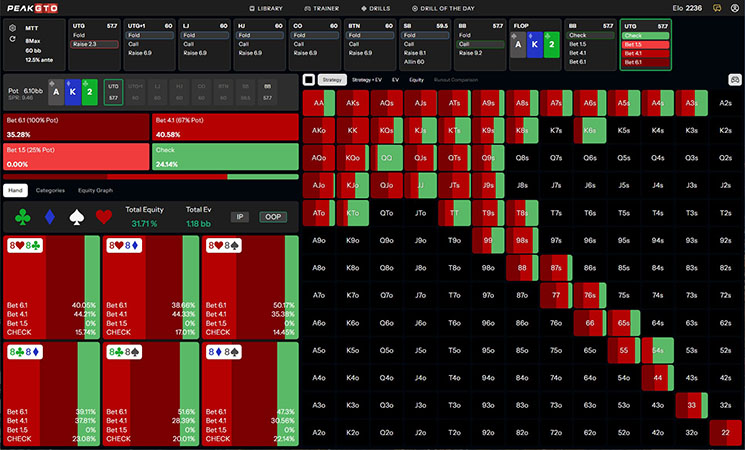
Range advantage means asking which player benefits more from a board texture based on both players’ realistic ranges entering the flop. In my experience, this is the concept most players skip entirely. They look at the board and evaluate their own hand strength without asking how the texture fits what their opponent is likely to hold.
Here is a clear example. A player opens from an early position and gets a caller in the big blind. The flop comes nine-eight-seven. The opener has a tight range construction because they raised from an early position: mostly premium pairs, big ace hands, maybe some broadways. Their absolute best hand on this board is an overpair. The big blind defended, which means their range includes sets, two pairs, straights, and a wide variety of connected hands that fit this board perfectly.
On that board, the big blind has a huge range advantage. Strong players recognize this and check-raise at high frequency because the texture fits their range so much better than the opener’s. They do not even need a great specific hand to apply this pressure effectively.
Asking whose range fits the board better, rather than just how your hand looks, is what turns range reading from a passive tool into an active strategic weapon.
How to Adjust Your Strategy Once You Have Built the Range
Identifying the range is only useful if you act on it. Here is how range reading changes specific decisions at the table.
Bet sizing against beginners and amateurs.
These players are largely unaware of what your bet sizing signals. They do not track whether you bet larger or smaller in different spots. Against them, there is no benefit to balanced sizing. Bet larger with strong value hands and smaller when bluffing. Sizing for maximum extraction is straightforward when the opponent is not adjusting to your patterns.
3-betting and building pots.
Against amateurs who only think about their own hand, 3-betting for value is often very profitable. They are not folding based on their position in a range. They are calling based on whether they personally like their cards. That means you can build bigger pots with strong holdings and expect to get paid more often.
Folding decisions against thinking players.
When a strong player bets into a multiway pot on a dangerous board, their range is tighter than a beginner’s would be. Folding is more justified because you are not continuing against a range loaded with random junk. The stronger the player, the more credible their aggressive lines are.
Using preflop charts as a baseline.
Charts show you what a logical player’s range looks like from each position at different stack depths. When you know what a thinking player should be opening from under the gun, you can start to narrow what they are likely to hold on various board textures. Charts are not the complete picture, but they are the foundation that makes range building possible.
Conclusion
Putting your opponent on a range starts with one question: how does this player think about poker? The answer shapes what ranges are realistic and how much logic you can extract from their actions.
From there, the process is the same on every street: take the range, filter it through what the board and their actions suggest, and make your decision based on how your hand performs against what remains. Players who do this consistently make better decisions even in ambiguous spots.
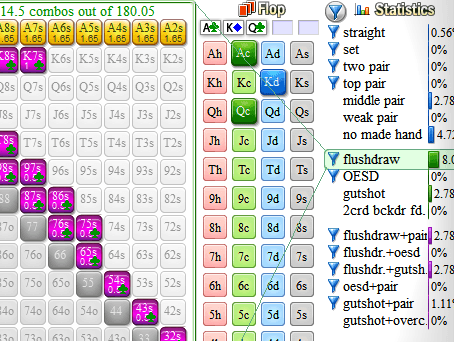
Go deeper than category labels. Study the actual hand combinations within a range. Knowing that an early position raiser holds roughly 16 combos of aces and kings combined, versus many more combos of weaker holdings, gives you far more precision than a vague sense of “they probably have something good.” The math behind the range is where real accuracy lives.