KK feels like a hand you can never fold, and on most boards that instinct is correct. But an overpair on a paired board is one of the great traps in tournament poker. The moment the board pairs, a huge chunk of your opponent’s continuing range turns into trips, and your beautiful overpair is, by the river, only mediocre two pair. The skill is not in betting these hands, it is in knowing when the story your opponent tells leaves your kings as a clear underdog.
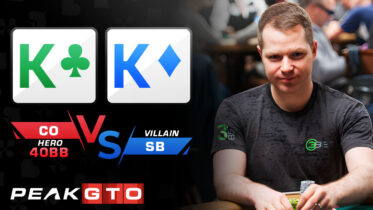
Today we will analyze a 40 big blind tournament hand where we raise KK from the cutoff and the small blind calls. The flop comes J♠J♥7♦, a paired board, and the action checks through. The turn is the 4♥, we bet for value and get called. The river is the 8♣, we bet close to pot, and the small blind check-raises all in. We will walk every street and show why folding our overpair, even getting a tempting price, is the winning play.
- Format: 8-max MTT, 40bb effective stacks
- Positions: Hero is in the cutoff (preflop raiser, in position); Villain is in the small blind (caller, out of position)
- Hero’s hand: K♣K♦
- Preflop: Hero raises the cutoff, the small blind calls. Single-raised pot.
- Flop: J♠J♥7♦, paired. Villain checks, Hero checks back.
- Turn: 4♥. Villain checks, Hero bets 4.4bb, Villain calls.
- River: 8♣. Villain checks, Hero bets about 15.4bb (pot), Villain check-raises all in for about 33.2bb.
Preflop
We raise KK from the cutoff, which is about as easy as preflop gets. It is worth remembering that the cutoff opens a wide range, including plenty of weak offsuit and suited junk, especially when the players behind are passive. That width matters later, because it means a lot of our flop bets and checks have to be built around protecting our weaker holdings, not just maximizing with the strong ones. The small blind calls, keeping a wide collection of medium broadways and connectors in the pot.
Flop: J♠J♥7♦
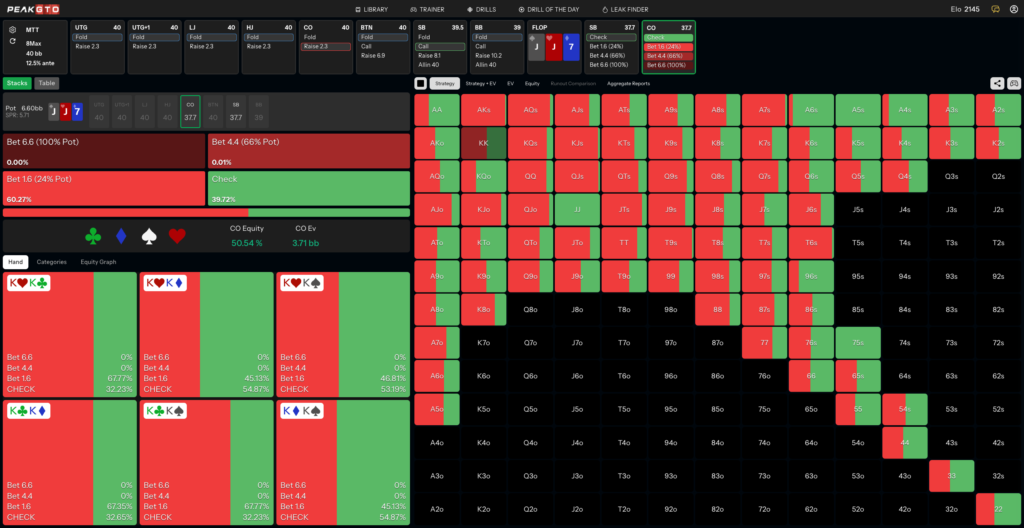
The small blind checks and we face a more interesting decision than it first appears. On a paired jack board, the standard play is to continuation bet fairly often with a small size, around a quarter of the pot. The catch is that we do not have the range advantage we might assume. We hold plenty of jacks, but so does the small blind, who called preflop with many medium cards. We also hold a lot of pure junk like queen-high and king-high that the opponent simply does not have, since they are not defending hands like Q4s.
That is why the hands that are almost always best yet not especially vulnerable, like aces and kings, actually want to check a meaningful amount here. Kings checks back roughly 53 percent of the time and aces closer to 76 percent. These hands can comfortably call a turn and a river, they do not need to build the pot immediately, and checking protects the rest of our weak checking range from being run over. This time we take that line and check back our overpair from in position, keeping our range disguised and avoiding an awkward check-raise.
It helps to picture both ranges at once. The paired jack flop hits the small blind’s calling range about as hard as it hits ours, and neither player can credibly claim a big nut advantage. That shared structure is exactly why small bets and frequent checks dominate this texture: there is little incentive to bloat the pot when your opponent’s range is sticky and your own strong hands play fine as bluff-catchers on later streets. Recognizing a low-leverage board like this early keeps you from overcommitting an overpair that looks far better than it actually plays.
Turn: 4♥
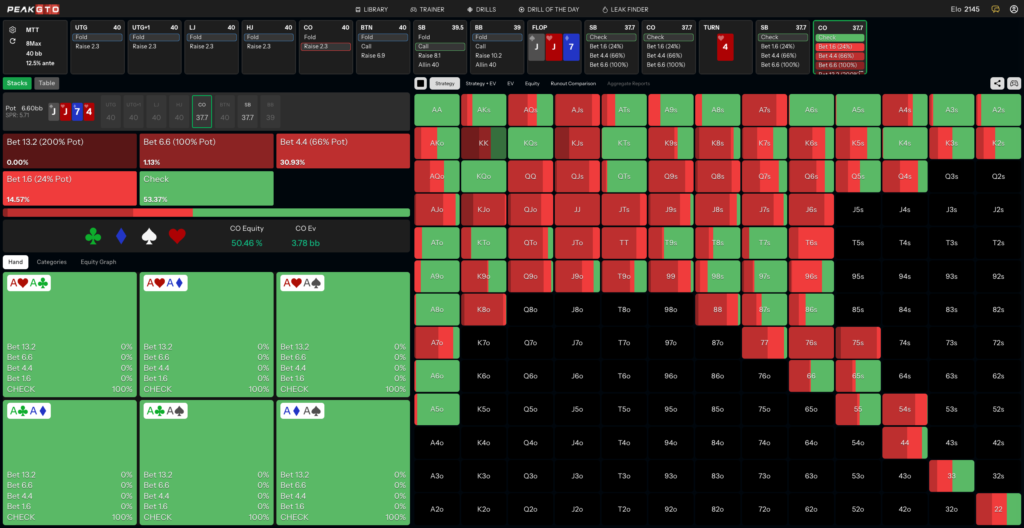
The turn is the 4♥, a card that changes very little. After the flop checks through, our range is full of random unpaired hands, so in theory the small blind should be betting aggressively to attack our weakness. Instead they check again, and now we get to bet our kings. Looking at the solver in PeakGTO, the overall range still checks about 53 percent and uses a medium 4.4bb size when it bets. KK, however, bets close to every time at this medium size, because after two checks our kings is essentially the top of a fairly marginal range.
One subtle point: AA actually checks on the turn even though kings bets, keeping a few strong hands in the check-back range so that line is not purely weak. That is a trap-and-protection consideration, not a sign that aces is afraid of the spot. We do not need to overthink it at the table. We bet our medium size, the small blind calls, and we head to the river with what still looks like a comfortable value hand.
River: 8♣
The river is the 8♣, a brick that completes no obvious draws. The small blind checks again, and KK is clearly good enough to value bet. Kings is the clean value bet here, with queens betting as a thinner value hand behind it. A nice feature of our line is that because we checked back some jacks on the flop, the opponent cannot get too aggressive against us, since we credibly have plenty of trips and full houses in our own range. We pick the pot-sized bet, about 15.4bb, which is what kings wants, and fire for value.
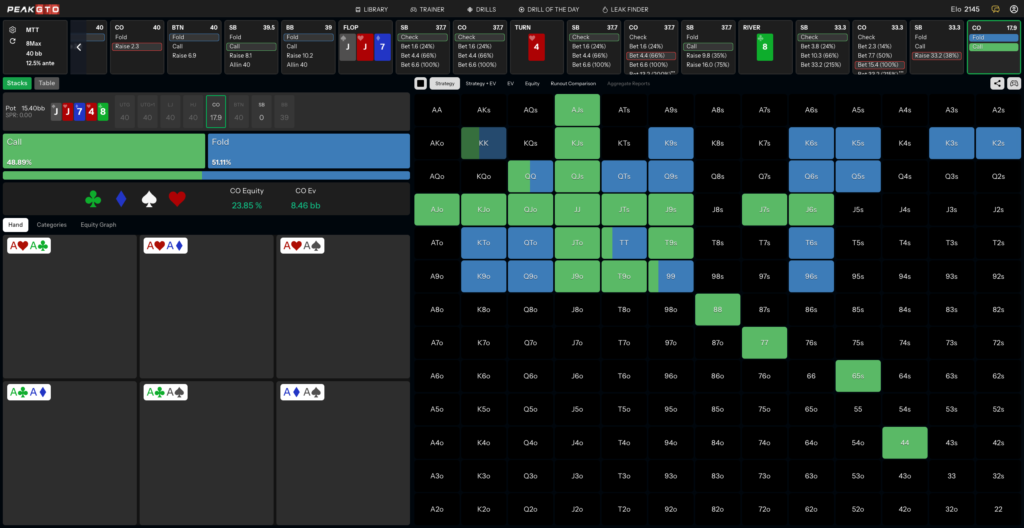
Then the small blind check-raises all in for about 33.2bb, and our overpair on a paired board is suddenly the story of the hand. We are getting a tempting price, so do the pot odds justify a call? Think about what a check-raise jam actually represents. The value hands are trip jacks like AJ, plus full houses like J8, 77, 88, and the 44 that filled up on the turn. Against that, our kings is just two pair, beating only the handful of bluffs the opponent can find. The solver confirms how thin this is: the entire continuing range calls almost exactly half the time, with kings sitting right at the indifference point between calling and folding.
The price is genuinely good. We are risking the rest of our stack to win a pot that already contains our bet plus everything that went in earlier, so we only need to be ahead a little more than a fifth of the time, roughly 22 percent, to break even. The problem is that our two pair clears that bar only if the opponent arrives with a meaningful number of bluffs, and on a paired board most players simply do not have them. Getting a good price against a range that is almost entirely value is still a losing call, and discipline beats curiosity here.
That theoretical coin flip is where population reads break the tie, and they break it hard toward folding. When someone jams a large chunk of their stack into your strong value bet on a paired board, they are almost never bluffing in practice. As GTO theory shows the spot is a pure mix, but real opponents are massively value-heavy here, so the correct adjustment is to overfold. The disciplined play is to fold the kings every time in this scenario, even against a world-class player, on the simple logic that a raise into a strong value bet rarely means anything other than a hand that beats you. We let the overpair go and move on to the next hand.
Key Takeaways
- Flop: On a paired board your overpair is not as far ahead as it feels. Check back a good share of your kings and aces to protect your range and avoid getting check-raised.
- Turn: When the action checks to you again, KK bets a medium size almost every time. Note that aces often keeps checking, because the check-back range is marginal.
- River: Kings is a clean value bet, and checking back jacks earlier keeps the opponent from raising too wide. Take the pot-sized line.
- Overall: Facing a check-raise jam, GTO treats kings as a breakeven mix, but real opponents almost never bluff here. Overfold and let the overpair go, even at a good price.