
Every orbit, the blinds put dead money in the pot, and every time the action folds to you, that money is up for grabs. Knowing how to steal blinds in poker is one of the clearest differences between players who slowly leak chips and players who steadily accumulate them.
This applies to a specific situation in which everyone before you has folded, and only the blinds remain. If someone has already limped or raised in front of you, different rules apply.
Here are five tips covering why you should raise or fold and never limp, how big your raise should be, which hands to open from every position in Texas Hold’em, why the small blind plays by its own rules, and how to adjust when the blinds are too tight or too aggressive.

Tip #1. Play Your Range, Not Your Hand
Before looking at specific hands, understand the idea that drives everything else: you are playing your entire range, not the two cards in front of you.
When you look down at queen-jack of diamonds on the button, recognize that you would raise king-jack of diamonds, jack-ten of diamonds, a pair of sevens, and a pair of aces in exactly the same way. All of those poker hands together form your range, and because you play them identically, your opponent cannot tell which part of it you hold this time.
The same logic applies in reverse. When the big blind calls your raise, they could have queen-jack offsuit or eight-seven suited, and pinning them on one exact hand will make you wrong far more often than right.
This is where your profit comes from. When opponents cannot narrow your range, they make mistakes, and mistakes are how you make money at poker.
Tip #2. Raise or Fold, Never Open Limp

When everyone folds to you, you have exactly two good options: raise or fold. Open limping, just calling the big blind as the first player in, is not one of them.
Limping lets the big blind check and see the flop for free with whatever junk they were dealt. You want the opposite: make them pay to play marginal cards from out of position.
The sizing is simple. As a default, raise to 3 big blinds when you have more than a 50 big blind stack, and drop to about 2.5 big blinds when you have fewer than 50 big blinds.
A consistent raise size across your entire range also protects the range concept introduced in the previous section. If you raise big with premiums and small with weak hands, observant opponents will read you like an open book.
Tip #3. Steal Wider as You Get Closer to the Button
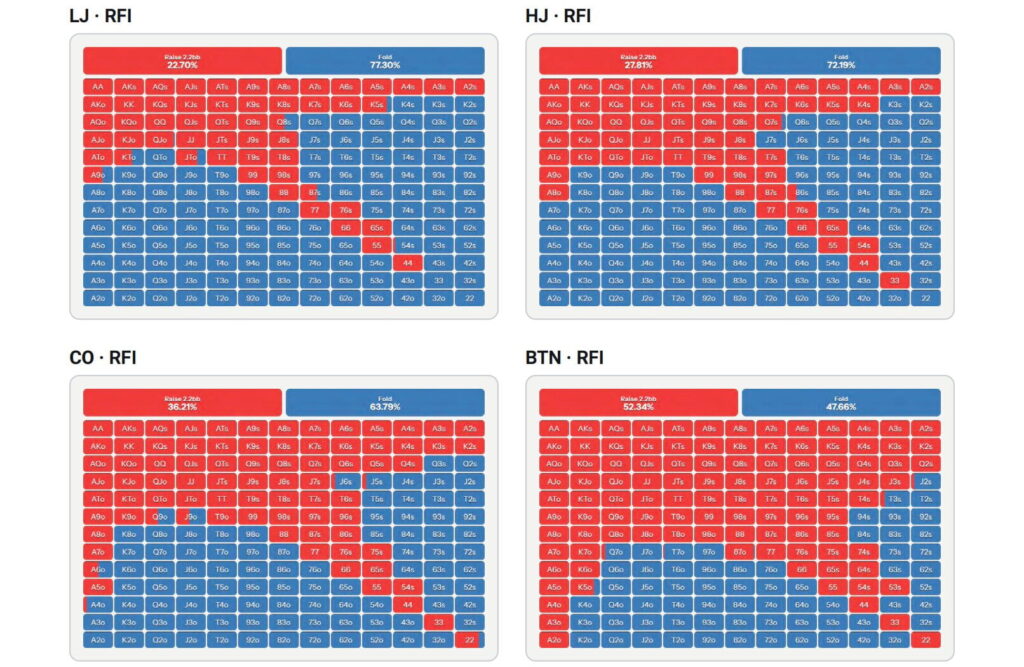
The single biggest pattern in profitable opening ranges: you get to play more hands as you move closer to the button. In later poker positions, you have more information, and fewer players behind you can wake up with a premium hand by pure chance.
Early Positions: Premium Hands Only
From under the gun, play only the best hands: pocket sixes and better, ace-three suited and better, ace-jack offsuit and better, king-nine suited and better, king-queen offsuit, queen-nine suited and better, jack-ten suited, and ten-nine suited. Everything else folds.
When I first started playing poker, I raised any ace from any position because the ace was the best card in the deck, and it cost me constantly: my ace-four would run into ace-jack, and I would lose a big pot with a pair of aces and a hopeless kicker. Weak aces, king-jack offsuit, jack-ten offsuit, and small pairs like fours look playable, but from early position they make junky hands that are hard to play out of position after the flop.
Middle Positions: Gradually Wider
From the lojack you add hands like king-six suited, queen-ten offsuit, pocket threes, and seven-six suited. The hijack widens further, and the cutoff opens a genuinely wide range.
You will occasionally see odd details in the preflop charts, such as seven-six suited being played from a seat where nine-seven suited is not. The charts come from high-end solver work, and small quirks like that are theoretically correct even when they look strange. You do not need to memorize every cell, just the principles: no junk from early position, no excessive tightness from late position.
The Button: Your Widest Steal Range
On the button you get to open roughly 55% of hands, including holdings like king-five offsuit, ten-seven offsuit, and ten-three suited. With only two opponents left, hands this weak become profitable raises.
That said, do not open everything. Hands like ten-three offsuit simply cannot be played profitably, even against just the blinds.
Tip #4. Use a Limping Strategy From the Small Blind
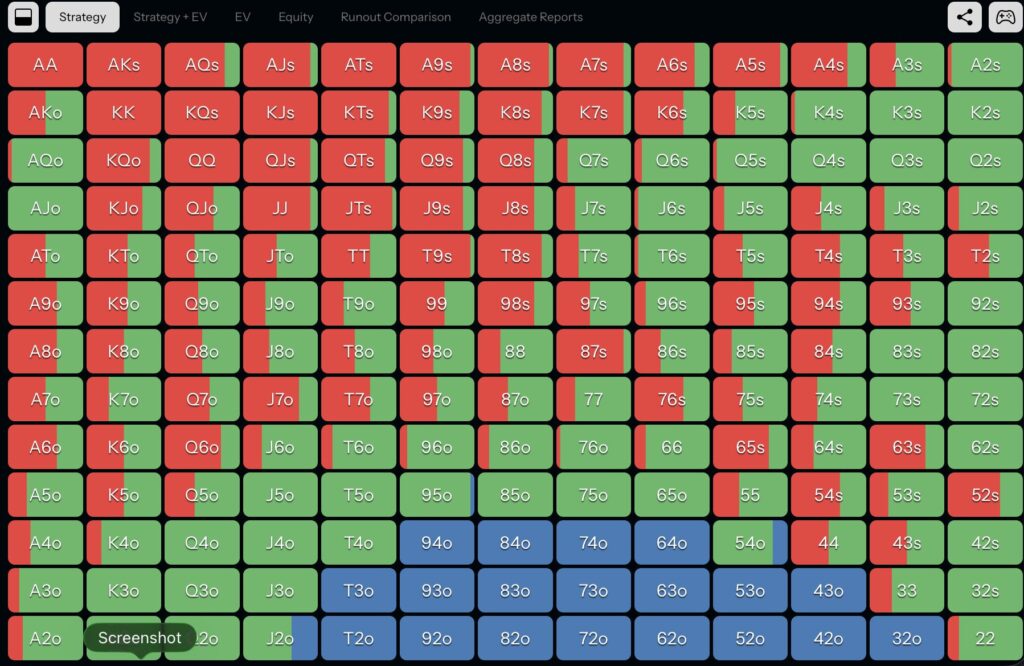
The small blind is the one steal position where limping belongs in your strategy. You have already posted half a big blind, so completing costs you only a quarter of the pot, and those favorable pot odds justify playing a much wider range than a cold raise would.
The trick is how you build the limping range. Most players limp their marginal hands and raise all their strong ones, which makes their limps trivially easy to attack.
The correct approach limps some of the absolute best hands, including aces and kings, alongside the weaker playable hands. When the big blind knows your limp can contain a premium, they can no longer raise your limps mindlessly, and your whole range gets protected.
Keep in mind that a folded-to small blind is relatively rare in soft, multiway games, so treat this spot as a bonus skill rather than a core one.
Tip #5. Adjust to the Players in the Blinds
The charts assume strong opponents. Your actual opponents, especially at small stakes, will hand you reasons to deviate, and the later your position, the more you should.
If the blinds are very tight and only continue with premium hands, your steals gain enormous fold equity, and from the button or small blind you can profitably raise far more than the chart suggests, sometimes any two cards.
If the blinds fight back with constant re-raises, cut the hands at the cusp of playability: the ten-three suiteds and king-seven offsuits at the bottom of your range. Those hands show a profit only when they take the pot down uncontested, and against aggressive blinds they will not.
Early position ranges stay mostly fixed regardless of opponents, because too many players behind you can still pick up a real hand. Remember that the baseline ranges come from poker solvers that assume perfect resistance; when the resistance is imperfect, the profitable answer is to attack more, not to follow the chart blindly.
Conclusion
The most important habit to build is simple: when everyone folds to you, raise or fold, never limp, and let position dictate how wide you go.
Follow the charts as your baseline, keep your sizing consistent at 2.5 to 3 big blinds, and steal wider whenever the blinds prove they fold too much. Most of your opponents play far too many hands from every seat; you profit by refusing to make the same mistake.
Get these open-raising fundamentals right and everything that comes after the flop gets easier, because you will be entering pots with the right hands, in the right positions, at the right price.