Most players understand that ICM pressure is essential at the money bubble. What few players recognize is that it peaks as the final table approaches.
Get this wrong, and you will be making decisions that cost you far more than a bad bubble call ever could.
This article walks through exactly how your strategy should shift at two critical tournament stages: when you first get into the money, and when you are nearing the final table.

How ICM Pressure Changes When You First Get In the Money
The moment you burst the bubble, something important happens: the risk premium that was squeezing your decisions drops sharply.
This is especially true in large-field tournaments where the payout jumps after the min-cash are small or nonexistent for a long stretch. When there is no meaningful pay jump close by, going broke hurts less. You had to outlast a lot of players just to cash, and you will need to outlast many more before you see any real money.
Because of this, your strategy should move back toward chip EV accumulation, similar to the middle stage of a tournament. The goal is to build your stack and press your edges. Playing overly cautiously at this point is a mistake because you are leaving chips on the table for minimal protection against a payout.
That said, you are not playing pure chip EV either. The same principles from the middle stage apply: stay a touch tighter than GTO and a touch more aggressive. You are looking to accumulate, but you are not looking to go broke on a coin flip.
Why the Final Table Is the Peak ICM Spot in Any Tournament

As you go deeper, future game considerations start to carry more and more weight.
ICM pressure does not build linearly. It spikes as you get close to significant pay jumps, and the biggest spike of all comes as you approach the final table.
Here is why: having the chip lead nine-handed is arguably the highest EV spot you can be in during an entire tournament. The chip leader at the final table benefits from maximum ICM leverage over every other player at the table simultaneously. That spot is worth protecting.
If you can reach the final table with a healthy stack, you want to do that. Not by playing scared, but by avoiding unnecessarily reckless spots that could knock you out just before you get there.
This is where many players give up serious money. They play correctly on the bubble, but then loosen up at 15 or 12 players left as if ICM stops mattering. It does not. It is about to matter more than it has at any point in the tournament.
Preflop Range Adjustments Nearing the Final Table
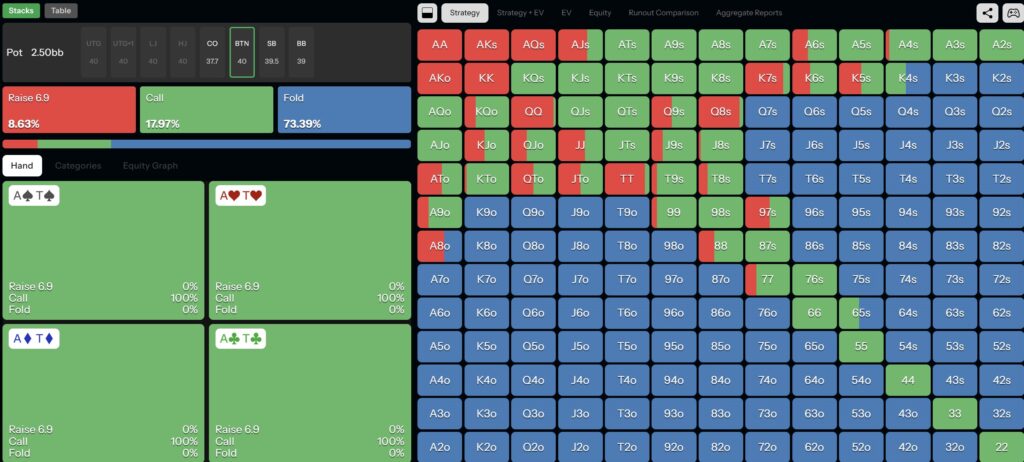
The shift in preflop charts near the final table is significant and follows a clear logic: hands that need to realize implied odds lose value, and hands that block your opponents lose value.
At 25 big blinds with 14 players remaining as the middle stack, a GTO-calibrated raising range shrinks from roughly 27% (chip EV) to around 22% under ICM pressure. That is a meaningful reduction, and it comes from specific hand categories.
Hands That Lose Value
Small pairs and suited connectors take the biggest hit. Hands like 55, 44, 76s, 87s, 98s, and weaker suited broadways like Q6s, Q7s, J8s, T8s all get cut from the open-raising range.
These hands depend on implied odds. They want to hit big and stack an opponent. But near the final table, playing for stacks becomes dangerous. The payoff does not justify the risk.
Hands That Gain Value
Ace-x hands move in the opposite direction. Hands like A5o, A4s, A7o, and A8s get added to the range even though some of them look weak on the surface.
The reason is blockers. Holding an ace reduces the probability that your opponent has a strong ace to 3-bet or shove with. That blocker effect is worth real equity near the final table because it affects how often you run into resistance when you open.
High cards in general go up in value for the same reason: they block your opponent’s continuing ranges, re-raising ranges, and all-in ranges.
Read more: Push Fold Charts
Why You Must Fold More to 3-Bets Near the Final Table
One of the most important, and most underappreciated, adjustments near the final table is how often you need to fold when facing a 3-bet or shove.
Here is the math. Suppose you raise and a player with 20-25 big blinds shoves. To call, you might need 45% equity from a pure pot-odds standpoint. But with a meaningful risk premium near the final table, you might need to add 10-15% on top of that. Suddenly you need 55-60% equity to justify the call.
That kind of equity is very hard to have against a reasonable shoving range. The result: you are folding a lot of hands that look like they should call.
This cuts both ways. Your opponents face the same pressure. If you raise and someone has 20-25 big blinds behind, a small 3-bet puts them in an extremely uncomfortable spot. Making it 2 big blinds and facing a 5-big-blind 3-bet means they are essentially playing for their whole stack. Their risk premium will force them to be very selective.
This is why 3-bet/fold strategies become so common near the final table. You can apply serious pressure with a small re-raise and force your opponent into a decision they do not want to make.
Postflop Strategy Adjustments Under ICM Pressure

Preflop adjustments are only half the picture. Postflop strategy changes significantly near the final table as well.
Bet Sizes Shift Down
When there is meaningful ICM pressure, smaller bets are effectively bigger in terms of the pressure they apply.
Think of it this way: if you bet 25% pot and your opponent faces a 4% risk premium on top of it, the total pressure they feel is closer to a 33% pot bet in chip EV terms. You do not need to bet big to get the job done. Smaller bets preserve your own equity while still applying real pressure.
Medium-Strength Hands Play More Passively
Hands that would go for thin value in a chip EV environment should mostly be checking near the final table.
The risk of betting, getting raised, and facing an all-in decision with a marginal hand is too costly when payout implications are high. Most medium-strength hands should be looking to check, control the pot, and realize their equity at showdown.
Sometimes, the Right Play Is to Jam
There are spots, usually involving vulnerable strong hands on dynamic boards, where going for a large bet or even an all-in is correct.
If your hand is almost certainly good but faces significant equity denial risk (draws, two-pair combinations), getting all the chips in forces those draws to fold. Picking up the pot without a showdown is a fine result. When called by a worse hand, you are in good shape. The key is that you are not going for thin value; you are protecting a hand that has real vulnerability.
Two Hand Examples: When to Check Back and When to Jam
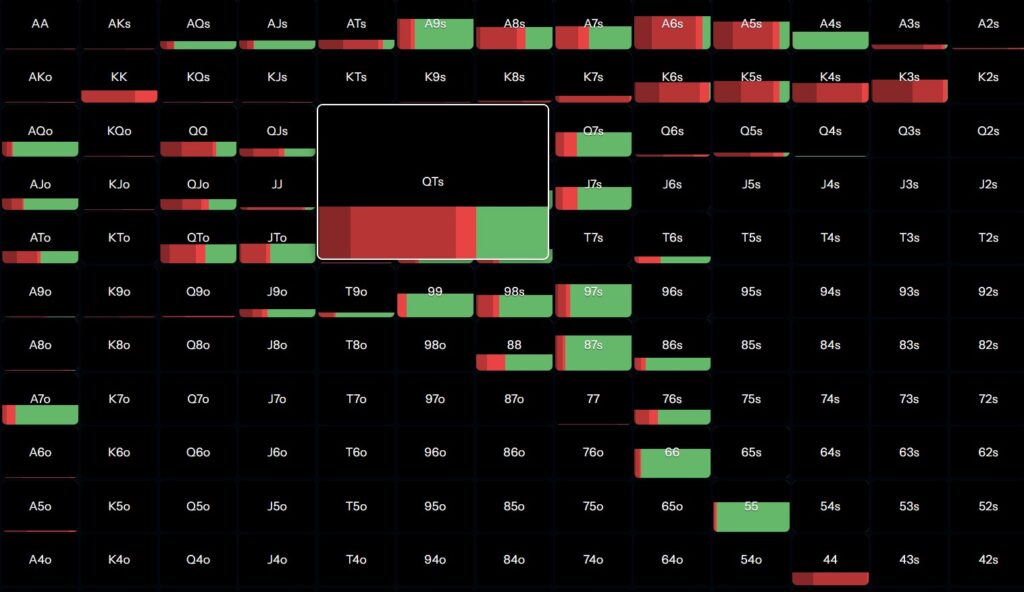
Hand 1: Queen-Ten Suited – Protect Your Equity, Not Your Chips
You are down to 15 players with 22 big blinds. You raise with Queen-Ten suited, and the big blind, a player with a bigger stack, calls.
The flop comes King-Ten-Seven.
You have a middle pair with a decent kicker. In a cash game or a chip EV tournament, this is often a bet. But here, the big blind covers you, and payout implications are significant. Betting and getting raised puts you in a nightmare spot.
The correct play is to check back.
The turn brings the four of spades, giving you a flush draw on top of your pair. You might think that improves your hand enough to bet. It does not. If anything, it makes betting worse. Now, if you bet and face a jam, you are calling off your tournament life with a draw. That is a disaster.
Check again.
The river is a blank. If your opponent bets a normal size, you call. You have checked multiple times, which invites bluffs. You have a reasonable hand. Calling here is straightforward.
The lesson: you gave up some chip EV by not extracting value on the flop or turn. But you made the correct dollar EV decision by not risking your tournament with a marginal hand.
Hand 2: Pocket Kings – Jam to Deny Equity
You are in the same tournament stage with pocket kings. You raise, a player calls.
The flop comes Ten-Seven-Five. You have an overpair that is almost always good but vulnerable to a wide range of draws and turned cards.
This is a spot to bet. Your hand needs protection, and picking up the pot right now is perfectly acceptable.
You bet. They call. The turn brings the Queen of spades — a dynamic card that puts flush draws and new straight draws on the board.
Now you have two reasonable options: check with the intention of check-calling or check-raising, or bet small and jam the river. Either line has merit.
What is not correct is checking and then giving up. Your hand is still almost certainly good, but the board is getting more dangerous with every card.
The best play is to put all the chips in now — a bet larger than the pot if necessary. Yes, your opponent will fold most of the time. That is fine. When they call with a queen, you are ahead. When they call with a ten, you have put them in a brutal spot. When they have a draw, you force them to fold the equity they were hoping to realize.
This is the right use of a large bet near the final table: not thin value, but equity denial with a hand that is likely good but vulnerable.
Final Thoughts
ICM strategy after the bubble comes down to two phases.
In the early money, relax. Risk premium has dropped, and this is a time to accumulate chips, focusing on playing close to chip EV while staying a little tighter and a little more aggressive.
As you near the final table, tighten significantly in the right ways: drop implied odds hands, lean on blockers, fold more to aggression, and handle postflop situations with patience. Medium-strength hands get checked more. Large bets get reserved for hands that need protection, not extraction.
Understanding when ICM pressure rises and falls is one of the clearest differentiators between players who cash consistently and those who go deep.