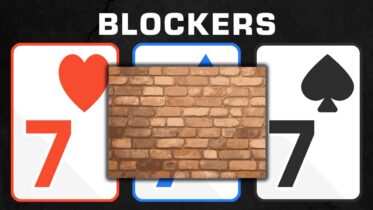

Blockers in poker are cards you hold that make it impossible or less likely for an opponent to have a specific strong hand.
For example, holding the ace of hearts means your opponent cannot have the nut flush on a three-heart board. I have reviewed thousands of hand histories in coaching sessions, and blockers come up in a meaningful way in nearly every deep-run tournament or large-pot cash game spot.
The concept applies to Texas Hold’em and Pot Limit Omaha alike, and players who learn to use blockers in their poker strategy to correctly gain an immediate edge in bluffing, value betting, calling decisions, and range construction.
- What Are Blockers in Poker?
- Using Blockers Before the Flop
- Bluffing with Blockers
- Value Betting with Blockers
- Using Blockers to Bluff-Catch
- Using Blockers in Range Construction
- Giving Up on Bluffs with Blockers
- When Blockers Don't Matter
- Use Blockers to Boost Your Poker Results
- Frequently Asked Questions About Blockers in Poker
What Are Blockers in Poker?
In my experience teaching this concept, the single most important thing to understand is that blockers shift probabilities: they do not eliminate hands. A player holding the ace of spades on a flush board cannot be certain their opponent lacks a flush; they can only know their opponent lacks the nut flush specifically.
The distinction matters every time you decide whether to bluff or call. Overestimating the power of a blocker is one of the most common leaks I see in students who have started studying GTO concepts.
Blockers can be more or less significant, depending on whether they make a certain hand less likely or completely impossible, especially in games like Pot Limit Omaha.
For example, imagine playing a PLO hand and facing a river bet on an unpaired board with three hearts on it. By betting here, your opponent is saying they have a flush and are forcing you to decide whether they are bluffing or not.

However, imagine you have the Ah in your hand but no other heart to go with it. You don’t quite have a flush, but you know for a fact your opponent does not have the nut flush.
In this example, you can go ahead and make a big raise, knowing your opponent can’t have the best possible hand, and they can’t know if you have it or not. You could easily have another heart to go with your Ace and will make the same play when you do.
In other situations, poker blockers may have a lesser impact but still be quite important. For example, in preflop situations in Texas Hold’em Poker, blockers can play a big part in your choice of bluffing hands.
If you noticed players in high-stakes tournaments on TV often bluffing preflop with hands like A2s and A5s, blockers are the reason why they choose these particular hands.
Having one of the Aces in your hand makes it significantly less likely your opponents have a hand like AA or AKs. For this reason, your bluff attempts are more likely to work.
For example, imagine facing a middle position raise while sitting on the button in an NLH tournament and looking down at As2s. Your hand is not very strong, but having that As in your hand brings down the number of the raiser’s AA combos from six to just three, making it significantly less likely they have the best hand in poker.
Blockers can also be used on all other streets, with pocket pairs often being great bluffing hands thanks to the blocker effect.
For example, if you are holding 66 on a board of 754, this is a great hand to bluff with, as it makes it very unlikely your opponent has a straight with 86 or 63. If preflop play allows you to have these hands in your range, you can play the hand very aggressively and often win without showdown.
Using Blockers Before the Flop
Blockers influence preflop decisions more than most players realize, particularly when building a 3-bet or 4-bet bluffing range. The clearest example is why A5s and A4s suited are the most common 3-bet bluffing hands at high stakes: not because they have the best equity, but because holding an ace reduces the number of premium hands your opponent can have.
In a standard single-raised pot, the opener can have six combinations of AA and twelve combinations of AK. When you hold an ace, those numbers drop to three and eight, respectively. That reduction makes it meaningfully less likely your 3-bet runs into the exact hands that will not fold, which improves your bluff’s success rate in a way that a hand like 76s cannot replicate.
I factor this into my own preflop decision-making in tournaments regularly. When I am on the button facing a raise and considering a 3-bet bluff, I prioritize any suited ace over offsuit connectors of similar equity.

The blocker alone is not enough to justify a 3-bet: position, stack depth, and opponent tendencies all matter, but holding an ace gives any marginal hand a structural advantage as a bluffing candidate.
The same logic applies to 4-bet bluffing. Holding an ace or a king reduces the number of AA, AK, and KK combinations your opponent can hold, which shrinks the portion of their range that dominates your bluff. When you are looking for hands to include in your 4-bet bluffing range, starting with Ax blockers is the correct approach.
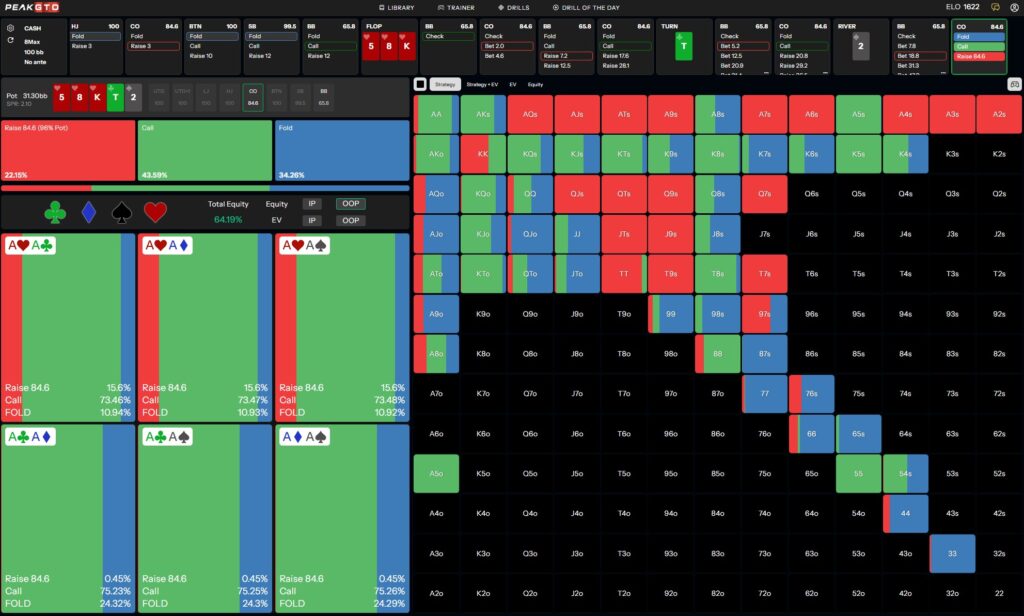
PokerCoaching’s own solver, PeakGTO, is the ideal tool for verifying which specific hands to include in your 3-bet and 4-bet bluffing ranges for different stack depths and positions.
Bluffing with Blockers
Blockers are most commonly used as part of the bluffing strategy, as having certain blockers in your hand can significantly improve your bluffing opportunities.
In fact, players who base their play on the GTO poker strategy often make their decisions based on whether or not they hold certain cards in their hand or not.
Here is a hand I use in coaching sessions to illustrate exactly how a single blocker transforms a marginal spot into a clear bluffing opportunity. Walk through the action to see how the As changes the decision at every street.

Playing in a $5/10 cash game, you are seated in the big blind with As5d. The cutoff raises to $30, and you make the call in the big blind, which is the standard play.
With $65 in the pot, the dealer puts out Ks3s2d, giving you a gutshot straight draw and a backdoor flush draw. You check in flow, and your opponent c-bets for $25, which you call, taking you to the turn.
The turn card is the 9s, and you check in flow once again. Your opponent bets once again, and it’s time to make a decision.
If you had a hand like Ad5d, this turn card would probably be the right time to fold your cards and move on to the next hand.
Your opponent could easily have a hand like AK, KQ, or K9s, all of which beat your hand and are fairly strong in terms of absolute hand strength.
However, since you hold the As turning your hand into a bluff makes a lot of sense. For one, you can make the nuts on the river with another spade and can also make a straight with a 4, giving you plenty of outs if you do get called.
More importantly, holding the As means your opponent can’t have the nuts, while you could potentially have it.
By putting in a significant raise on this turn card, you will put your opponent in a very difficult spot, even if they do have a small flush.
If they have a hand like one pair or two pairs, they will most likely have to fold either now or on the river, as you can reasonably have the nut flush to have them beat.
This is just one of many examples where holding the right blocker can help you find great spots to bluff in poker and win against a much stronger hand.
Value Betting with Blockers
The value betting application of blockers is the one most players underuse. I see students who understand blocker-based bluffing instinctively, but then size their value bets identically whether they hold top set or bottom set on the same board.
The set you hold changes your opponent’s range of poker hands, which changes the optimal bet size. Getting this adjustment right over thousands of hands adds up to a meaningful win rate improvement.
For example, imagine calling a raise in position and flopping a set on a board of J73. Whether you have JJ or 33, you almost definitely have the best hand, but there is a big difference in how you should approach these hands.
If you have the top set with JJ, you are blocking your opponent from having a hand like AJ, KJ, QJ, or JT, all of which would probably be willing to put more chips into the pot.
On the other hand, holding a hand like 33 or 77, all of those hands are unblocked, meaning there are significantly more Jx combinations that your opponent could potentially have.
You can apply this knowledge by usually raising bets you face with your bottom and middle sets while setting a trap and just calling with the top set more often, especially if that top card is a Broadway card.
A similar application of this concept can be used when you have a two-card straight on a board where a one-card straight is possible, such as holding JT on a board of 9s8c7s6d2c,
While it would be great if your opponent had a T and could pay you off, the T you hold blocks quite a few realistic Tx combos. For that reason, going for a small value bet that targets hands like two pairs can often make more sense than betting big and simply folding those hands out.
Using Blockers to Bluff-Catch
Most players think about blockers from the aggressor’s perspective: do my cards help me bluff? But blockers are equally important when you are the one facing a bet and deciding whether to call. This is called bluff-catching with blockers, and it requires thinking about card removal from the defender’s side.
The core question is: does my hand block my opponent’s value range or their bluffing range? These produce opposite conclusions.
If you hold a card that reduces your opponent’s value combinations, they are more likely to be bluffing, which makes calling more profitable. For example, facing a river jam on a board with three clubs, holding the ace of clubs means your opponent cannot have the nut flush. Since the nut flush is a primary value combination in that spot, your call has better odds than it would without that blocker.
If you hold a card that reduces your opponent’s bluffing combinations, calling becomes worse. Suppose you are facing a river bet on a board where missed straight draws are common. If you hold a card that would have been part of those draws, your opponent has fewer of those hands available to bluff with, making their bet more likely to represent value.
When I review river call decisions with students, I run a quick two-part check: first, does this hand block their value? Second, does it accidentally block their bluffs? A hand that does the first improves your call.
A hand that does the second makes calling worse. Most situations are mixed, but even a rough mental accounting of these two factors produces better decisions than ignoring blockers entirely when facing a large bet.
Using Blockers in Range Construction
Range construction is where blockers do their most consistent work. Every time I am building a range estimate for an opponent in a hand, my first step is removing any combination containing a card I hold.
This sounds mechanical, but it has a compounding effect: on a board that interacts heavily with my hand, I can eliminate ten or more opponent combinations before they have taken a single action. That changes the equity distribution of every subsequent decision in the hand.
Every time you see a flop and try to build your opponent’s range, remember to account for the two cards you are holding and remove all the key combos that contain those cards.
For example, if you hold AdJs on a board of Ts9d8d, you have to remember not to consider card combos like AdJd, AdTd, Ad9d, QsJs, KsJs, and others as part of your opponent’s range.
Holding key cards that have a lot of connectivity with the board texture means you can significantly shrink your opponent’s poker range even before they take any action.
Following that step, you can decide whether the blockers you hold work more in your favor or your opponent’s and whether they make their range more value-heavy, draw-heavy, or trash-heavy.
Giving Up on Bluffs with Blockers
Blockers can often help put pressure on opponents and represent strong hands, but they are equally useful for knowing when to stop. Some of the most expensive bluffing mistakes I see involve players firing a third barrel while holding blockers to their opponent’s draws rather than their opponent’s made hands.
If you hold a blocker to the draw, your opponent is less likely to have the hands that would fold to your bet, which flips the blocker from a reason to bet into a reason to give up.
A clear example is when you hold a strong draw, bet the flop and the turn, and get called on both streets.

For example, imagine raising from the cutoff to $30 before the flop in a $5/10 game with QsJs and getting called by the button and the big blind.
The flop brings Ts9s4d. You bet out for $65, the button folds, and the big blind calls. With $225 in the pot, the flop brings the 2d, and you go for another bet of $150 on the turn. Your opponent again calls.
The river brings the 4c, and your opponent once again checks. At this point, you need to consider the types of hands they probably have and think about whether or not they are really going to fold.
You are holding both the Qd and the Jd, which means they are much less likely to have all the key draws that exist on this board. In fact, as the hand was played, and considering your blockers, the player is most likely to have a one pair hand, most likely the top pair.
Your decision at this point should be based mostly on whether you think your opponent will fold the top pair to a big bet and how big the bet should be. If not, you should not fire again, as your opponent having a drawing hand like an OESD or a flush draw is much less likely than it would be if you have a hand like AA or KK.
While this does not mean you should never fire a triple-barrel bluff in a situation like this, it is worth considering how your blockers influence your opponent’s range and what hands they block them from having.
When Blockers Don’t Matter
Blockers are a fine-tuning tool, not a decision-making framework. In the right conditions, a single blocker can shift a fold into a profitable bluff or a fold into a profitable call. In the wrong conditions, spending time thinking about blockers is a distraction from more important factors.
The conditions where blockers have the most impact: three-bet and four-bet pots where ranges are tight and polarized, river decisions where value hands are easy to identify, and situations where the pot odds are close enough that small probability shifts matter.
The conditions where blockers have little impact: multiway pots where multiple opponents have wide ranges, spots against recreational players who do not have balanced ranges, and preflop decisions in limped or single-raised pots where too many hand combinations exist for any single card to move the needle meaningfully.
This last point is one I emphasize consistently in coaching. I have worked with students who learned about blockers and immediately started applying them in every decision, including calling off a recreational player’s all-in on the river because they held an ace blocker.
Against a player who bets big with top pair and never bluffs, the blocker is irrelevant. The most reliable way to decide whether blockers should factor into a decision is to ask: does my opponent have a balanced, solver-informed range in this spot? At high-stakes online and competitive live games, the answer is often yes. In most low-to-mid-stakes live games, the answer is usually no.
When you are ready to use a solver to check specific blocker-heavy spots in your own game, PokerCoaching’s own solver, PeakGTO (peakgto.com), lets you build out ranges and verify when card removal is mathematically significant in a given spot.
Use Blockers to Boost Your Poker Results
Blockers will not transform your results overnight, but the players who use them consistently make better decisions in the spots where the margin is smallest. Bluffing, value betting, bluff-catching, and range construction all become sharper once you build the habit of asking: what does holding this card say about my opponent’s range?
My recommendation for putting blockers into practice is to start with two situations: preflop bluff selection (prioritize ace blockers in your 3-bet range) and river bluff decisions (ask whether you block their value or their bluffs before firing a large bet). These two applications will produce the clearest feedback from your results.
When you are ready to go deeper, use a solver to run specific spots. PokerCoaching’s own PeakGTO solver is the recommended tool for this work: you can build out a scenario, assign ranges, and check directly which hands the solver selects as bluffs and why. Blockers will consistently appear as a factor in the solver’s reasoning once you know where to look.
Try PeakGTO for FREE and up your game!