
A cooler in poker is a hand where both players hold such strong cards that getting all the chips in the middle is unavoidable, and one player loses through no strategic error of their own. The hand is lost before it begins. No amount of folding instinct or reads can save you when you flop a set, and your opponent flops a better one.
I have personally been on both sides of coolers, and what makes them so psychologically difficult is that there is nothing you could have done differently. You played the hand correctly.
You lost because poker involves cards you cannot control. That distinction matters enormously for your mental game and your ability to move on without tilting.
Some of the most dramatic coolers on record have played out on televised high-stakes games, where the dollar amounts involved amplify everything. Below, I explain the poker term in detail and break down seven of the most memorable, from High Stakes Poker to Hustler Casino Live to Triton Poker.
- What Is a Poker Cooler?
- Poker Cooler vs. Bad Beat: What Is the Difference?
- Cooler #1 – Gus Hansen v Daniel Negreanu – High Stakes Poker
- Cooler #2 – Santhosh Suvarna vs Andrew Robl – High Stakes Poker
- Cooler #3 – Tom Dwan vs Phil Ivey – Million Dollar Cash Game
- Cooler #4 – Alan Keating vs Rahul – Hustler Casino Live
- Cooler #5 – Tan Xuan vs Adrian Mateos – Triton Poker Series
- Cooler #6 – Elton Tsang vs Tony G – Triton Poker Series
- Cooler #7 – Patrik Antonius vs Daniel Negreanu vs Phil Ivey – High Stakes Poker
- How to Handle Poker Coolers Without Going on Tilt
- Poker Cooler FAQ
What Is a Poker Cooler?
A poker cooler is a situation where two players each hold a very strong hand, and the strength of both hands makes it essentially impossible for either player to fold before all the chips go in the middle. The losing player cannot be blamed for the outcome. They played correctly; they simply ran into something better.
The classic cooler is set over set: you flop three of a kind with pocket Jacks, your opponent flops three of a kind with pocket Queens on the same board, and money goes in on the flop because of course it does. You both played the hand the only reasonable way it could be played.
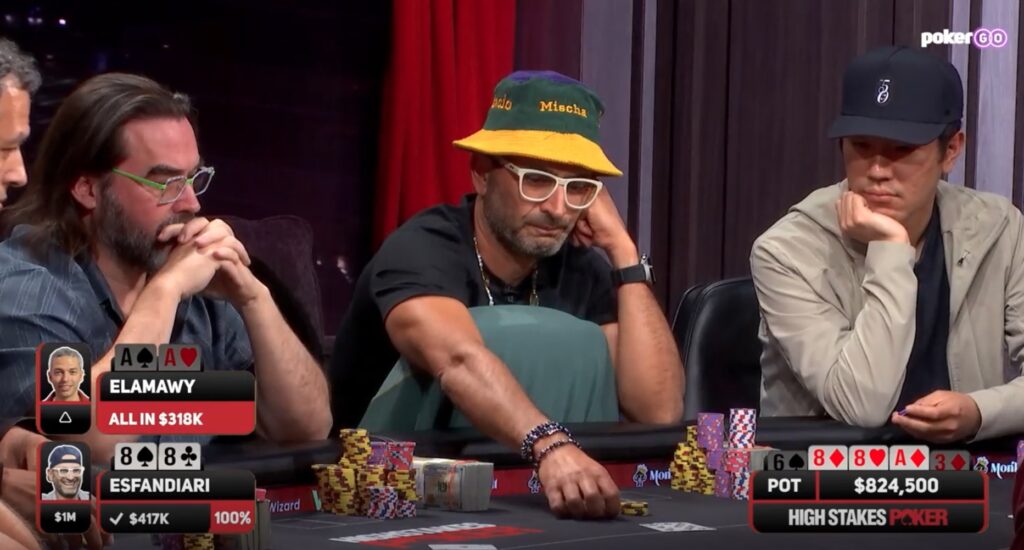
In my experience coaching players at all levels, one of the most common mental game errors I see is players treating coolers the same as bad beats. They are not the same thing. A bad beat happens when you have a significant mathematical edge but lose to a low-probability outcome. A cooler happens when both hands are so strong that neither player can reasonably deviate from committing their stack.
Understanding this distinction has real implications. If you lose what feels like a cooler but was actually a situation where a fold was theoretically possible, you need to examine whether your play was correct. If it was a true cooler, there is nothing to examine. The only work to do is manage the emotional aftermath and move on.
Poker Cooler vs. Bad Beat: What Is the Difference?
These two terms are often used interchangeably in casual poker conversation, but they describe fundamentally different situations.
A bad beat happens when you get your money in as a significant mathematical favorite and lose to a low-probability card. The classic example: you hold Aces against Kings preflop and your opponent hits a King on the river. You were an approximately 80% favorite. They hit their 20% shot. That is a bad beat.
A cooler happens when neither player is a significant favorite when the chips go in, because both players hold hands that are effectively monsters in context. The set-over-set example is the textbook case, but coolers also include: nut flush against the straight flush on the river, top two pair against flopped trips on a paired board, and Aces versus Kings preflop at shallow stack depths where the mathematical edge exists but folding Kings preflop is not a practical option for most players.
The practical question I always tell students to ask themselves is this: could you have played this hand differently without making a significant strategic mistake? If the answer is no, it was a cooler. If the answer is yes, it was either a bad beat or something you contributed to.
I find that most players who claim to suffer constantly from coolers are actually experiencing a mix of bad beats and genuinely marginal spots where a fold was theoretically available but practically unrealistic. True coolers are rarer than people think, which makes them more bearable once you understand what they actually are.
Cooler #1 – Gus Hansen v Daniel Negreanu – High Stakes Poker
One of the most iconic televised poker hands of all time was played during Season 2 of High Stakes Poker, one of the most epic poker shows ever.
This hand had everything a poker fan could hope for, from big names like Gus Hansen, Daniel Negreanu, and Doyle Brunson seated at the table to two big hands colliding and a massive pot building up.
The hand may have been played nearly two decades ago, but both Hansen and Negreanu were already poker superstars, and playing for hundreds of thousands of dollars did not faze them too much.
With blinds at $300/600, Hansen opened the pot to $2,100 with 5d5c, and Daniel decided to 3-bet to $5,000 with 6s6h, a play you would not see too much these days.
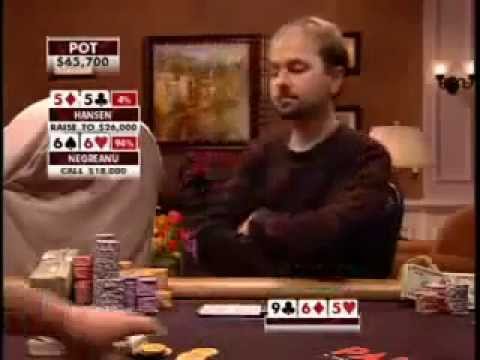
That said, other players got out of the way, and Hansen naturally called, revealing the flop of 9c6d5h, which both players surely loved to see despite the possibility of a straight.
Hansen check-raised Negreanu to $26,000, and the Canadian poker champion made the easy call. It seemed like he was destined to win a big one until the last remaining five in the deck, the 5s hit the turn.
Hansen kept betting but made it very small, betting just $24,000, and after some Hollywood, Negreanu made the call.
The 8s did not change too much, and instead of barreling once again, Hansen decided to check this time, giving Daniel a chance to hang himself.
With one of the best hands he could possibly have, Daniel bet $65,000 for value, only to be met with an all-in from the Great Dane, which Daniel did not want to hear.
It was another $167,000 to call, and being as curious as he usually gets in spots like this, Negreanu paid off the bet, saw the bad news, and could not do much but shake his head in utter disgust at what went down just seconds before.
My coaching takeaway: The flop of 9-6-5 was deceptive. Negreanu’s set of Sixes was a monster but also extremely vulnerable on that board, with a four-to-a-straight already in play and multiple hands that could catch up. I think about this hand often when reviewing student hands where the question is whether to fast-play or slow-play a set on a coordinated board. Here, the right play was clear: Negreanu had to continue aggressively. The result was a cooler, not a mistake.
Cooler #2 – Santhosh Suvarna vs Andrew Robl – High Stakes Poker
Andrew Robl has been around poker longer than most others, coming up during the days of the Poker Boom and playing on High Stakes Poker and other TV poker shows ever since.
In early 2024, playing on the 12th season of the popular show, Robl was faced with one of the up-and-coming players, the Indian businessman Santhosh Suvarna.
The two played a pot that would go down as the biggest in the show’s history, just nearly missing out on the million-dollar mark.
With the blinds up to $1,000/$2,000 and each player playing with at least $500,000 to start with, things were always going to get hectic.
Suvarna started things off with a $4,000 poker straddle, and Robl opened the pot to $16,000 from the small blind holding 5c4c. Suvarna woke up with a monster in the form of AcKh in the straddle and decided to pump it right back to $54,000, which Robl called out of position.
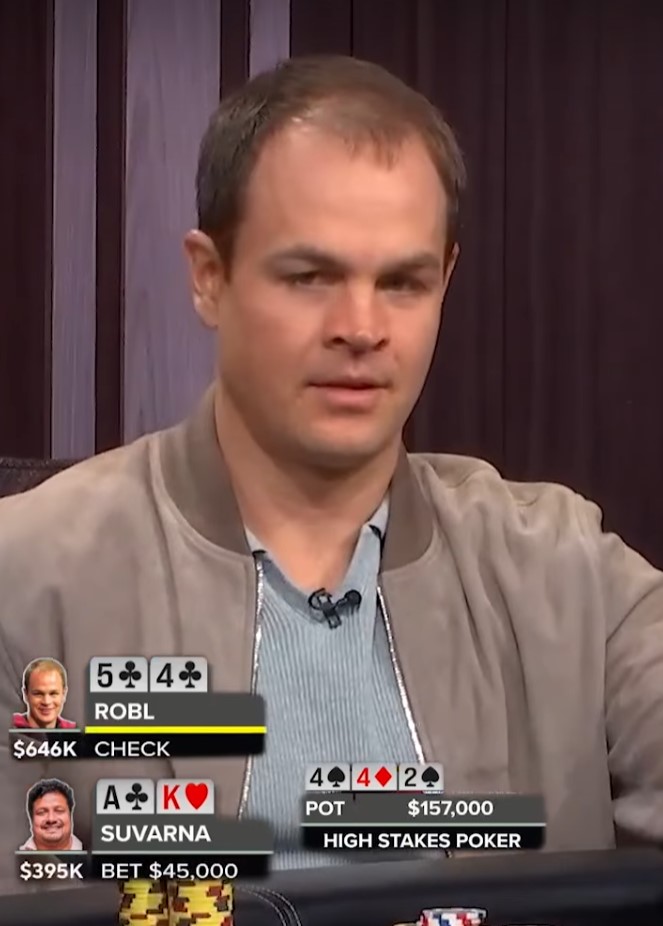
Robl got the dream flop of 4s4d2s and was holding trips in a spot where few would believe he had such a strong hand.
Hoping that he was on the winning side of a poker cooler, Robl checked his option and allowed Santhosh to fire out a standard $45,000 c-bet. Robl smooth called the bet and was going to let the Indian casino owner hang himself.
The turn was an absolute disaster for Santhosh, as the Kd now gave him top pair, a hand that would beat nearly all of Robl’s potential holdings.
Both players checked, believing they were trapping the other, before the Ks hit the river and brought the unlikely win for Santhosh.
Holding a full house and up against what is likely to be a pocket pair at this point, Robl overbet the pot for $300,000, only to be met with resistance in the form of an all-in from Suvarna.
It was only $95,000 more for Andrew to call, but it seemed like his hand was always going to be beat. The high-stakes legend made the call after some deliberation and ended up losing one of the biggest pots in TV poker history.
My coaching takeaway: Robl’s decision to overbet the river for $300,000 is the kind of play that works against most of the range he would expect to be ahead of. What made this a cooler rather than a mistake is the river card: the Ks completing a full house for Suvarna was one of the worst possible cards for Robl to face. Once the Ks hit, folding to the all-in was mathematically correct, but calling off $95,000 more into a $600,000+ pot at those odds remains defensible. Either way, Robl played the hand well and ran into one of the top few hands that could beat him.
Cooler #3 – Tom Dwan vs Phil Ivey – Million Dollar Cash Game
Back in 2009, poker was booming, and Full Tilt Poker was one of the big brands in the industry. As part of their promotional efforts, they hosted a Million Dollar Cash Game on Sky Sports for a few years straight, with some of the biggest names in the game playing for insane stakes.
In the dying hours of one of the sessions, the game was down to just three players, and these three were Tom Dwan, Phil Ivey, and Patrik Antonius, three of the most beloved players of the time.
With only 3 players, and especially with these 3, the poker ranges were always going to be wide and lead to some extremely interesting situations.
Dwan opened the pot with his 7h6s and was met with a 3-bet to $23,000 from Ivey’s Ac2d, which he called on the button to see the flop of Jc5c3d.
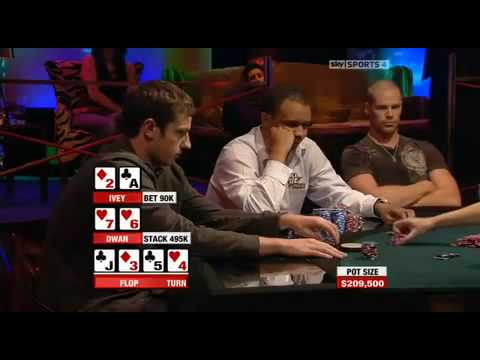
Ivey fired a $35,000 bet and would have won the pot on many turn cards. The 4h, however, was not one of them, as it gave both players the straight and created the ultimate cooler scenarios.
With both players believing they just struck gold and Dwan still sitting on nearly half a million in chips, this pot was setting up to grow insanely big.
Ivey fired a $90k bet and Tom responded with a raise to $232.6k. Phil didn’t take too long before moving all-in, as he knew Tom was committed to the pot and would not fold if he had a hand like a set or two pair.
Yet, Dwan had the absolute nuts this time around and would walk away as the winner of a $1.1 million pot, a number that left most poker fans in awe of the young internet poker prodigy.
My coaching takeaway: Straight versus straight coolers are among the most unavoidable in poker. When both players hit the same card to complete a straight and one holds the higher straight, there is no strategic path that separates the losing player from their chips. What stands out to me about this hand is the flop: Jc-5c-3d, where Ivey held A2 and Dwan held 76. Ivey had a significant equity advantage on the flop and played it correctly. The turn 4h was simply a card that ended his chance of winning. No training or game selection prevents a hand like this.
Cooler #4 – Alan Keating vs Rahul – Hustler Casino Live
The Hustler Casino Live Million Dollar Game has offered us some of the most epic lineups and biggest pots in TV poker history, including this huge cooler situation between Alan Keating and Rahul.
With blinds at $1k/2k and a $4k straddle on, Rahul opened the action to $15k holding 8s7s, and Thomas, Stanley Tang, Brandon Steven, and Alan Keating all made the call to create a massive $77k pot before the flop.
The flop saw Js8h4s, giving Rahul a pair and a flush draw, while Keating held Ts9s for an open ender and a flush draw.
Rahul bet out for $40k, and Keating uncharacteristically decided to call with his massive draw, taking us to the Ad turn card.
Alan checked once again, and Rahul wagered $140k this time, putting Keating in a bit of a tough spot with his draw.
Once again, Keating decided to just call out of position. The dealer put out the 7h, which was one of the worst cards Rahul could possibly see.
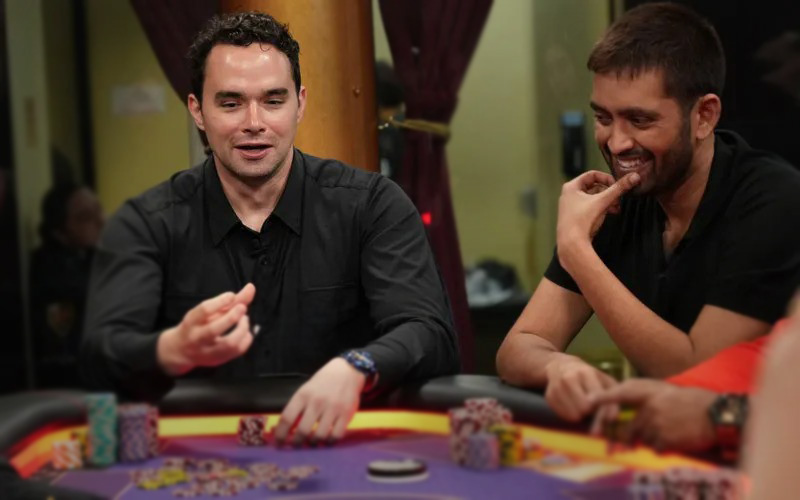
With a million dollars back, Keating once again checked, and Rahul had a decision to make between showing down his hand or going for the value bet.
He opted for the latter and put out a $200k bet, which was naturally met with a million-dollar shove from one of the most fearless players in the game.
This might not be much of a cooler against most other players, but with Alan Keating being capable of bluffing in nearly every spot, Rahul decided he had enough hand to bluff catch.
The newcomer to the game made the call and sent the pot to $2.4 million, prompting Keating to take a short walk around the table after winning one of the biggest pots in HCL history.
My coaching takeaway: This hand sits on the edge of a true cooler and a call that was influenced by opponent tendencies rather than pure hand equity. Rahul’s straight flush draw combined with two pair on the river gave him a very strong hand. What made the call borderline rather than purely correct was the river card completing the straight flush: against a typical opponent, this call might be too loose, but Keating’s history of big bluffs changes the math. I tell students that exploitative adjustments like this are valid, but they require genuine reads, not simply the feeling that someone bluffs a lot.
Cooler #5 – Tan Xuan vs Adrian Mateos – Triton Poker Series
The Triton Poker Series has taken the meaning of high-stakes poker to a new level, creating some of the biggest poker tournaments and cash games ever seen.
In early August 2024, Triton Poker set up a super high-stakes cash game in Montenegro, with the likes of Phil Ivey and Adrian Mateos taking on the Asian pros and businessmen in the beautiful Mediterranean location.
In one of the sessions, the Spanish tournament super-pro Adrian Mateos clashed with a Triton Poker regular, Tan Xuan, right out of the gate, leading to a massive pot worth just under a million dollars.
Holding AdKs, Mateos 3-bet over the top of Xuan’s open, making it $32,000 to go, and Tan called with a pair of tens, revealing the flop of Th7s5c.
Unimproved, Mateos c-bet for $40k and got the call from his opponent, which would probably not have cost him too much had the turn card not been the Ah.
Now beating many of the hands Xuan calls with on the flop, Mateos once again bet, this time making it $90,000 to go.

Once again, Xuan called, and once again, the board decided to punish Mateos by putting out the Kc on the river, now making his hand very close to the nuts.
Barring a few sets, Mateos could beat any other card combo in Xuan’s hand, which is why he confidently bet out for $168,000 on the river as well.
Xuan pushed all-in for $336,000, and Adrian was forced into making a call in one of the ugliest poker coolers of the session. This awarded Tan Xuan a million-dollar pot very early in the day.
My coaching takeaway: Mateos played this hand as well as anyone could with top pair top kicker, and it became a lesson in how dangerous the flop call from Xuan with a set can be. The turn Ace gave Mateos a hand that was almost certainly the best hand against most of the range that calls twice on wet boards, which is why he continued betting. The river King completing what Mateos believed was the near-nuts is the kind of runout that defines a cooler. I use this hand in coaching sessions to illustrate why set-over-set spots feel so catastrophic: every card that improves one hand can simultaneously create a false sense of security in the other.
Cooler #6 – Elton Tsang vs Tony G – Triton Poker Series
The recent Triton Poker Series Invitational Cash Game in Montenegro created more than one massive cooler, including this one that involved the “Bad Boy of Poker,” Tony G.
Known for his aggressive playing style and abrasive demeanor, Tony G is usually the one putting bad beats on players, but this time, the tables were turned.
Starting the hand with nearly three-quarters of a million dollars, Tony looked down at a pair of red cowboys and, facing an open limp from Elton Tsang, bumped it up to $20k, with blinds sitting at $1k/2k and a $5k ante in play.

To his great misfortune, Tsang had ignored GTO poker principles completely and limped pocket Aces, and he 3-bet to $70k when action folded back to him, to which Tony responded with another raise, this time to $245k.
Elton decided to just call, and with half a million dollars in the pot, the money quickly got all-in on a board of QhJc7h that didn’t really change much for either player.
Tsang held the Ah in his hand, denying Tony’s chance to make a flush, and eventually made a set of Aces on the river, awarding him the $1.45 million pot, the biggest of the session.
With that, Tony G suffered one of the biggest coolers in TV poker history in terms of dollar value, but certainly not the biggest of his illustrious poker career, which includes plenty of games even bigger than this one.
My coaching takeaway: Tony G’s four-bet with Kings is standard play. The trouble came earlier, when Tsang’s limp with pocket Aces gave Tony no information to work with before the stacks were already heavily committed. This hand shows both sides of the slow-play debate. Tsang’s limp was rewarded here, but in most situations against opponents who do not four-bet light, limping Aces leaks significant value compared to an immediate three-bet. Against Tony G specifically, this play was well-calibrated. The lesson for students is that table-specific reads matter enormously in spots like this, and what looks like a mistake in a vacuum can be correct against a known aggressive player.
Cooler #7 – Patrik Antonius vs Daniel Negreanu vs Phil Ivey – High Stakes Poker
It’s not every day that a poker cooler involves three players in a meaningful way, but this hand that was played on Season 9 of High Stakes Poker did, and it was three of the most iconic players in the game.
The action started with Patrik opening to $2.5k, and Gibbs, Negreanu, and Ivey all calling to see the flop of Th9d5c, giving Patrik a set of 5s and Negreanu a set of 9s, while Ivey held KcTd.
Patrik continued for $5k with his set, Daniel called to trap, and Ivey overcalled holding top pair with a good kicker that’s often going to be the best hand.
The Tc on the turn improved Ivey’s hand significantly, giving him every reason the believe he now holds the best hand of the three.
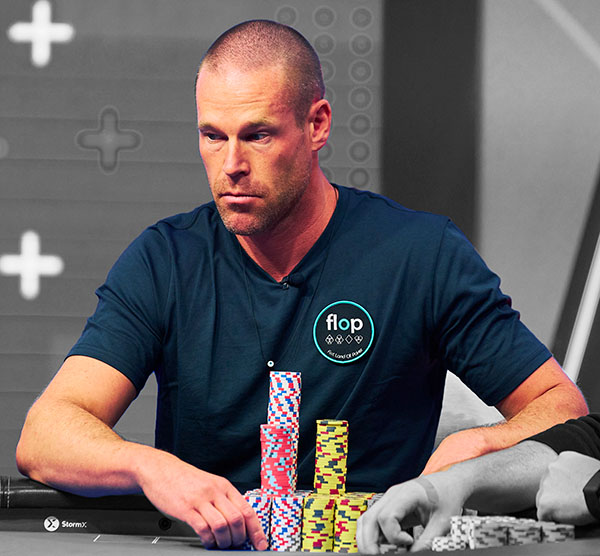
Everyone checked to Negreanu on the button, and he bet out for $26k, a bet that both players called before the inconsequential Qd hit the river.
With $104.5k in the pot, everyone checked to Daniel again, and he bet $54k with his full house, one of the best poker hands he will have in this spot. Ivey took some time but eventually found a great laydown, while the stoic Finn decided to bet all his chips, still believing he had the best hand.
Despite holding a very strong full house and getting over 3:1 on his money, Negreanu eventually decided to make a very big fold, which turned out to be wrong this time.
Patrik walked away as the winner despite not having the best hand in this ultimate poker cooler, while Negreanu was left lamenting his decision, which perhaps had to do something with the pot he played against Gus Hansen many years earlier.
My coaching takeaway: Negreanu’s fold with 9s in a three-way pot was the most interesting decision in this hand. Holding a flopped set that improved to a full house, then facing an all-in from Antonius who showed no weakness the entire hand, Negreanu made a great read. The problem is that even correct reads can cost you pots. Antonius had a stronger full house (Fives full of Tens against Nines full of Tens), but Negreanu could not know this with certainty. I find this hand useful for teaching students that folding in a three-way pot where one opponent plays like they have the stone cold nuts is often the correct play, even with what most players would consider an uncallable holding.
How to Handle Poker Coolers Without Going on Tilt
Coolers are part of poker. Every player at every level encounters them. The question is not how to avoid them (you cannot) but how to process them quickly so they do not damage the rest of your session.
- Separate the outcome from the decision. A cooler is not a mistake, and it should not trigger the same internal review process as a bad play. When you evaluate a hand after a cooler, the conclusion should be rapid: I played correctly, the cards ran out badly, move on. If the review takes longer than that, you are looking for an error that does not exist, which is its own form of tilt.
- Recognize the financial math. Coolers are expensive in the moment but neutral over large samples. If you flop a set of Queens and your opponent flops a set of Kings, you will lose that hand every time. But over thousands of sessions, you will also be the one flopping the Kings. The money you lose in coolers is returned to you in coolers you win. Keeping this perspective in the immediate aftermath of a bad cooler is genuinely difficult, but it is the correct frame.
- Take a short break when the stack is gone. In my own experience playing high-stakes tournaments and cash games, the coolers that lead to tilt are almost always the ones where I get back into a hand within five minutes of the loss. I now build in a forced break of at least one orbit after any significant cooler, not to recover emotionally, but to confirm I am making decisions for the right reasons before putting money back into play.
- Do not explain the cooler to other players at the table. The impulse to recount what just happened is understandable, but it keeps the emotional impact alive longer than it needs to be. Let the dealer move on. Get your chips back if you rebought, and focus on the next decision.