
The worst poker hands in Texas Hold’em share three characteristics: they are unconnected (cannot make a straight), unsuited (low flush potential), and contain low cards that make weak pairs when they hit. The bottom of the hand rankings is dominated by two-gap offsuit combinations involving Deuces and low Sevens or Eights.
I have played millions of poker hands across live and online formats, and the patterns I see in losing players are remarkably consistent. The single most common mistake is not folding these hands preflop.
Players convince themselves they can outplay the board, but the equity is so unfavorable that no amount of postflop skill recovers the expected value lost by calling or raising with these starting hands. Below, I rank the ten worst starting hands in Hold’em and explain exactly why each one should stay in the muck.
Download Worst Poker Hands PDF Guide
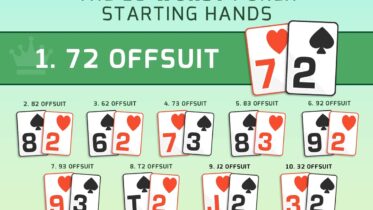
#1 Worst Poker Hand – 72 Offsuit
If there is one hand poker players hate to see, it is 72 offsuit. Statistically speaking, this is the worst possible starting card combination you can be dealt in Texas Hold’em.
If you look at the two cards, the reasons why 72 offsuit is so bad become quite clear. The two cards are low, making any potential pair quite weak and disjointed, which makes it impossible to form a two-card straight.
Since 72 offsuit also doesn’t contain any suited cards, the potential for a flush is weak, and the flushes you do make will rarely be the best.
Essentially, 72 offsuit will very rarely make any of the stronger poker hands.
If you are dealt 72 offsuit in a regular poker game, throw your cards away immediately and don’t think about making any fancy plays.
The only time you should consider playing 72 offsuit is when the “72 Game” is in effect, which means that any player who wins with 72 offsuit wins additional money from each player at the table.
Even if you are playing with the “72 Game,” you should still be careful not to overplay this hand, as the extra money you stand to win is nothing in comparison to the chips you stand to lose if you go too far with a bluff.
I use 72 offsuit as a benchmark in coaching sessions. When a student asks me whether a particular hand is too weak to play in a spot, I ask: “Is it better than 72 offsuit?” If the answer is yes, we at least have a conversation. If the answer is no, the fold is automatic. No hand in Texas Hold’em is statistically worse to start with, and the data in the win rate table below confirms this.
#2 Worst Poker Hand – 82 Offsuit
There isn’t much of a difference between 72 and 82 offsuit. Both hands are disjointed and unsuited, and they are both comprised of a couple of low cards.
Making a pair of eights is a tiny bit better than making a pair of sevens on some boards, which makes 82 offsuit a notch better than 72 offsuit, but both are at the very top of the list of the worst poker hands you could be dealt.
If you are dealt 82 in a poker game, you should throw your cards away the same way you would throw away your 72.
Since “82 Game” is not really a thing, even the one redeeming quality of the worst poker hand does not apply to the next worst!
I find 82o actually gets misplayed more than 72o in recreational games, likely because players see the Eight as a meaningful card. It is not. Against any reasonable opening range, 82o wins around 27% of the time. That number does not improve much regardless of position, stack depth, or how your opponent is playing. Fold it.
#3 Worst Poker Hand – 62 Offsuit
Looking over the list of the worst poker hands, you are probably noticing a pattern in that they are all made up of low and junky offsuit cards.
Next on the list is 62 offsuit, whose one advantage over 72o and 82o is the ability to make a two-card straight.
If you start with 62, there is a chance the board will bring 5, 4, and 3, giving you a straight. A straight is a powerful hand and will often win you the pot if you do get the right board.
Of course, the odds of making a straight are astronomically low, but the ability to flop some straight draws also allows you to find more bluffing opportunity spots with 62.
Overall, 62o is a hand you should still fold in almost all cases, but one that can become playable in a few extreme scenarios.
The straight potential of 62o sounds meaningful in theory, but in practice it means very little. The straight draw arrives so rarely and requires such a specific board that treating 62o as a “connected” hand in any strategic sense is a mistake. In my experience reviewing student hands, players who try to use 62o as a semi-bluffing vehicle end up overcommitting on draws that miss far more often than they hit.
#4 Worst Poker Hand – 73 Offsuit
Another one of the worst poker hands you can imagine is 73 Offsuit. Much like 62 offsuit, 73 offsuit can make a two-card straight, which makes it slightly more playable than a hand like 72 offsuit.
In either case, 73o does not have many redeeming qualities, including the lack of “72 Game” opportunities, and is almost as bad as it can get in terms of starting poker hands.
You will occasionally see the splashiest poker players get in the mix with 73o, but if you look at optimal poker ranges for any play, this hand will not be a part of them.
In the long run, almost any other starting hand plays better and has more potential to win the pot than 73o, which is why playing 73o makes very little sense.
73o occasionally appears in student hand histories where a player in the big blind “floated” into the hand for free and then continued down a losing path. The mistake is treating the free look as permission to play the hand seriously. Being in the big blind does not change the fundamental equity problem with 73o. Check if you get to check; fold to any aggression.
#5 Worst Poker Hand – 83 Offsuit
The first hand on this list without a Deuce, 83 offsuit is not meaningfully better than the hands already covered here.
In fact, there is very little difference between 83o and 72o, as neither hand has the potential for a two-card straight, and both hands are made up of two low cards that don’t play well postflop.
Generally speaking, 83o is considered one of the worst poker hands you can get, and most players never play this hand, regardless of the situation.
The next time you get dealt 83o, the best thing to do is show restraint, throw the cards in the muck, and wait for a better opportunity, regardless of your poker position or chip stack.
One thing I consistently tell players about hands like 83o: the absence of a Deuce does not make it playable. The relevant question is how often the hand wins at showdown, and 83o has roughly the same win rate against a standard range as 72o. Fold it the same way.
#6 Worst Poker Hand – 92 Offsuit
92 offsuit has slightly better equity than the hands listed above it, since the Nine gives more high-card potential than the lower cards in 72o or 83o. This advantage is minimal in practice. Against any realistic range, 92o wins around 27% of the time, and the pairs it makes rarely hold up by showdown.
The reason 92o appears on this list rather than 94o or 95o comes down to straight potential and board coverage. 92o cannot form a two-card straight and is consistently outperformed by the similar-looking hands that edge slightly above it in equity rankings.
I find that players who get into trouble with 92o are usually treating the Nine as a “big card” anchor. It is not. Against a player raising with a range of top 15% hands, your Nine is beaten by a majority of their holdings. Fold 92o from any position except in situations where you can take a free flop from the big blind, and even then, proceed cautiously.
#7 Worst Poker Hand – 93 Offsuit
We already mentioned the 92o, and there is very little difference between it and 93o.
In fact, the two hands are nearly identical, and the slightly improved kicker in 93o almost never makes any real difference.
Making a pair with either hand will put you in a situation where you can win a small pot or lose a fairly hefty one, while straight and flush possibilities are not available.
Much like 92o, 93o plays very badly on almost any board, gives very few semi-bluffing opportunities, and simply doesn’t make for a good starting hand.
The next time you are dealt 93o, throw the hand away and wait for the next deal, as you are almost guaranteed to have better cards come your way.
93o and 92o are nearly interchangeable in terms of playability. The Three kicker makes almost no difference. What I look for when coaching players on these hands is whether they are treating the Nine as a reason to play. It is not a reason. Fold both 92o and 93o from any position before the flop.
#8 Worst Poker Hand – T2 Offsuit
Another terrible starting hand in poker is T2, the hand that was made famous by poker legend Doyle Brunson, who won two World Series of Poker Championships holding these exact cards.
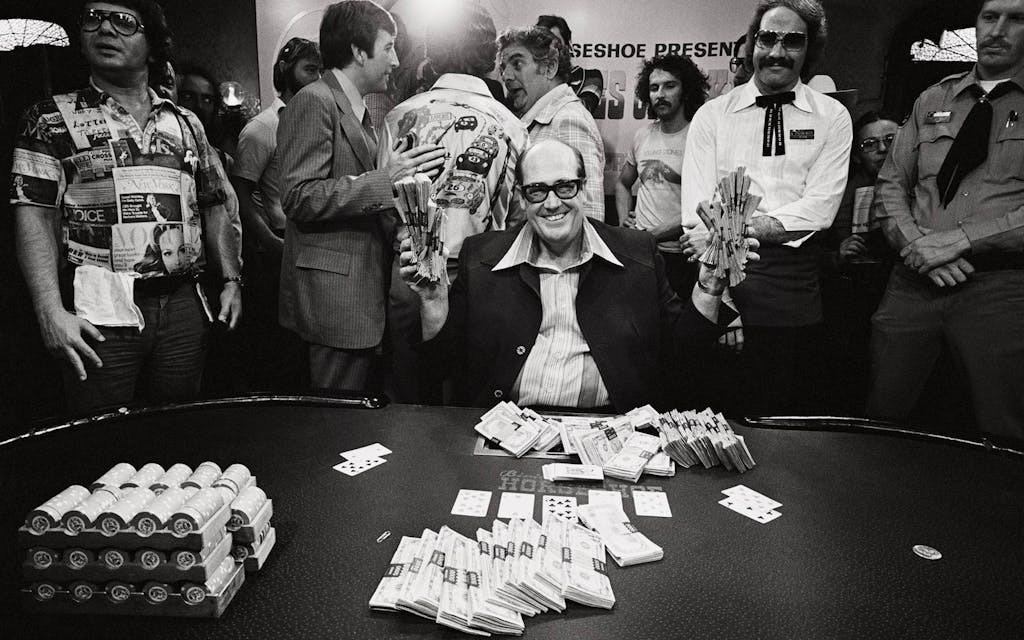
Out of all the bad poker hands, T2 offsuit is probably the most overplayed one, as poker players around the world try to impress their peers and show off by winning pots with the hand that Texas Dolly got lucky with a couple of times.
The truth is that T2 offsuit is one of the worst hands in poker, and it is definitely not worth putting more chips into the pot than necessary.
Having a Ten in your hand is a bit better than having a low card to go with your Deuce, but the fact that you can’t make a straight with T2o somewhat negates that slight advantage.
Overall, avoid playing T2o in most scenarios and definitely avoid playing it just for the sake of turning over “The Doyle” once everyone else has folded.
T2o comes up in coaching more than any other hand on this list because of the Doyle Brunson mythology. Players want to believe that winning with a legendary player’s hand makes them a better player. It does not.
Doyle Brunson winning two World Series bracelets with T2 is the definition of survivorship bias. He played thousands of hands and that combination happened to come through twice at critical moments.
I have reviewed hundreds of student hands where T2o was played “for the story” and it almost never ends well. If you want to honor Doyle Brunson, play tight and aggressive. That is what actually made him great.
#9 Worst Poker Hand – J2 Offsuit
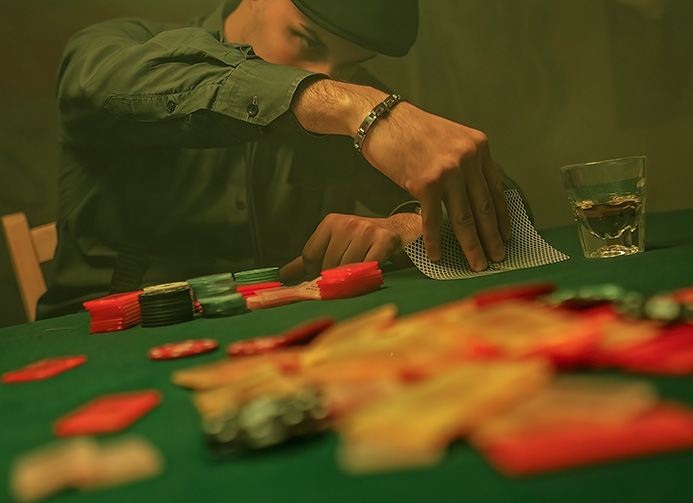
Seeing a picture card like a Jack can be a big refreshment after getting dealt cards like 83 and 72, but it should not be enough to tempt you to play if your other card is a Deuce.
A starting hand like J2o is very similar to T3o and T2o, and it does not provide any real reasons to get involved in a pot.
Much like other hands on our list of the worst poker hands, J2o cannot make a two-card straight, although flopping a pair of Jacks can sometimes be enough to win a pot.
Yet, you should at least wait for your J2 to be suited before you start opening from the small blind or defending in the big blind, while you can safely throw away all your J2o combinations before the flop.
Put simply, whether it’s a GTO poker strategy or otherwise, J2o should never be part of a sound poker strategy.
The Jack in J2o is the most dangerous part of this hand for recreational players. A Jack feels like a face card worth playing. It is not, not with a Deuce attached.
The Deuce eliminates straight potential across almost any board, and pairs of Jacks frequently lose to top pair with a better kicker. I tell students: if your kicker is the worst card in the deck, assume your pair will lose to a better kicker more often than not.
#10 Worst Poker Hand – 32 Offsuit
Much like 62 offsuit, 32 offsuit has some potential to make a straight. In fact, there are two different ways you can make a straight with 32, which makes it slightly better.
The fact that a 3 and a 2 are the two lowest cards in the deck does not help in any way, but making a pair of deuces or a pair of sixes usually won’t make much of a difference anyway.
On the other hand, the slight straight potential of 32 offsuit does make this hand a bit more playable than hands like 82 and 72, which is why it sits in fourth place on the worst poker hands list.
But 32o didn’t get its poker nickname, “The Dirty Diaper”, for no reason, and should still not be a part of your raising or calling range too often, but playing it from the small blind or checking back in the big blind can give you a chance to see some flops with it.
32o has the unique distinction of being the worst non-Deuce hand on this list. Its “Dirty Diaper” nickname is accurate. While the straight potential is real (more so than most hands here), the card values are so low that even a completed straight is often the lower end of possible straights on a given board.
In my live cash game experience, I find it profitable to fold 32o from any position other than the big blind, and even there, I proceed only when I can do so cheaply.
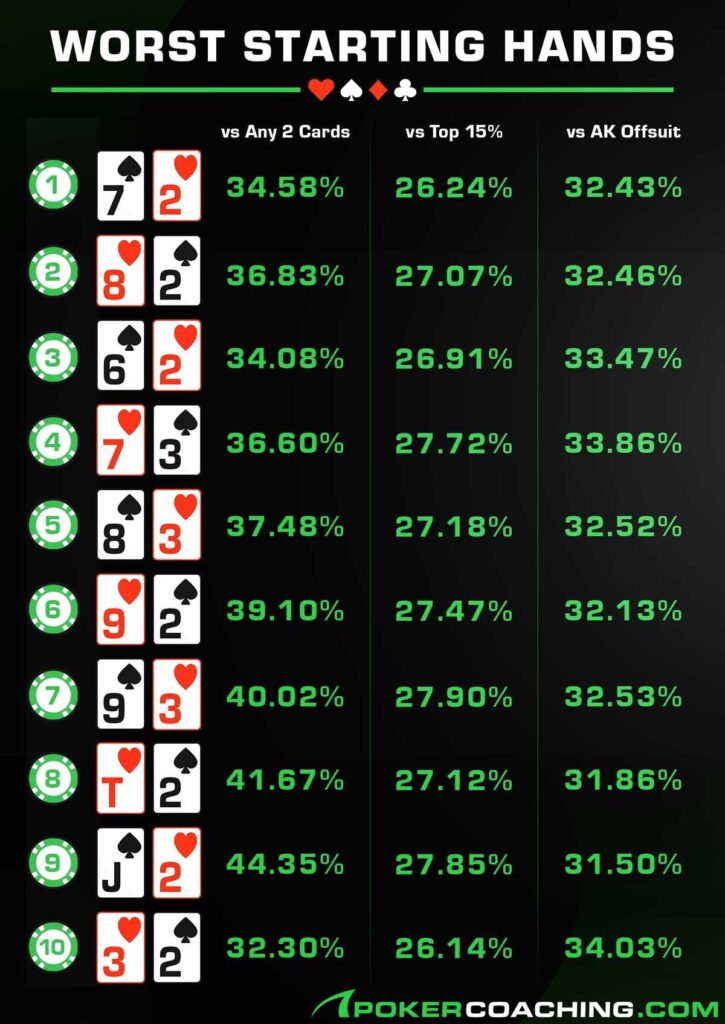
Worst Poker Hands Probabilities
| Hand | vs Any 2 Cards | vs Top 15% | vs AKo |
| 72o | 34.58% | 26.24% | 32.43% |
| 82o | 36.83% | 27.07% | 32.46% |
| 62o | 34.08% | 26.91% | 33.47% |
| 73o | 36.60% | 27.72% | 33.86% |
| 83o | 37.48% | 27.18% | 32.52% |
| 92o | 39.10% | 27.47% | 32.13% |
| 93o | 40.02% | 27.90% | 32.53% |
| T2o | 41.67% | 27.12% | 31.86% |
| J2o | 44.35% | 27.85% | 31.50% |
| 32o | 32.30% | 26.14% | 34.03% |
How to Play the Worst Poker Hands
The answer is straightforward: fold them. Every hand on this list should be discarded before the flop in the vast majority of situations, and the equity tables above confirm why.
The suited version of some of these hands (72s, 62s, 32s) adds flush potential that the offsuit versions lack, but this improvement is marginal in absolute terms and does not transform any of them into profitable hands in standard poker strategy situations.
There are a small number of edge cases worth knowing. From the big blind, when there is no raise and you can see the flop for free, checking is often correct even with hands this weak.
The free flop does not cost you anything, and you may connect in an unexpected way. However, the moment any investment is required preflop (a call, a limp, or certainly a raise), these hands should go to the muck immediately.
Position does not rescue these hands. I have seen students argue that hands like 73o or 93o become playable in late position because they can pick up the pot with a steal. That argument requires opponents who fold too much to continuation bets, and it requires the board to cooperate.
Folding and waiting for a better spot is almost always higher expected value than manufacturing a reason to play garbage.
The clearest signal I have seen from tracking student results over thousands of hands is this: the players who leak the most chips preflop are not the ones who misplay big hands. They are the ones who find reasons to play small hands.
Eliminating your worst starting hands from your preflop range is one of the fastest, most measurable improvements available to any player who is not yet consistently winning.
FAQs
What is the worst hand in poker?
Statistically speaking, 72 offsuit is the worst hand in poker. This hand contains the two lowest cards that can’t make a two-card straight and thus has the lowest potential to win a pot against the range of all other poker hands.
What are the most dangerous hands in poker?
Hands like 72o and 93o are not very dangerous because they are almost never played. However, hands like A7o and K9o can get you into a lot of trouble if you overplay them and make a pair, as you will often be up against the same pair with a better kicker.
Why is 72 offsuit the worst poker hand?
72 offsuit is the worst poker hand because it has the lowest equity against all other starting hands in the deck. The hand can’t make a two-card straight or flush and is made up of the two lowest cards with these characteristics.
What is the weakest card in poker?
The weakest card in poker is the Deuce. Since suits don’t really matter in Texas Hold’em Poker, any Deuce you are dealt will be equally as bad as any other.