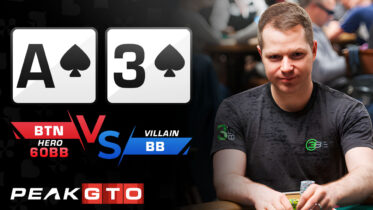
Every poker player learns how to bluff. Few learn when to stop bluffing. The decision to fire a second barrel feels aggressive and smart. The decision to check back the river with ace-high after two streets of aggression feels like surrender. But the solver disagrees. Knowing which cards in your hand make you bluff versus a check-back is the difference between printing chips and lighting them on fire, and the answer comes down to blockers, showdown value, and range composition.
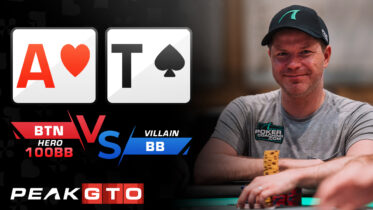
Today we will analyze a 60bb 8-handed tournament hand where the button opens A♠3♠, range bets small on J♠9♥2♦, fires a pot-sized barrel on the K♣ turn, and then checks back the 2♣ river. This hand illustrates how the flop c-bet, turn barrel, and river check-back each serve a distinct purpose, and why the solver treats ace-high differently from queen-high and ten-high when selecting river bluffs.
Assumptions
- Stacks: 60bb effective
- Format: 8-handed MTT, 12.5% ante
- Positions: BTN (Hero) vs BB (Villain)
- Action: BTN raises, BB calls
- Flop: J♠9♥2♦ (Pot: 6.1bb)
- Turn: K♣ (Pot: 9.1bb)
- River: 2♣ (Pot: 27.3bb)
Preflop
At 60bb, the button opens roughly 54% of hands in GTO. A♠3♠ is comfortably inside that range. In practice, most opponents do not 3-bet from the blinds nearly often enough with the hands they should, like K6 suited, A5 offsuit, and 96 suited. That means the button can profitably open even wider than the solver suggests, adding hands like K4 offsuit, Q7 offsuit, and 76 offsuit.
The big blind calls. At 60bb, BB’s calling range is wide and capped. The absence of a 3-bet removes premiums from BB’s range, which will matter on every street that follows.
Flop: J♠9♥2♦
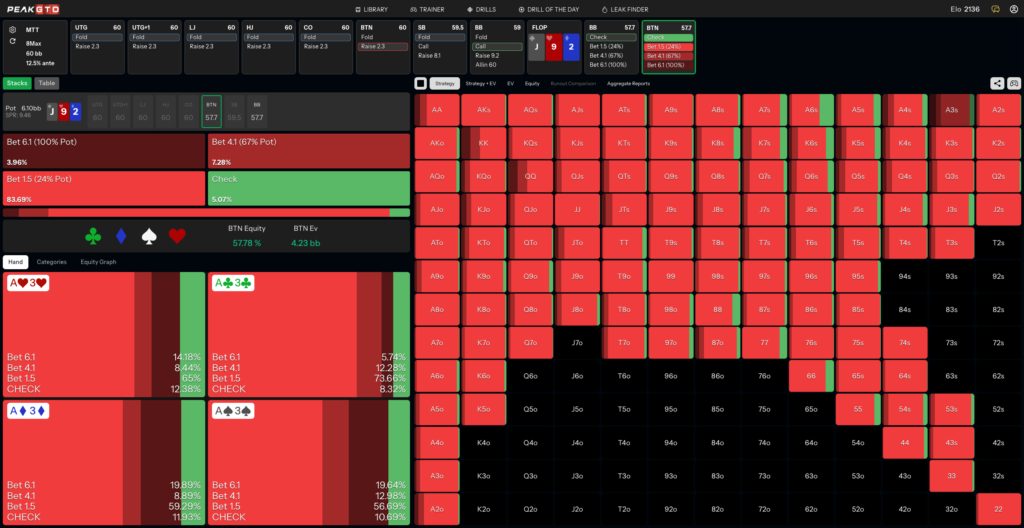
BB checks 99.3% of the time. This board gives the button a slight equity advantage at roughly 57.8%. The equity graph shows the green (IP) line sitting just above the red (OOP) line across the entire range. That small, consistent edge is the signature of a range c-bet spot.
Hero bets the small sizing at 83.7%, with larger sizes appearing at 7.3% (67% pot) and 4.0% (100% pot). Only 5.1% of the range checks. This is a spot to bet the entire range small and push equity across the board. The board connects well with BTN’s marginal opens: J8 offsuit, 98 offsuit, 97 offsuit, and 94 suited all have pieces of this flop.
A♠3♠ specifically is not an ideal hand to bet. It does not fold out many better hands, and it does not get called by many worse hands with zero equity. But in a range-bet spot, individual hand logic is less important than range logic. When the plan is to bet nearly everything for a small price, every hand comes along for the ride.
Hero bets 1.5bb. BB calls 46.6%, folds 36.2%, and raises 17.2% across two sizes. BB calls.
Turn: K♣
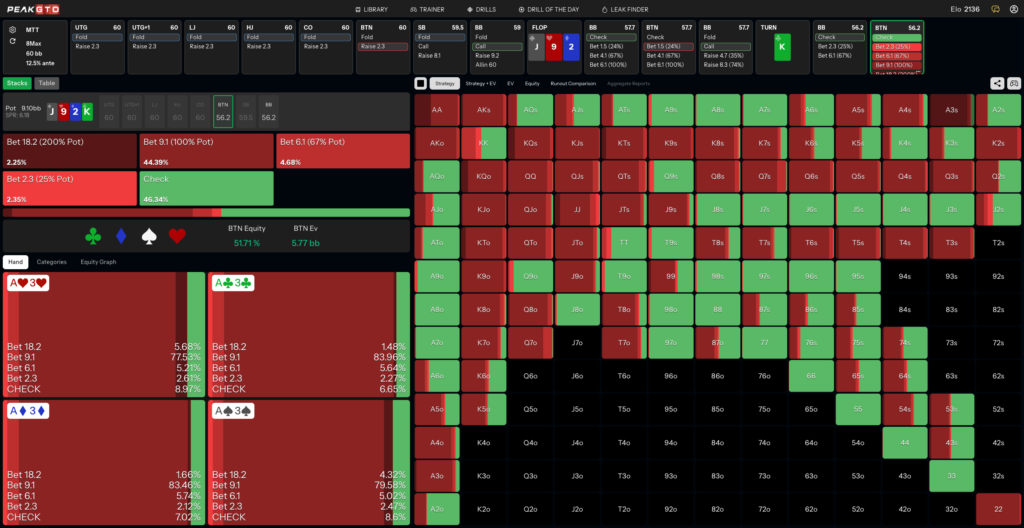
BB checks 99.5%. The K♣ is a significant card for the button’s range. Every K-x offsuit that opened preflop just made top pair. K8 and better bets every time. Even K5 offsuit and K3 suited bet the majority. That creates a wide, strong value range on the turn, and a wide value range needs bluffs to stay balanced.
PeakGTO shows Hero betting 53.7% of the time, with the pot-sized 9.1bb (100% pot) as the primary sizing at 44.4%. The overbet is appropriate because the turn completes QT to the nut straight (K-Q-J-T-9), gives T8 an open-ended straight draw, and gives T7 a double gutshot. BTN’s nut advantage widens further on this card. Hero checks 46.3%.
Which bluffs qualify for the turn barrel? The solver starts with the obvious draws: T8 picks up an open-ended straight draw and T7 gains a double gutshot. Low T-x hands (T3 suited, T4 suited) also gain gutshots. All Q-x that missed the board goes for a bluff. And then it reaches for the lowest overcard with the weakest kickers: ace-low hands like A5, A4, and A3.
Why A3 and not A8? Because A3 gets better hands to fold. When Hero bets ace-three and the opponent calls, it is almost always with something that was ahead anyway. But when Hero bets ace-eight, the opponent folds hands like ace-five that were actually behind. A8 gains nothing from the bluff. A3 forces the opponent into difficult decisions with hands like middle pair and weak top pair that should be continuing but often do not.
Hero bets 9.1bb. BB folds 55.3%, calls 39.6%, and raises 5.1%. Over half the time, BB folds to the turn barrel. BB calls.
River: 2♣
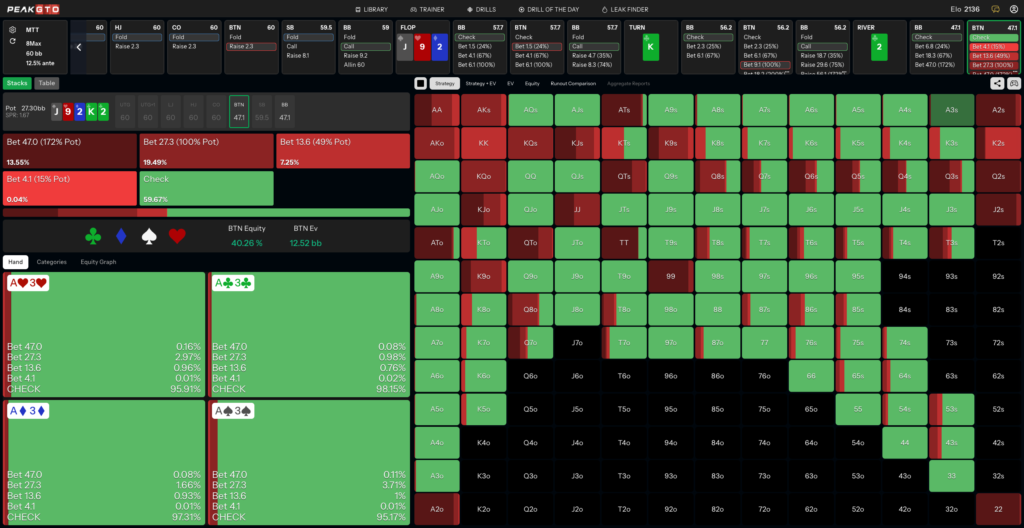
BB checks 96.4%. The 2♣ pairs the board and changes nothing structurally. No draws complete. The board finishes J♠9♥2♦K♣2♣. BB has some trips (K2, Q2, J2 suited, T2 suited from the flop call) and plenty of K-x that will never fold (K7 with a backdoor flush draw, K9 for two pair). Hero’s value range is narrow: the solver only bets K10 and KQ or better.
Hero checks 59.7%. When Hero does bet, the preferred sizes are large: 27.3bb (100% pot) at 19.5% and 47.0bb (172% pot, all-in) at 13.5%. The in-position river rule holds: when betting, use half pot or bigger. Smaller sizes do not appear.
The critical question is which bluffs get to fire the third barrel. The answer comes down to two factors: showdown value and blockers. Hands with zero showdown value, like T3 suited and Q4 suited, are the first choice. They can never win at showdown and gain everything from a fold. Hands with a queen or ten also block BB’s calling hands: KQ, KT, QJ, and JT are all combinations that would call a river bet, and holding a queen or ten removes some of those from BB’s range.
A♠3♠ fails both tests. Ace-high has a small amount of showdown value. It is not much, but it beats every busted draw that checks behind. And the ace does not block any of BB’s calling range. BB is not calling a river shove with ace-high. The GTO solution has A♠3♠ checking back the river close to 100% of the time. In practice, betting every Q-x and T-x as a bluff while checking ace-high is a clean, exploitable simplification. Most opponents call the turn too wide and fold the river too often, making the Q-x and T-x bluffs even more profitable while ace-high retains its thin showdown edge.
Hero checks. The pot odds never enter the equation because Hero is the one deciding whether to bet, not whether to call. The question is purely about range construction: do I have enough bluffs, and is this hand one of them? The answer is no.
Key Takeaways
- Flop: On J♠9♥2♦, BTN has a slight equity edge (~57.8%) and range bets small at 83.7%. A♠3♠ is not individually strong on this board, but range-betting spots pull the entire range along. The small 1.5bb sizing targets BB’s air while keeping the pot manageable.
- Turn: The K♣ gives BTN a wide value range (all K-x), which requires a large bluffing range to balance. The pot-sized 9.1bb bet polarizes the range. A♠3♠ qualifies as a bluff because it is the lowest overcard with the weakest kicker, and betting it forces better hands like A8 to fold. BB folds over 55% of the time.
- River: The 2♣ completes nothing. Hero checks 59.7%. A♠3♠ is not a bluff candidate because ace-high retains thin showdown value and the ace does not block BB’s calling range. Better bluffs are T-x and Q-x: zero showdown value plus they block KT, KQ, QJ, and JT.
- Overall: The three-street arc of this hand, range bet, polarized barrel, disciplined check-back, shows how each street has its own bluffing criteria. The flop bets everything. The turn selects bluffs by overcard rank and kicker strength. The river demands both zero showdown value and the right blockers. A♠3♠ passes the first two filters but fails the third, and that is exactly where most players go wrong: they fire the third barrel because they fired the first two, not because the hand qualifies.