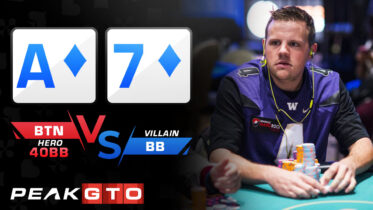
Being the preflop raiser who gets 3-bet and calls in position is one of the most common and most misplayed situations in tournament poker. You have a range and stack disadvantage, but you also have the single most valuable asset at the table: position. When you understand how to use it, a 3-bet pot stops being scary and starts being a place where you can quietly win pots your opponent never wanted to give up. This hand shows exactly how a weak-looking ace turns position into profit.
Today we will analyze a 40bb 8-handed tournament hand where Hero opens A♦7♦ on the button, calls a 3-bet from the big blind, and plays the flop and turn in position. The board comes T♥6♣2♦, K♥, and Hero floats a small flop bet, then stabs the turn when checked to and takes the pot away. This hand shows why ace-seven defends preflop, why a low flop is great for the in-position caller, and why the right turn bluff depends on your exact suits.
Assumptions
- Stacks: 40bb effective
- Format: 8-handed tournament (MTT)
- Positions: BTN (Hero) vs BB (Villain)
- Action: BTN raises, BB 3-bets to 9.2bb, BTN calls
- Flop: T♥6♣2♦ (Pot: 19.9bb): BB bets 5bb, BTN calls
- Turn: K♥ (Pot: 29.9bb): BB checks, BTN bets 7.5bb, BB folds
Preflop
Hero opens A♦7♦ on the button and the big blind makes it 9.2bb. Facing a 3-bet, Hero calls. The key to defending these spots is knowing the bottom of your range: against this standard size the weakest continues are offsuit hands like ace-eight and ace-ten offsuit, plus the bottom suited hands such as suited eights, king-four suited, and queen-six suited. A suited ace with a wheel card sits comfortably inside that defending range, so ace-seven suited is a clear call.
There are two adjustments here that most players skip. First, be sensitive to the 3-bet size: if the big blind makes it 7.5 or 8bb you defend wider, and if they make it 10 or 10.5bb you defend tighter, with offsuit hands far more size-sensitive than suited ones. Second, be sensitive to the opponent’s 3-bet frequency. A balanced big blind 3-bets around 17%, and if a player 3-bets much less than that you should fold out your weakest offsuit aces and junky suited hands, while a maniac who 3-bets far more lets you defend and re-shove wider. Knowing your exact bottom hands here is what makes the postflop decisions easy.
Flop: T♥6♣2♦
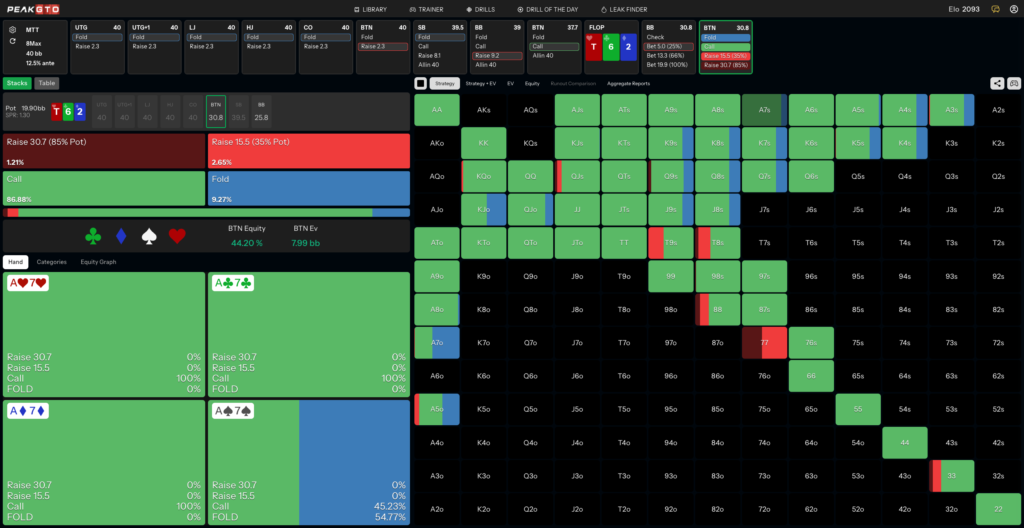
The big blind fires a small continuation bet of 5bb into the 19.9bb pot, about a quarter of the pot, and Hero calls. The math on a quarter-pot bet says the defender only needs to continue often enough that folding 80% would be too much, but in position Hero folds only about 9% of the time here, far less than the roughly 20% the bet size alone would suggest. Position lets Hero realize more equity, so marginal hands are worth peeling.
The reason this specific flop is so good for the caller is the ten. The bottom of Hero’s preflop defending range was offsuit tens, and a ten-high board means those hands just made a pair, while king-queen, king-jack, and queen-jack all hold two overcards and backdoor equity. Almost nothing in Hero’s range is truly dead. Crucially, every backdoor flush draw continues, and ace-seven of diamonds is exactly that: an ace-high hand with a backdoor flush and pair-outs to the ace. Many players would incorrectly fold a hand like this, but it is a comfortable float. Hero calls the 5bb bet, the pot grows to 29.9bb, and the hand goes to the turn with a wide, flexible range full of pairs, gutshots, and backdoor draws.
It is worth being clear about why calling is better than raising here. Raising the flop bloats the pot with a hand that is rarely best right now, and at 40bb it can commit Hero against a range that 3-bet preflop and is unlikely to fold many of its strong hands. Flatting instead keeps the pot manageable, conceals the strength of Hero’s actual continuing range, and most importantly preserves the advantage of acting last on every future street. From that seat, Hero gets to see what the big blind does on the turn before committing another chip, which is the entire reason a hand as thin as ace-seven can profitably continue. Position is not a tiebreaker here, it is the whole strategy.
Turn: K♥
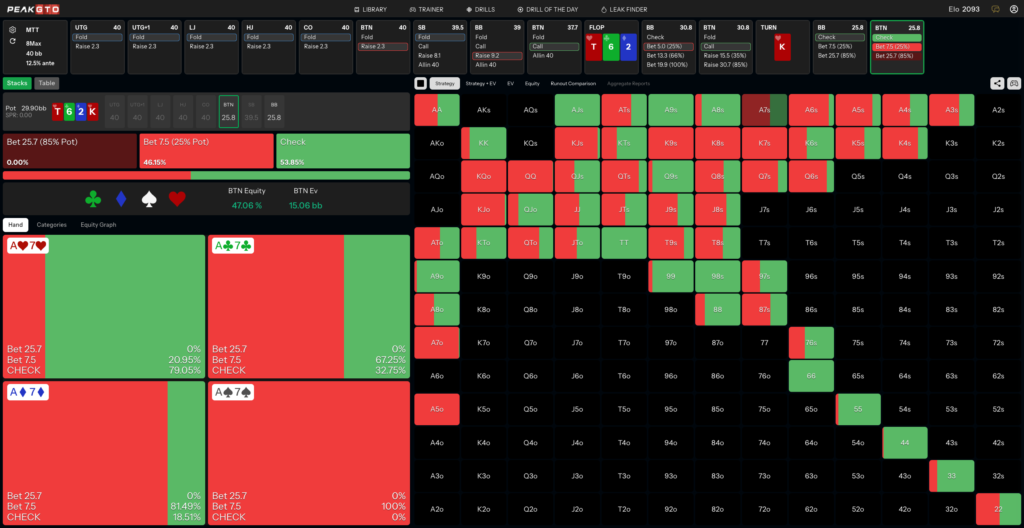
The K♥ arrives and the big blind checks. A huge chunk of Hero’s expected value in this whole line comes from exactly this moment, because the opponent will not bet or jam the turn every time, and when they check, Hero’s weakest floats get to keep playing. The king is also a card that improves Hero’s range: the king-queens and king-jacks that floated the flop now have top pair, every suited king connects, and the heart draws pick up a flush draw. Hero arrives on the turn in a strong spot with a clear plan.
With a stack-to-pot ratio of about one, the in-position play is not to jam but to bet small, somewhere between a quarter and 40% of the pot. Jamming is an out-of-position tool used to neutralize the other player’s position; in position you simply apply a small, relentless bet. The logic is that the big blind almost never has a king, since they would have bet it rather than checked, so Hero can value bet a ten or better and pile on bluffs. PeakGTO bets a quarter-pot 7.5bb here, and Hero takes that line with ace-seven.
The value side of that small bet is wider than it looks. Because the big blind would have bet a king, Hero can value bet basically every king for thin value and protection, and even a single pair of tens with hands like ten-nine, ten-eight, queen-ten, and jack-ten is happy to bet small, occasionally running into a better hand but rarely paying much given how big the pot already is. That deep value range is what gives Hero license to bluff aggressively, since the small size only needs to fold out the big blind’s air, which is exactly what it is full of: missed ace-high hands, weak offsuit aces, and small pocket pairs like pocket sevens, eights, and nines that cannot stand more pressure. The bet does not need to win often to print, and against a confused defender it wins almost every time.
The most instructive detail is which ace-seven gets to bluff. There is a rule here that feels counterintuitive: bet the suits that cannot improve and check the ones that can. Hands with a heart can make the flush, so they prefer to check back and avoid getting check-raised off their equity, while the club and diamond combinations, which have no flush potential, are the ones that turn into bluffs. Ace-seven of diamonds has no heart draw, so it is a natural small stab, betting its near-zero equity rather than checking. It feels backwards to bet your worst hands and check your draws, but that is precisely how you build a balanced, aggressive 3-bet pot strategy in position. Hero bets 7.5bb, the big blind folds its missed overcards and small pairs, and Hero scoops the pot without showdown.
Key Takeaways
- Preflop: Know the exact bottom of your defending range against a 3-bet. Ace-seven suited is a comfortable button call against a standard 9.2bb size, but adjust tighter or wider based on the sizing and the opponent’s 3-bet frequency.
- Flop: A low ten-high board is great for the in-position caller, so Hero folds only about 9% to a quarter-pot c-bet. Every backdoor flush draw, including ace-seven of diamonds, is a clear float.
- Turn: When the big blind checks a card they would usually bet if strong, stab small in position rather than jamming. Bluff the suits with no flush potential and check the ones that can improve.
- Overall: Playing a 3-bet pot in position as the preflop raiser is about patience and pressure. Float wide on good boards, let the opponent check to you, and apply small, persistent bets with the exact combos that make the best bluffs.