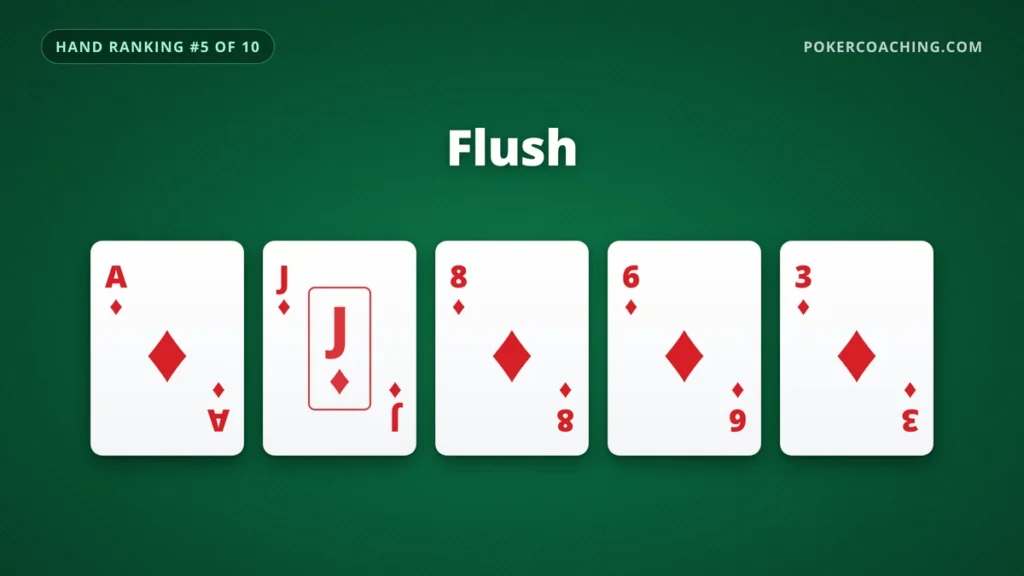
A flush in poker is any five cards of the same suit that aren’t in order, like A♦ J♦ 8♦ 6♦ 3♦. It ranks fifth of the ten poker hands, beating a straight and everything below it, and losing to a full house or better.
In Texas Hold’em you’ll make a flush about once every 33 times you see all seven cards. That’s often enough that you’ll regularly run into another flush, which is why knowing exactly how flushes are compared matters so much.
When I review student hands, the flush mistakes are rarely about making the hand. They’re about not noticing when it’s the second-best flush, or when a paired board has quietly turned it into a bluff catcher.
Poker hand rankings
What Beats a Flush?
4 hands beat a flush (a royal flush, a straight flush, four of a kind and a full house). It ranks #5 of 10 and beats the 5 below it.
- #5 of 10Hand ranking
- 5Hand types it beats
- 1 in 33Texas Hold’em hands
- 1 in 509Five-card deals
- 1Royal FlushA, K, Q, J and 10 of one suitA♥K♥Q♥J♥10♥Beats a flush
- 2Straight FlushFive cards in a row, all one suit9♠8♠7♠6♠5♠Beats a flush
- 3Four of a KindFour cards of the same rankQ♣Q♦Q♥Q♠7♦Beats a flush
- 4Full HouseThree of a kind plus a pairK♠K♦K♣4♥4♠Beats a flushDoes a full house beat a flush?
- 5FlushAny five cards of one suitA♦J♦8♦6♦3♦You’re here
- 6StraightFive cards in a row, mixed suits10♣9♦8♠7♥6♣Loses to a flushDoes a flush beat a straight?
- 7Three of a KindThree cards of the same rank7♠7♥7♦K♣2♠Loses to a flushDoes a flush beat three of a kind?
- 8Two PairTwo different pairsJ♥J♣5♦5♠A♣Loses to a flush
- 9One PairTwo cards of the same rank9♣9♥A♠Q♦4♣Loses to a flush
- 10High CardNo pair or better, highest card playsA♠J♦8♣5♥3♠Loses to a flush
Good to knowIn Texas Hold’em you’ll make a straight more often than a flush, which is exactly why the flush ranks higher.
Flush Examples (What It Looks Like)
Any five cards of one suit make a flush. Here are a few, from strongest to weakest.
- A♥ 10♥ 9♥ 7♥ 3♥ is an ace-high flush
- K♠ Q♠ 9♠ 8♠ 6♠ is a king-high flush
- 10♦ 9♦ 7♦ 5♦ 2♦ is a ten-high flush
- 8♣ 6♣ 5♣ 3♣ 2♣ is an eight-high flush
If the five suited cards are also in a row, like 9♠ 8♠ 7♠ 6♠ 5♠, you don’t have a flush anymore. You have a straight flush, which ranks second only to a royal flush.
In Texas Hold’em you can make a flush in three ways. Two suited hole cards plus three on the board, one hole card plus four on the board, or all five on the board.
When the Flush Is on the Board
If the board runs A♠ K♠ 9♠ 6♠ 3♠, every player still in the hand has at least that ace-high flush. Your hole cards only matter if one of them is a spade higher than the 3♠.
So Q♠ x beats J♠ x, and anyone without a spade above the three just plays the board and splits.
Which Flush Wins?
When two players both have a flush, you compare the highest card in each. If those match, you compare the second-highest card, then the third, and so on down to the fifth.
Here’s how that looks in practice.
- A♥ 7♥ 6♥ 3♥ 2♥ beats K♠ J♠ 10♠ 9♠ 8♠, because the ace beats the king
- J♥ 10♥ 8♥ 7♥ 5♥ beats J♣ 10♣ 8♣ 6♣ 5♣, because the fourth card (7 vs 6) decides it
- A♦ Q♦ 9♦ 5♦ 4♦ and A♠ Q♠ 9♠ 5♠ 4♠ split the pot
Suits never break ties. A king-high flush in spades is exactly as strong as a king-high flush in hearts.
Why the Nut Flush Matters
In Hold’em, only one suit can make a flush in any given hand, so flush-versus-flush comes down to who holds the highest card of that suit.
Say the board is K♠ J♠ 8♠ 5♠ 2♦ and you hold 9♠ 6♠. You have a king-high flush, K-J-9-8-6. But anyone holding the A♠ has A-K-J-8-5, and that beats you no matter what their second card is.
That’s why I want students to always ask one question before committing a big stack on a flush board. Do I have the nut flush, and if not, how many better flushes can my opponent actually have?
Flush Odds (How Often You’ll Make It)
| Situation | Odds | Probability |
|---|---|---|
| Five random cards | 1 in 509 | 0.20% |
| Seven cards (Texas Hold’em, seeing the river) | 1 in 33 | 3.03% |
| Being dealt two suited cards | 1 in 4.2 | 23.5% |
| Two suited cards, flopping a made flush | 1 in 119 | 0.84% |
| Two suited cards, flopping a flush draw | 1 in 9.1 | 10.9% |
| Two suited cards, ending with a flush by the river | 1 in 15.6 | 6.4% |
| Flush draw on the flop, hitting on the turn | 1 in 5.2 | 19.1% |
| Flush draw on the flop, hitting by the river | 1 in 2.9 | 35.0% |
A flush draw has nine outs, the 13 cards of the suit minus the four you can already see. The quick shortcut I teach is the rule of 4 and 2. On the flop multiply your outs by four, on the turn multiply by two, and you’ll land close to the real numbers.
Those numbers tell you when you can call. If the pot is 100 and your opponent bets 50, you’re getting 3-to-1 and need about 25% equity, so a flush draw on the flop is a comfortable call. For the full method, see our guide to pot odds.
Notice one thing in the table. Two suited cards only end in a flush 6.4% of the time. Suited hands are better than offsuit ones, but the flush alone won’t carry a weak hand, so don’t play junk just because it’s suited.
How to Play a Flush
A flush is a strong hand, but it isn’t automatic. How you play it depends on the board more than on the flush itself.
Bet Big on Clean Boards
When you hold the nut flush or a high flush on an unpaired board, build the pot on every street. Plenty of opponents will call down with top pair, two pair, a set or a weaker flush.
The biggest leak I see here is checking or min-betting the nuts out of fear the opponent will fold. Don’t leave that money in the middle.
Slow Down When the Board Pairs
The moment the board pairs, full houses enter your opponent’s range. Any hand that flopped two pair or a set can now beat you.
I once reviewed a hand where a student held 9♥ 7♥ on Q♥ 6♥ 2♥ and loved his flush. When a second queen hit the turn, the hands that kept calling were full of queens and sets. He was right to cut his bet size and check back the river.
Play Low Flushes Carefully
A seven-high flush is still a flush, but any opponent with two higher cards of the suit beats you. With a low flush, value bet thinner and be ready to fold to big raises, especially in multiway pots.
Play Your Flush Draws With a Plan
When you’re still drawing, aggression usually works better than calling. Betting a flush draw gives you two ways to win, and the implied odds of a nut flush draw are huge because a hidden ace-high flush gets paid.
Our guide on how to play a flush draw covers the full decision.
Stop Making These Flush Mistakes
Ignoring the Paired Board
A paired board turns a strong flush into a vulnerable hand. If you face a big raise on a paired board, don’t call off your stack on autopilot. A lot of the hands raising there have a full house.
Overvaluing a Low Flush
On a board with three suited cards, your six-high or seven-high flush is near the bottom of your opponent’s flushes. Before putting in a large raise, ask how much of their range holds a higher flush than yours.
Forgetting What the Ace Blocks
When you hold the ace of the flush suit without a flush, you block the nut flush. That makes it a great card to bluff with, because your opponent can never have the best flush. This is a simple use of blockers that most players miss.
Under-Betting the Nuts
Once you have the nut flush on an unpaired board, your only job is to get paid. Size up rather than down, especially on the river.
Flush FAQ
What is a flush in poker?
A flush is any five cards of the same suit that aren’t in sequence. For example, A♦ J♦ 8♦ 6♦ 3♦ is an ace-high flush.
What beats a flush?
Four hands beat a flush. They’re a full house, four of a kind, a straight flush and a royal flush, and a higher flush also beats a lower one.
Who wins, a flush or three of a kind?
The flush wins. It ranks fifth, and three of a kind ranks seventh.
Is it harder to get a straight or a flush?
A flush is harder. In five cards it’s 1 in 509 versus 1 in 255 for a straight, and in Texas Hold’em you’ll make a straight more often too (4.6% versus 3.0%). That’s why the flush ranks higher.
What happens when two players have a flush?
Compare the highest card of each flush, then the next highest, and so on. If all five cards match in rank, the pot is split, since suits never break ties.
What is the nut flush?
The nut flush is the best possible flush on the current board. It’s usually the ace-high flush, but if the ace is on the board, the king-high flush becomes the nuts.
Can ace 2 3 4 5 be a straight?
Yes. A-2-3-4-5 is the lowest straight, called the wheel. If all five cards share a suit, it’s a straight flush instead.