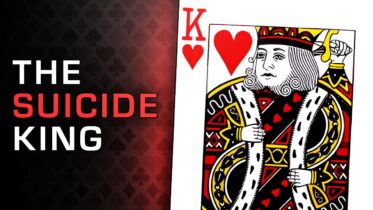

The Suicide King is the popular nickname for the King of Hearts, the only card in a standard 52-card deck where the depicted figure appears to be stabbing himself in the head with his own sword.
The name comes entirely from the visual design of the card, not from any historical event or intentional symbolism.
I find that poker players who know this card’s backstory have a surprisingly different appreciation for the cards they hold every session. The actual origin of the design is a centuries-long printing accident rather than anything deliberate or to do with modern games like Texas Hold’em.
What Is the Suicide King in Playing Cards?
The poker term Suicide King is commonly used to refer to the King of Hearts, one of the most recognizable playing cards in the common deck.
King of hearts is one of the four Kings in the deck, with each of the four holding a weapon of some kind, but the Suicide King is the only one seemingly hurting himself with his.
While there is no clear explanation as to what this could mean, it is more likely that the image is supposed to represent a king with a sword drawn and ready to go to battle rather than committing suicide.
Yet, the nickname Suicide King has come to life and is here to stay, as most hardcore poker players and other card players call this card by this name.
In 2005, the card was made a part of the title for “The Professor, the Banker, and the Suicide King,” a book by Michael Craig that talked about billionaire Andy Beal and his massive poker game against “the corporation” of some of the best poker players in Las Vegas.
The Origins of the Suicide King
Playing cards are fairly standardized today, but many different patterns have been used over the years and the cards evolved in many ways.
Today’s playing cards have their origins back in the middle ages, with the 15th-century Rouen Pattern being one of the first ones similar to what we see in our decks these days.
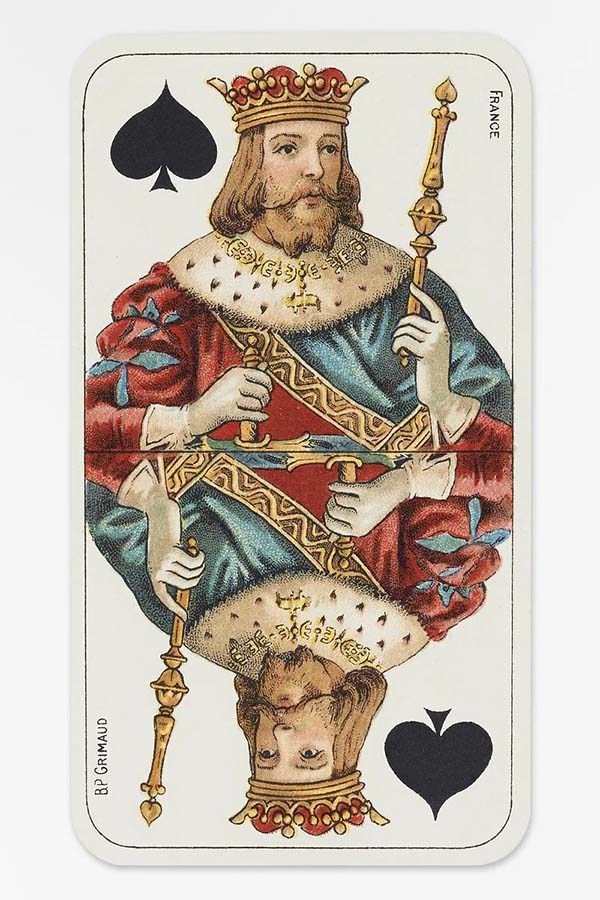
In the original Rouen Pattern cards, the Kings all held weapons, and the King of hearts held a battle axe, a weapon that was very popular at that given period in time.
In these early French cards, each of the four Kings was associated with a specific historical or legendary figure.
The King of Hearts represented Charlemagne, the medieval Frankish ruler and first Holy Roman Emperor.
The King of Diamonds was associated with Julius Caesar, the King of Spades with King David, and the King of Clubs with Alexander the Great.
These associations were common in French playing card tradition, though they were not always consistent across different decks and manufacturers.
These cards became very popular in both France and England in the centuries to follow, but the technology did not exist to re-print cards to be exactly the same as others.
Instead, each batch of cards would be slightly different, with artists forced to create new designs and many different decks being created over the next two hundred years.
While the current card rankings and the 52-card deck were partially derived from the Paris Pattern, which only emerged in the 18th century and also included a 32-card version, the modern-day Suicide King seems to be derived from the Rouen Pattern.
According to experts, the Suicide King’s weapon changed from a battle axe to a sword in the 18th century, and the modern design of the card makes it the only King with a depiction of four hands, as the card shows the King twice over.
One other distinctive side effect of this reprinting process is that the King of Hearts is the only King in a modern deck without a mustache. All three other Kings retain the mustache that was standard in the original designs.
The King of Hearts lost his across the same centuries of reproduction that transformed his axe into a sword. Like the weapon change, it was likely a gradual omission rather than an intentional design decision.
Author of World of Playing Cards, Simon White, also notes: “A similar late medieval derivation can be shown for the remaining court cards in the English pack. Many of the attributes or symbols of office have changed or become unrecognizable over the years, but the basic features are still there. The question of whether they were facing left, right, or straight forwards seems to be simply a matter of chance.”
So, today’s Suicide King certainly draws its history from a long line of centuries over which the card changed its design ever so slightly until it became standardized in modern-day playing card decks around the world.
Interesting Blooper in Fournier Decks
One very interesting appearance of the Suicide King in pop culture came in the 1967 Hollywood film “For a Few Dollars More” by Clint Eastwood.
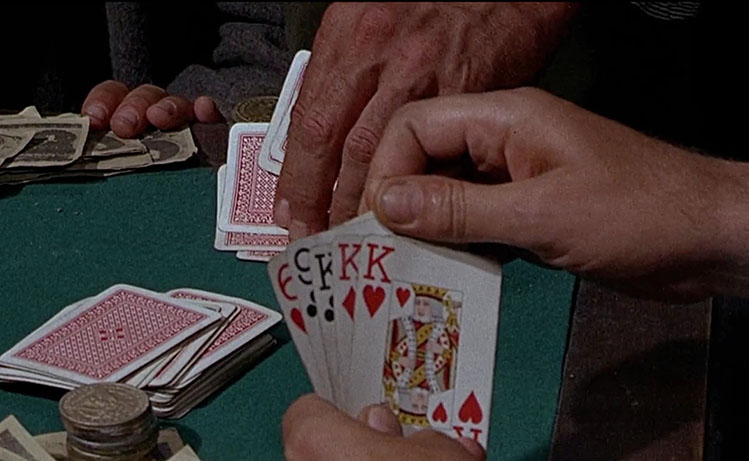
While not a poker movie, this thrilling western film, which became one of the most well-known of its era, protagonists are playing cards, and in one scene, the Suicide King card is shown quite clearly.
The movie used decks of modern-day Fournier cards, which were completely inconsistent with the period the movie was supposedly set in (late 1800s).
In this scene, you can see the King of hearts holding the familiar sword in his left hand and seemingly pushing it into the back of his head. However, another left hand is also shown lower on the card, holding the King’s coat.
This particular Suicide King has four hands in total on the card, a mistake that is only found in that particular deck of cards and nowhere else, probably a design or printing error that was overseen.
Other Famous Card Nicknames
King of hearts is one of the most famous playing cards, in part thanks to its nickname and its use in various works of popular culture.
However, it is not the only card that players have given a nickname to over the years or the only one that has some importance apart from its face value.
Here is a look at a few other cards that have unique nicknames or special stories related to them:
- Four of Clubs: Known as the “Devil’s Bedpost” or “Devil’s Four-Poster,” the four of clubs is often considered one of the unluckiest cards in the deck. The card is supposed to be a bad omen and may have been used in divination rituals back in the day, but for the purposes of poker strategy, you should definitely consider it just like any other card in the deck.
- Seven of Diamonds: Bridge players have made the seven of diamonds a famous card amongst them, as they often call it the “Beer Card.” The card got its nickname because winning the last trick with this particular card means your partner owes you a beer!
- Nine of Diamonds: Back in the day, the Duke of Cumberland supposedly wrote an execution note on the Nine of Diamonds playing card, and this might be the origin of why Nine of Diamonds is called the “Curse of Scotland” to this day. However, other theories have also been derived since, but the nickname persists regardless of its origin.
- Queen of Clubs: Known as the “Black Widow” or “Black Maria,” the Queen of clubs is almost as well-known of a card as the King of hearts.
- King of Diamonds: Much like the Suicide King, the King of diamonds also has a unique nickname and is usually called the “Axe Man.” As you may have guessed, that’s because the diamond version of the card is depicted holding an axe, much like the King of hearts did back in the day.
The Significance of the Suicide King in Your Game
So now that you know what the Suicide King is and how it differs from other Kings in the deck of cards, you may be wondering if that has any bearing on your poker strategy.
The answer is that it does not. The Suicide King is the same card as any other King in the deck in every game that matters, including poker.
Suits carry no ranking significance in Texas Hold’em, meaning the King of Hearts has exactly equal value to the King of Spades, the King of Diamonds, and the King of Clubs.
My strong recommendation is to treat card folklore as entertainment and nothing more. I have seen players make superstition-based decisions at the table, avoiding certain hands because of how a card “feels” or folding suited connectors because of an unlucky nickname. None of that has any place in serious poker.
What I do find genuinely useful about knowing card nicknames is that it gives you a shared vocabulary with experienced players. Referring to the Suicide King, the Black Maria, or the Devil’s Bedpost at a live table is a small signal that you have been around the game long enough to know the lore.
These nicknames can make for good table conversation, but keep them entirely separate from your decision-making at every point in a hand.