

Pocket queens, also known as the Ladies, are the third-best starting poker hand in No-Limit Hold’em: only pocket aces and pocket kings have you beat before the flop.
I have reviewed thousands of student hands involving this hand, and the mistakes almost always follow the same pattern: players either get too passive preflop and invite trouble, or they get too stubborn postflop and call down when the board has clearly turned against them. These 10 tips will help you identify and fix those exact leaks.
- Tip #1 – Don’t Get Too Fancy
- Tip #2 – Don’t Fold QQ to a 3-Bet
- Tip #3 – Find Spots to Flat 3-Bets
- Tip #4 – Continuation Bet Flops That Favor Your Range
- Tip #5 – Look for Value with Your Overpair
- Tip #6 – Bet Big in Heads-Up Pots
- Tip #7 – Be Careful in Multiway Pots
- Tip #8 – Don’t Be Afraid of Monsters
- Tip #9 – Play Your Sets Aggressively
- Tip #10 – Don’t Overplay Your Hand
- Frequently Asked Questions About Sit and Go Strategy
Tip #1 – Don’t Get Too Fancy
In my experience coaching players on pocket queens, the most common preflop mistake is not folding when you should — it’s getting creative when you should not. I have seen players limp QQ from early position trying to trap, only to face four callers and a board they have no idea how to navigate.
The simple rule: raise your standard size when first in, and 3-bet whenever you face an open. Play the hand as part of your normal strategy, not as a special occasion.
An amateur poker player can see QQ in the hole and get a little bit too excited, immediately starting to look for ways to do something out of the ordinary with this hand.
Among other things, this can include limping in an early position, flat calling raises, or 3-betting the minimum before the flop. All of these plays are quite bad and should always be avoided.
Instead, you should play your pocket Queens as part of your overall poker strategy. Being one of the best hands in poker, QQ warrants a standard size raise when the pot is not opened and a 3-bet practically every time when it is.
One of the main reasons you don’t want to get fancy with QQ is because this pocket pair is quite susceptible to losing to many hands on the flop, and making sure your opponents pay the right price preflop is essential to playing this hand well.
If you often undervalue your Ladies preflop, you will end up losing many big pots while often just winning small ones and not really maximizing the value of one of the best hands in poker.
Tip #2 – Don’t Fold QQ to a 3-Bet
I have reviewed hand histories where players fold pocket queens to a 3-bet and genuinely convince themselves it was a good decision. It almost never is. For a preflop fold with QQ to be correct, your opponent would need to 3-bet exclusively with AA and KK, which would mean having a range of roughly four combos total.
In my experience, even tight players include AK, JJ, and occasional bluffs in their 3-bet range. Against those hands, folding QQ is a costly mistake.
This may seem like very straightforward advice, but many players in this day and age are still trying to find their edge at the poker table where there is none. In particular, they look for an edge in spots where they think they can get away with folding big hands like pocket Queens before the flop.

Almost regardless of who your opponent is, you should always be willing to play QQ against a 3-bet, except if you are 100% certain that the particular player is the biggest nit you have ever played with.
Such players are few and far between, and everyone else might be 3-betting you with JJ, TT, AK, AQ, or even a pure bluff.
The least you can do when facing a 3-bet with a pair of Queens is call, and while a 4-bet is not always the best option, a fold almost never is either.
Tip #3 – Find Spots to Flat 3-Bets
One of the adjustments I make frequently is flatting 3-bets with QQ from early position rather than automatically 4-betting. When I open from UTG and a tight blind 3-bets me, my range is perceived as strong and theirs is polarized.
4-betting into a polarized range just folds out all the bluffs and forces me to play a bloated pot against only the top of their range. Calling in position and playing postflop is often the higher expected-value option in this specific scenario.
The previous tip had to do with not folding to 3-bets with QQ, and it mentioned something about not folding your QQ to a 3-bet.
However, there are definitely some spots in which just calling a 3-bet can make sense. Namely, if you open in an early position and get 3-bet by the blinds, you may want to just call.
Your perceived range when opening from an early position is strong, and the blinds are getting a great price to flat call your raise.
If they choose to 3-bet instead, they should be doing so only with their strongest hands, mixed in with a few bluffs.
Against a strong and polarized range like this, 4-betting does not achieve much, as it forces your opponents to fold their bluffs and continue with monsters.
Instead, flat call the 3-bet in position and go to a flop, looking to play further streets well and make the right decisions to maximize your value.
Note that getting a 3-bet in the same spot by the button, you may want to put in that 4-bet, as the button’s range in the same scenario will be wider and you would be playing out of position post flop.
Tip #4 – Continuation Bet Flops That Favor Your Range
Ace-high flops are where I see players panic most often with pocket queens. In my coaching sessions, the instinct to shut down every time an ace hits the board is one of the most expensive habits to break.
But the reality is your range as the preflop aggressor contains far more aces than your opponent’s calling range, which means you have a significant range advantage on those boards and can bet small for a lot of value.
The biggest problem that amateurs face with QQ comes from playing Ace and King-high flops. In these spots, recreational players tend to get flustered and often give up immediately.

However, there is no reason to give up on your pocket Queens every time an A or a K hits the flop, and there is no reason your opponents should have any of those hands.
For example, imagine a scenario where you open the pot UTG, the button calls, and everyone else gets out of the way.
The flop comes As9c5d and you are first to act. While many players may check here, going for a small bet is perfectly reasonable.
Your range still contains all the big aces like AK, AQ, AJ, as well as a ton of suited hands with an Ace, including A9s and A5s, as well as 99 and 55.
Your opponent, on the other hand, will have some of these combos but will also have many other pocket pairs, suited connectors, and other hands that didn’t connect with the board in any meaningful way.
What’s even more, your opponent could have a hand like TT, 88, 77, or T9, all of which might continue to your small continuation bet, giving you value.
If you check the flop, and your opponent sniffs out what you are doing, they may be able to steal the pot away from you even if they don’t have top pair.
Tip #5 – Look for Value with Your Overpair
When the flop comes in below queens and you hold an overpair, I want to be betting almost every time. In my experience, the players who cost themselves the most money in this spot are the ones who check back the flop trying to “protect their hand” — and then face aggression on the turn after giving their opponents a free card to improve. Your overpair is strongest on the flop. Extract value immediately.
What happens most often when you open or 3-bet pocket Queens is that the flop comes made up of three undercards to your QQ.
In these spots, unless the pot goes multiway, you almost always have the best hand, and you want to start betting immediately.
Whether the flop is J-high, 9-high, or 5-high, there are plenty of reasons to bet immediately. You can get value from a variety of hands, and you want to make sure your opponents don’t get a free shot at hitting an overcard.
Your bet sizing should depend on the board texture as usual, with more connected boards warranting a larger bet and dry flops warranting a smaller one.
For instance, on a flop of 5s5d2c, firing a 25% or 30% pot bet makes a lot of sense, while betting 70% pot on a board of Ts9d8d is better, as more hands might be interested in continuing on the latter and more hands you want to fold out that have reasonable equity against you.
Tip #6 – Bet Big in Heads-Up Pots
When I hold an overpair in a heads-up pot, I lean toward larger bet sizes rather than small probing bets. The reason is a mathematical reality: I hold two queens, which means none of the board cards are queens.
My opponent is therefore more likely to have connected with the board than they would be against a player holding cards that match the board. A bigger bet charges them fairly for the equity they hold.
When you flop an overpair and are facing a single opponent with your QQ, going for a big bet instead of a small one is the GTO poker approved strategy.
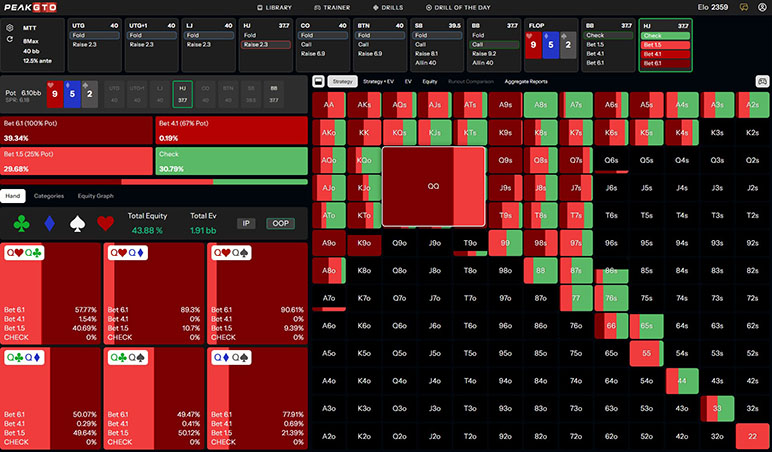
The reason, of course, is the fact your QQ unblocks all three of the cards on the flop, meaning your opponent is more likely to have a pair.
For instance, on a board of 8s7d3c, your opponent is more likely to have an 8 or a 7 if you hold QQ than they would be if you held A8, A7, or 87.
Seeing as you hold the best hand most of the time, and your opponent is reasonably likely to have a decent piece of the board, going with a big bet is preferred.
On super-dry boards, however, going with a small bet still makes sense, as it allows your opponent to call you with a hand that has some hope but very little actual equity.
Tip #7 – Be Careful in Multiway Pots
Multiway pots with pocket queens are some of the most difficult spots in poker, and in my experience, the players who navigate them best are the ones who accept that their hand strength has diminished relative to a heads-up pot.
When three or more players call a raise, someone in that field connects with the flop at a much higher rate. I find myself checking flops far more often in multiway spots than heads-up spots, even with an overpair.
Multiway pots are the bane of every skillful player’s existence, as a lot of our time studying the game falls off to studying heads-up pots.
When found in spots where you raise QQ and get called in two, three, or more spots, continuing on the flop can be a bit tricky.
On the one hand, pocket Queens will still often be the best hand on the flop, even in a multiway pot. On the other, you will get outdrawn more often.

On many flops, continuing with a bet will lead to one or more players calling, if not raising you, and this can lead to some very awkward situations on turns and rivers.
Checking Queens on the flop can make a lot of sense in multiway pots, although protecting against A or K coming on latter streets is also somewhat important, making small bets the preferred option.
If the flop does contain an A or a K in a multiway pot, it may be time to shut the operation down and play your QQ very straight up.
Tip #8 – Don’t Be Afraid of Monsters
Fear of running into aces or kings is one of the most profitable weaknesses I exploit in opponents. If a player is visibly uncomfortable going all-in with pocket queens against a 3-bet, that reluctance leaks into their entire preflop game.
In my experience, the players who have learned to comfortably commit stacks with QQ preflop — accepting that they will occasionally run into KK or AA — win more money over the long run than the cautious players who let fear drive their decisions.
Pocket Queens is a very strong hand, and in most cases, none of your opponents have one of the two higher pairs.
Instead, your opponents will often have a variety of other hands they want to raise for value or as a bluff, and you will often get a lot of pressure on your QQ before the flop.
In these situations, unless you are playing very deep like a cash game, you should usually be willing to go all the way and not be very concerned with losing to KK or AA.
While these situations do come up once in a while, there is no shame in losing in this situation, and these chips can be recovered when the situation is reversed.
On the other hand, if you play your QQ too cautiously, you will often end up losing chips to inferior hands, and this is especially the case in tournament poker where stacks are shallower, and QQ is almost always good enough to be all-in preflop.
Tip #9 – Play Your Sets Aggressively
Flopping a set of queens is one of the strongest positions you can be in, but I have seen players squander it repeatedly by checking back the flop looking for a check-raise that never comes.
The problem is that other players will often just check behind with their draws, taking a free card. In my experience, betting the flop with your set — even a small amount — keeps the pot growing while protecting your equity.
Flopping a set with pocket Queens is every player’s dream in Texas Hold’em, but it is also a spot many players play wrong.
This is especially true in multiway pots, as players often check the flop with their set of Queens, hoping for someone else to bet.
Instead, other players often choose to take a free card with their draws, giving them free equity and allowing them to win a big pot off you when they hit.

Instead of checking the flop, always continue with a bet when you flop a set of Queens in a multiway pot, and if your opponents all fold, take the pot down and hope for a better outcome next time.
Betting the flop with a set of Queens is especially important when the board is connected or when your set is not the top set, allowing your opponents to have a top pair against your set.
Tip #10 – Don’t Overplay Your Hand
I have been in spots where I knew I was beaten with pocket queens and still called another street because the pot was too big to let go. That is one of the most expensive mental traps in poker.
The hand that wins you the most money in the long run is not the hand you refuse to fold — it is the hand you play correctly at every decision point, including the ones where the correct decision is to release it.
Pocket Queens is definitely a monster hand to start with and one that you will win heaps of chips with over the long run, but it’s also not the winner every time.
One of the worst things you can do with QQ is get stubborn when you are beaten and keep calling bets despite all the signs indicating you don’t have the best hand anymore.
Like with any poker hand, you are going to lose some pots with a pair of Queens, and folding them at the right time is going to make all the difference.
The next time all the obvious draws get there and your opponent fires the river, let your Ladies go. I would rather be bluffed once in a while than call down in spots where I am losing the majority of the time. Preserving chips in losing spots is how you build a bankroll over the long run.
If you want to study these exact spots away from the table, I recommend using PokerCoaching’s own solver, PeakGTO, to run pocket queens scenarios across different board textures. Seeing the solver’s preferred frequency for calling versus folding in various multiway and heads-up spots will make these decisions much clearer at the table.