Aggression wins pots, but firing every street with a draw is how good players go broke. Playing a gutshot on a bad turn teaches one of the most underrated skills in poker: knowing when to shut it down. Not every turn is a green light to keep barreling, and a card that smashes your opponent’s range should slam the brakes on your bluff, even when you have outs. The reward for that discipline is that you keep a live, marginal hand for a river where you can pick the spot to attack again.
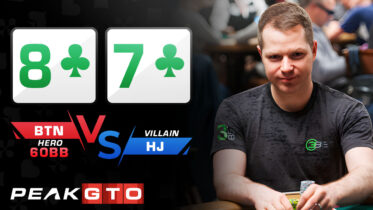
Today we will analyze a 60 big blind tournament hand where we call on the button with 8♣7♣ against a hijack open. The flop comes J♠6♥4♦, the hijack checks, and we bet small with our gutshot. The turn is the Q♠, a brutal card for us, and we check back. The river is the 3♥, the hijack checks again, and with eight-high we fire a half-pot bluff. We will walk every street and explain why giving up the turn and reloading on the river is the winning play.
- Format: 8-max MTT, 60bb effective stacks
- Positions: Hero is on the button (caller, in position); Villain is in the hijack (preflop raiser, out of position)
- Hero’s hand: 8♣7♣
- Preflop: Hijack opens with a standard raise, Hero calls on the button.
- Flop: J♠6♥4♦. Villain checks, Hero bets small (about 1.8bb), Villain calls.
- Turn: Q♠. Villain checks, Hero checks back.
- River: 3♥. Villain checks, Hero bets about half pot (around 5.4bb) as a bluff.
Preflop
We call on the button with 8♣7♣, a standard continue against the hijack. Some 3-bets belong in our strategy too, but flatting keeps our range wide and our hand disguised in position.
Flop: J♠6♥4♦
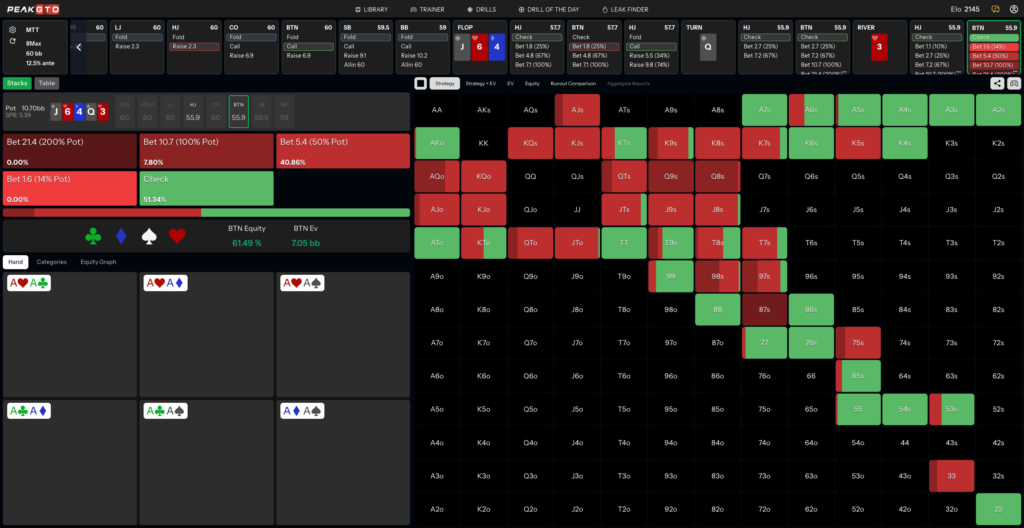
The hijack checks, which they will often do here. With a gutshot to the five and position, 8♣7♣ is a fine hand to bet about half the time against this capped, checking range. We take the small 1.8bb size, which lets us apply pressure cheaply and keeps barrels available on good turns. The hijack calls, and we move on with a plan to reassess based on what the turn brings.
The key idea on the flop is that not every bet needs a follow-through plan locked in. We bet because our range wants to pressure a weak opponent and because our gutshot has equity and fold equity, but what we do next depends entirely on the turn card.
One reason the small size shines with a gutshot is equity realization. We are trying to blow the opponent off the pot immediately, but we do not want to bloat a pot against a range that can still have a wide assortment of broadways and pairs. A small bet denies equity to their weaker hands, charges a price that can generate some folds, and still lets us see a turn cheaply when called.
Turn: Q♠
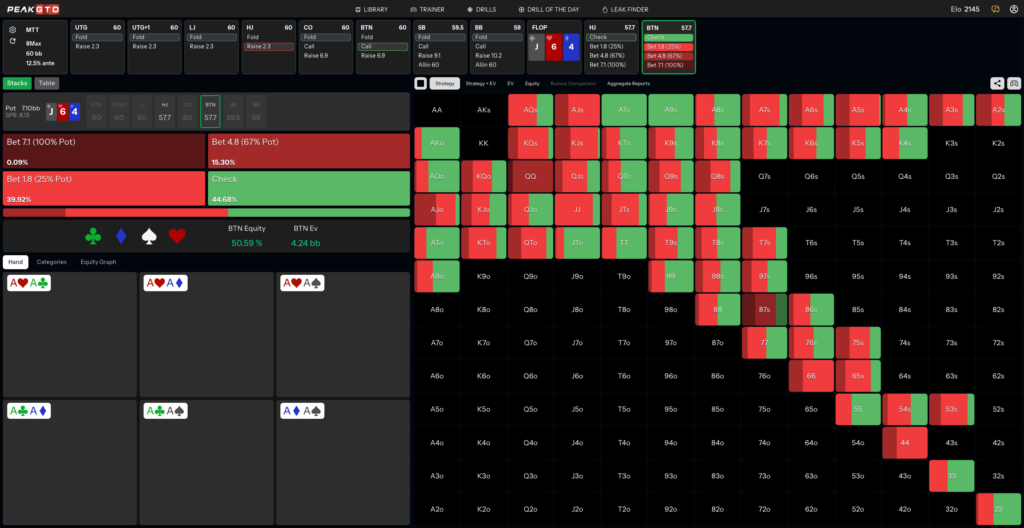
The turn is the Q♠, and this is a genuinely bad card for the button. The hijack called our flop bet with a range full of broadways, so the queen connects with many of their hands: AQ, KQ, QJ, QT, even some Q9s. When a turn improves the part of the opponent’s range that just called, your bluffs lose value fast, because the hands you most want to fold out now have a pair.
This is why we check back. The solver bets 8♣7♣ only about 43 percent of the time here, mixing toward a check. The hands that still want to barrel are the ones that block the top pairs and overpairs the opponent would call with, like A7, K7, or K5, which still have a way to improve to a pair of aces or kings that beats a queen when called. A pure gutshot does not have those blocker benefits, so it is happy to take the free card and keep its showdown potential alive. Checking back also protects our checking range so we are not always giving up when we slow down. You can see these combo-by-combo barrel decisions clearly in PeakGTO.
It is worth generalizing the lesson, because bad barrel cards show up constantly. The turns you want to keep firing are the ones that miss the opponent’s calling range and improve yours, like a blank that lets your overcards and draws keep representing strength. The turns to slow down on are the ones that pair the opponent’s likely holdings or complete the broadway cards they called with. The queen does the second thing here, turning many of their floats into genuine pairs, so our fold equity craters and a second barrel would simply burn chips into a range that is no longer folding. A quick test before firing a second bullet is to ask which of the opponent’s calling combos just got better, and if the answer is most of them, the turn is screaming for a check rather than a barrel.
River: 3♥
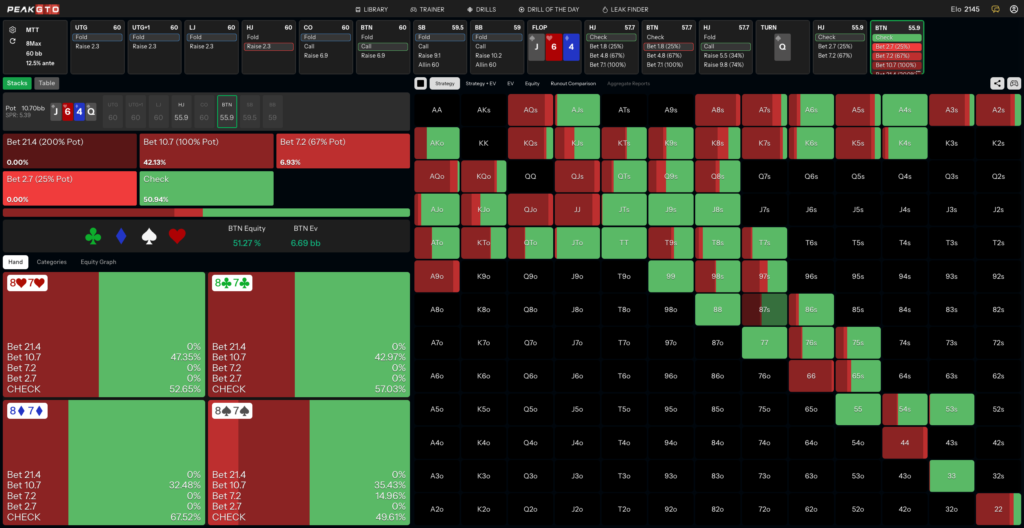
The river is the 3♥, a total brick, and the hijack checks. Our gutshot has fully busted, leaving us with eight-high that cannot win at showdown. After two checks, the opponent’s range is now weighted toward ace-highs and small pairs, exactly the marginal collection we can attack. When you are last to act against a capped, weak range and you cannot win by checking, it is time to bluff.
The right size here is only about half pot, around 5.4bb, which can feel too small to fold anyone out. The reason is that checking back the turn stripped most of the nutted hands out of our own range, since those hands would have barreled. With a value range capped around a queen, we cannot credibly use a huge size, so a half-pot bet keeps our betting range honest while still pressuring the opponent’s ace-highs and weak pairs into folding. Against most players who fold too much in these spots, this is a clear, profitable GTO bluff, and an even bigger size can work exploitatively. We fire and take it down a healthy share of the time.
The opponent’s line is what makes this bluff work. They arrived at the river having checked the flop, called a small bet, and then checked again on the river after a we checked back a scary queen. That sequence screams a hand that wanted a cheap showdown rather than a queen that would have bet for value somewhere along the way. We do not need to fold out a queen, we just need that give-up-prone range to let go, and it will far more often than not.
Key Takeaways
- Flop: A gutshot in position is a fine small bet against a capped checking range, but bet with the plan to reassess rather than auto-barreling.
- Turn: A card that improves the opponent’s calling range is a bad barrel card. Check back your pure gutshot and keep the blocker-heavy hands as your bluffs.
- River: Once a marginal range checks twice, a busted draw becomes a bluff again. Size down to about half pot because checking the turn capped your value range.
- Overall: Discipline on the wrong turn preserves a hand you can profitably bluff later. Aggression is most powerful when you aim it at the right street, not every street.