The late stages of a poker tournament compress every decision. Stacks are shorter, antes inflate the relative value of each pot, and the bubble creates genuine pressure on players who cannot afford to be wrong. A mistimed bluff or a bad call does not just cost chips — it can end your tournament.
This phase rewards players who understand how stack depth changes what hands are worth, how board texture should shift your c-bet sizing at shorter depths, and when to push your edge versus when to protect your equity near the money.
Here is how to approach the late stages of a Texas Hold’em tournament.

Stack Depth Thresholds: When to Open, Shove, or Limp
Not every stack depth plays the same way in the late stages, and using the wrong framework for your depth is one of the most expensive leaks in tournament poker.
At 35 to 50 big blinds, the open-raise-and-play framework still applies. You build pots in position, navigate postflop with meaningful depth, and the stack-to-pot ratio stays manageable through all three streets. The implied odds from speculative hands start shrinking, so suited connectors and small pairs need to be treated with more caution than at deep stacks.
At 20 to 30 big blinds, decisions become more polarized. Opening to 2x and folding to a three-bet wastes chips you cannot afford to leak. The cleanest approach is to open only hands you are comfortable calling a reshove with, or to shove directly when stack depth and position support it.
Below 20 big blinds, the default for most hands is shove or fold. The one exception worth knowing: at 10 to 12 big blinds, limping a premium hand is often better than opening to 2x. When you open aces at 11 big blinds, you face an awkward spot if someone shoves and you have to call off your stack against a caller you would have rather had bet into you. Limping keeps in weaker hands that would fold a min-raise and builds a bigger pot when you connect postflop.
Always check the stacks behind before committing chips from an open. If several players with 15 to 18 big blind stacks sit behind you, they can reshove with wide ranges. Opening a hand, you would fold to that reshove, which leaks chips that a direct shove would have captured cleanly.
C-Bet Sizing by Board Texture at Late Stage Depths
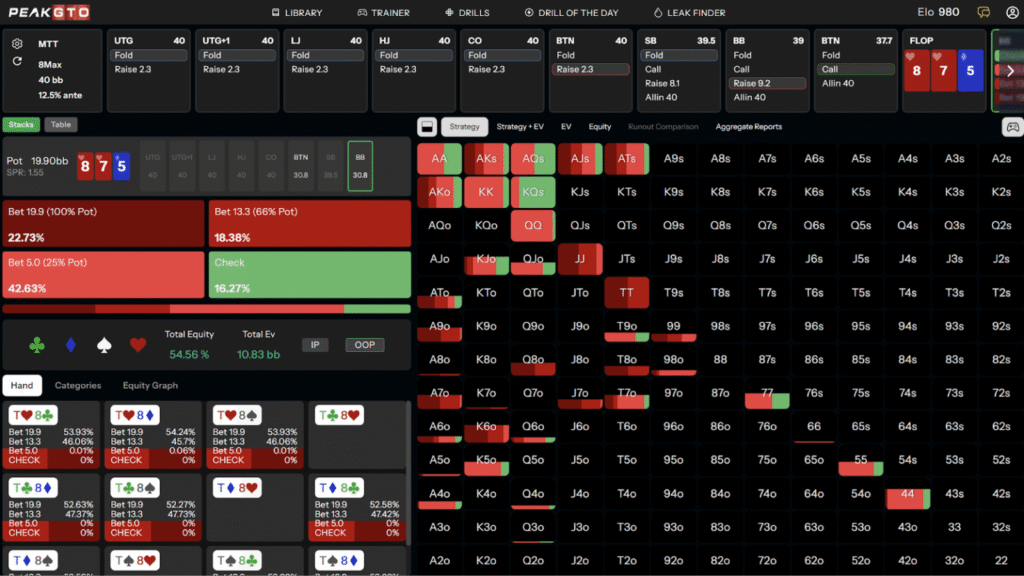
At shorter effective stacks, c-bet sizing becomes more important. The range of correct sizes narrows, and the choice between options matters more because pots represent a larger fraction of your remaining chips.
High and Disconnected Boards
On boards like king-eight-two with unrelated suits or king-ten-seven with modest draw potential, bet the majority of your range and use a larger size. Your range contains all the kings, all the overpairs, and all the top pairs, while your opponent defends with a wide range of weaker holdings. Betting half pot to 60% puts them in a difficult spot with marginal hands that would call a smaller bet comfortably. The goal on these textures is to pressure the wide defending range into a tough decision rather than allowing live cards to see cheap turns.
Low and Connected Boards
On boards like seven-seven-two, five-four-three, or eight-six-two, check a large portion of your range. These textures favor the big blind’s calling range: small pairs, suited connectors, and two-pair combinations from connected holdings. Betting every hand into a board that structurally advantages the caller is a leak. Strong hands on these boards often benefit from a check on the flop, then a large delayed bet on the turn when the texture changes and your sizing carries more credibility.
Three-Card Broadway Boards
On three-broadway boards like queen-jack-ten or king-queen-three, range betting makes sense, but sizing does not need to be large. A small bet around a quarter pot or 20% charges draws and protects made hands without over-committing to a board where your opponent holds many strong holdings. A min-bet is not a weakness here; it is the correct size when your objective is to force a decision from a wide range rather than build a pot you cannot safely navigate.
Check Range Construction When the Board Favors Your Opponent
One of the most important late-stage adjustments is recognizing when a board favors the caller more than the preflop raiser.
On a board of four-three-seven, the big blind has every three-x, four-x, and five-six suited that you do not have. They hold more straights, more two-pair combinations, and more disguised strong holdings than any middle or early-position opener can match. Betting ace-king on that board accomplishes almost nothing: you are not folding out better hands, and the hands you do fold have very little equity against you anyway.
The correct adjustment is to check the majority of your range on these boards, including strong hands like ace-king. This is not passivity. It is recognizing that your range advantage does not exist on this texture and protecting your strategy by keeping strong hands in your checking range. Opponents who know you only check weak hands can fire every board you check. Opponents who know your check range contains real hands must treat your checks with respect.
In my experience, players who routinely check ace-king on low boards are far harder to play against than players who bet their good hands and fold everything else. The check-raise with a strong holding becomes believable. The check-call line carries weight. Passive-looking streets become genuine traps rather than predictable surrenders.
Fast Playing vs. Slow Playing Strong Hands

Whether to fast-play or slow-play a strong hand comes down to two factors: how dynamic the board is and how many players are in the pot.
In a multi-way pot with a draw-heavy board, fast playing sets and two-pair hands is almost always correct. Draws are live, opponents hold equity, and every card on the turn could kill action or complete something against you. Shoving all-in immediately with a set in a three-way pot on a dynamic board is not a trap; it is the most efficient way to extract value from a range full of draws and pairs. If you make a small raise instead, a blank turn followed by a scare card can prevent you from getting all the money in at all.
In a heads-up pot on a less dynamic board, the calculation shifts. If you are blocking the top card on the board, holding eights on a board of eight-x-x, your hand is disguised and unlikely to trigger fear. Checking lets your opponent pick up equity with overcards, potentially make top pair on the turn, and put in chips they would have folded to a flop bet. The slow play sacrifices some theoretical equity but gains practical value from the type of hands your opponent holds.
The rule of thumb: the more players in the pot and the more draws on the board, the more urgently you need to fast-play strong hands.
Kicker Precision in Short-Stack Calling Decisions
Near the bubble and at short stacks, the difference between a clear call and a marginal fold often comes down to a single kicker.
Ace-nine suited and ace-jack offsuit are not the same hand for calling a reshove. Ace-nine is frequently dominated by hands your opponent shoves: ace-ten, ace-jack, ace-queen. Ace-jack knocks out those lighter ace-x holdings and calls more profitably. The kicker matters because being dominated removes your best outs at exactly the wrong time.
The same logic applies in the opposite direction. A player open-shoving from the hijack with 25 big blinds will sometimes shove offsuit king-jack but not king-ten. Being able to call that shove with ace-jack confidently and fold with ace-eight is the kind of kicker precision that saves and earns chips consistently across a long session.
Always calculate the pot odds in these spots: that number tells you the equity you need to call. Pair it with an honest read of the shoving range and the frequency of domination within it. Strong poker hands like ace-queen and kings call comfortably. Weaker aces frequently do not, even when the pot odds look attractive on the surface.
River Decisions, Blockers, and ICM Pressure
In the late stages, river decisions carry more weight than at any other point in the tournament because of ICM considerations. Losing a significant pot near the bubble costs far more than its face value in tournament equity.
When deciding whether to bluff the river, the card you hold matters as much as the size of your bet. The best river bluffs use blockers to the hands that would call you. When representing a flush on a three-suited board, holding a card of that suit reduces the chance your opponent has the flush that would call you confidently.
Without the relevant blocker, the probability that your opponent holds exactly the hand you are representing increases, and the bluff success rate drops considerably.
Without the blocker, a smaller bet at 60 to 70% pot is often preferable to a polarizing all-in. You can still represent a strong made hand and fold out marginal holdings without committing everything in a spot where your opponent is more likely to call.
The ICM dimension adds an additional layer near the bubble. Players tighten to survive, and that tightening creates bluffing opportunities that do not exist in other phases. If you can identify a player sitting uncomfortably near the money cutoff, river bluffs carry more fold equity than pure chip EV would suggest.
At the same time, if you are the covered player, being more selective about large river calls is correct. Losing a big pot near the bubble is a disproportionate tournament equity hit that chip EV alone cannot capture.
Conclusion
The late stages demand precise execution on decisions that look simple from the outside but carry real complexity. Stack depth sets the preflop framework. Board texture sets the c-bet size. Check ranges protect your strategy when the board does not favor you. Kicker discipline defines which calls are correct near the money. Blockers and ICM awareness determine the right approach on the river.
Players who make these adjustments consistently tend to accumulate chips while others either bleed them from poorly-timed bluffs or leave value on the table by playing too passively near the bubble. The late stages are where preparation compounds into results.