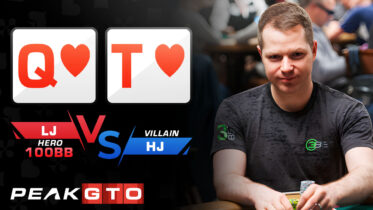
A pair with an open-ended straight draw feels like a hand that wants to bet, bet, bet. Out of position against a caller, though, the most profitable line is often more patient and more thoughtful. Pair plus a draw out of position is a spot where you have to weigh range advantage, protection, and pot control all at once, and where the correct play can shift from checking to value betting to bluff-catching across three streets. This real cash-game hand shows exactly how to navigate it.
Today we will analyze a 100 big blind cash game hand where we raise Q♥T♥ from the lojack and the hijack calls. The flop comes 9♣T♦J♦, giving us middle pair and an open-ended straight draw, and we check it through. The turn is the 3♦, completing a flush draw, and we bet for value and protection. The river is the 2♠, our draws brick, and after we check the hijack bets big, leaving us with a classic bluff-catching decision. We will walk every street and explain the reasoning.
Assumptions
- Format: 8-max cash game, 100bb effective stacks
- Positions: Hero is in the lojack (preflop raiser, out of position); Villain is in the hijack (caller, in position)
- Hero’s hand: Q♥T♥
- Preflop: Hero raises the lojack, the hijack calls. Single-raised pot.
- Flop: 9♣T♦J♦. Hero checks, Villain checks back.
- Turn: 3♦. Hero bets 4.5bb, Villain calls.
- River: 2♠. Hero checks, Villain bets 12.4bb, Hero calls.
Preflop
We open Q♥T♥ from the lojack, a clear raise but not a hand to play much looser than from early position. The solver folds hands like QJo and KTo here, but QTs is comfortably in what we open. The hijack calls, keeping a wide range of broadways, suited connectors, and pairs in the pot, and we take the flop out of position.
Flop: 9♣T♦J♦
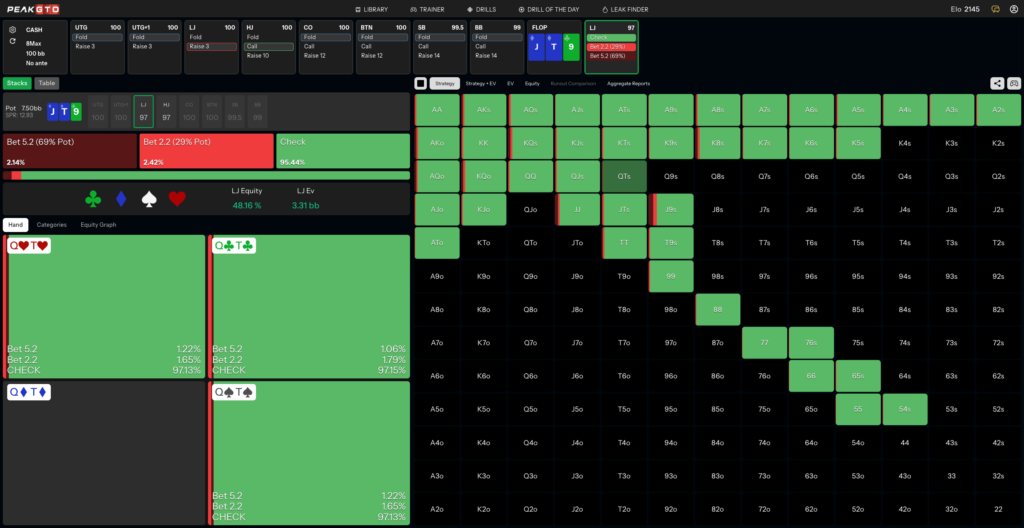
We flop middle pair and an open-ended straight draw, a hand many players would auto-bet. The problem is that this flop is excellent for the hijack’s calling range and offers us no real edge. They show up with queens, KQ, AJ, QJs, sets, and JT type hands, so the board nails their range as hard as ours. With no meaningful range or nut advantage, the correct play is to check close to 100 percent of our entire range, and that includes our pair plus draw. We decline the continuation bet and check.
The hijack checks back, which is the moment the hand really opens up. In theory their check-back range is full of slow-played sets, two pairs, and made straights mixed with weaker hands. In practice, most players in a small-stakes cash game will bet those monsters on a board this wet, so when they check, their range becomes far weaker than the solver’s. That single read shapes the rest of the hand.
It can feel uncomfortable to check a hand with this much equity, but giving up almost nothing is exactly the point. We are not folding, we are keeping the pot small and our range protected on a board where betting would mostly get called by better and fold out worse. If the hijack had bet after our check, we would have called the majority of the time and continued to the turn. Checking does not surrender the hand, it just refuses to bloat a pot when we hold no structural edge.
Turn: 3♦
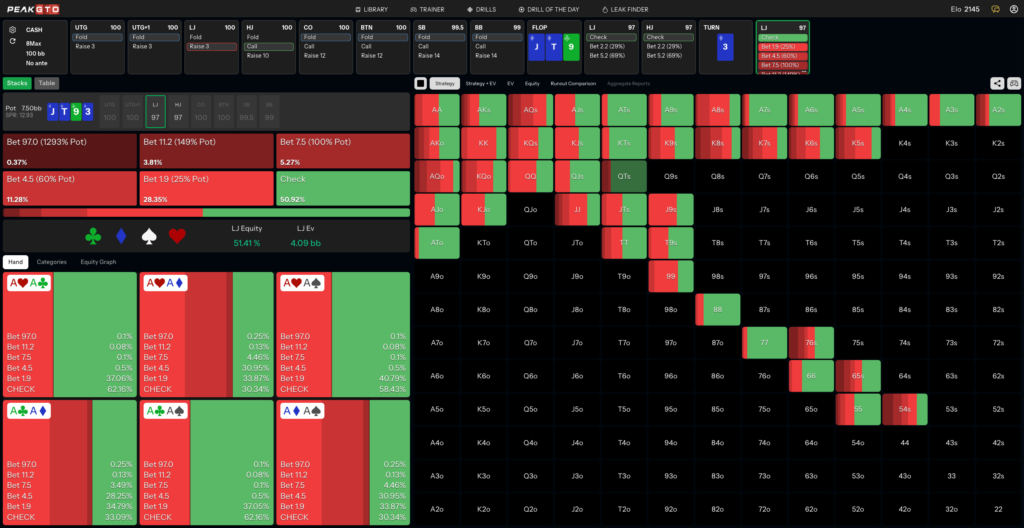
The 3♦ completes the diamond flush draw, but it changes little for our middle pair and open-ender. Now that the hijack has checked back a capped, weakened range, we can bet for value and protection. The solver bets QT about 22 percent of the time straight up, but exploitatively, against an opponent who would have bet all their strong hands on the flop, we can value bet far more often. A hand like ours is almost always best against the range that actually checked back.
We choose a 4.5bb bet, around 60 percent of the pot, a size that fits a value-and-protection bet here, and the hijack calls. This is wider than the solver’s baseline, an exploitative choice against a range that already gave up its strong hands on the flop. We are betting to get value from worse pairs and gutshots while denying equity to overcards, and our own straight draw gives us a backup if we get raised. You can explore how often each made hand and draw wants to bet this turn inside PeakGTO, which makes the value-and-protection logic concrete.
Many of the hands that call are ones the hijack floated on the flop and will continue with again. Because our open-ender gives us outs even when we do run into something better, this is a low-risk bet: we are usually ahead, and we have a comfortable backup for the times we are not.
River: 2♠
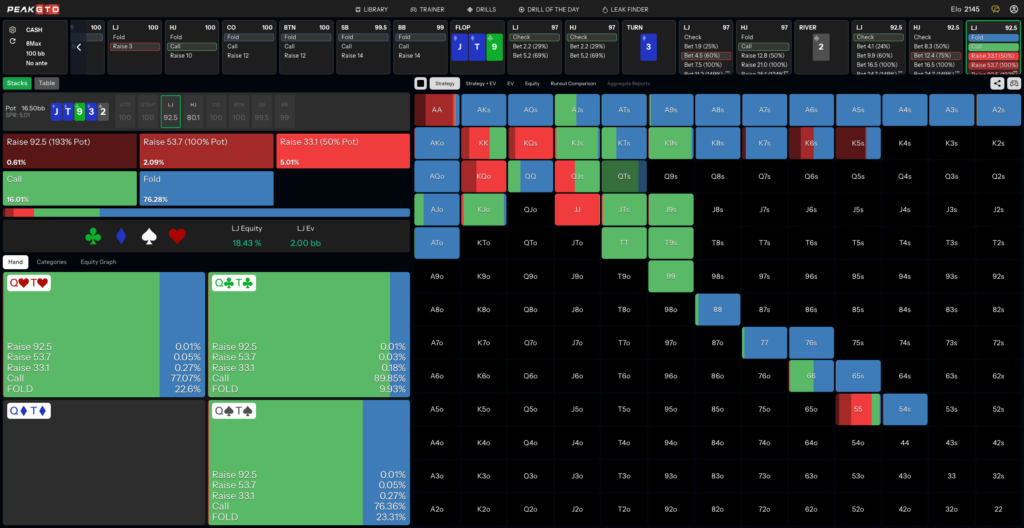
The 2♠ is a brick. Our straight draw misses and we are left with a pair of tens and a queen kicker. While we still have the best hand a good portion of the time, the opponent can easily hold a jack or two pair such as JT that beats us, so betting again is too thin. The solver checks this river the large majority of the time, and notably even KJ mostly checks, which tells us QT is far too weak to value bet. We check and let the hijack act.
The hijack fires 12.4bb, and we face a bluff-catch. In theory our pair is roughly indifferent, and the pot odds mean we only need to be good around a third of the time. The whole decision hinges on the opponent. If they have a strong, well-protected range, we cannot call wide, because their bets are mostly value. But against a player whose flop check-back was already too weak, it becomes much easier for them to arrive on the river with busted draws and air, and those hands overbluff. Since the opponent must be polarized to bet this size, and many players will not fire a thin value hand like a jack here, the GTO indifference tips toward a call exploitatively. We make the call, and the hijack mucks a busted bluff.
The broader lesson is that a river bluff-catch is a read on the bettor, not a referendum on your own hand. A pair of tens is not impressive, but it does not need to be. It only needs to beat the bluffs the opponent shows up with often enough to clear the price. When a player overfolds the flop and arrives on the river with a capped, frustrated range, they tend to bluff more than they should, and your medium hands quietly become profitable calls. Against a tight, value-heavy opponent, that very same pair of tens is a clean fold.
Key Takeaways
- Flop: A pair plus a draw is not an automatic bet. On a board that smashes the caller’s range and gives you no advantage, check close to your entire range out of position.
- Turn: When the opponent checks back and caps their range, value bet for protection. Around 60 percent pot is ideal, and your draw is a bonus if raised.
- River: When the draw bricks, your pair is usually too thin to bet, since even KJ checks. Check and reassess.
- Overall: Playing a pair plus a draw out of position is about adjusting to the opponent’s range each street. Bluff-catch the river when they are polarized and prone to overbluffing.