When a weak player never bluffs, you know exactly what to do and stop paying off their river bets. When a loose player calls everything, you stop bluffing and bet your good hands. Easy game.
But what about the player two seats over who studies as hard as you do? Most people shrug and try to play by the book against them, yet these players still often have many holes in their strategy that can be exploited.
Here are the three GTO mistakes that cost players the most money in Texas Hold’em tournaments. If any of them sound like your game, they are costing you money as well.

Mistake #1. Three-Betting a Polarized Range Full of Junky Blockers
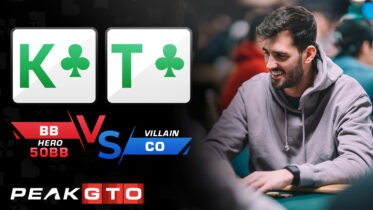
Watch what happens when stacks get shallow and the big blind three-bets a late position open. The theoretical range is polarized, strong value plus bluffs built from high card blockers, hands like king-five offsuit, king-six offsuit, and ace-four offsuit.
Humans make it worse. They almost never three-bet the mixed-frequency medium hands like ten-nine suited or small pairs, so their real range becomes even more polar, tens-plus and ace-jack suited-plus for value, and pure junk for bluffs.
Some aggressive regulars even overdo the junk because the blocker logic feels clever.
The deficiency is postflop playability. A range stuffed with king-five offsuit has to play turns and rivers out of position, and those poker hands have terrible equity and a hard way to realize it. The strategy looks fine on a chart and falls apart the moment someone makes it see a river.
Mistake #2. Playing Four-Bet-or-Fold Against That Range
Facing that polarized three-bet, most players jam their strong hands and fold everything else, and that response is exactly what lets the junky range print money. Every four-bet ends the hand before the polarized range has to face its weakness.
The solver’s counter is radical. At 40 big blinds in position, it calls the three-bet with around 40 percent of hands and jams under 12 percent.
Kings and aces flat every time, queens and jacks flat half the time, and hands as thin as king-jack with a backdoor suit or ace-three suited come along too. At 25 big blinds it barely jams a single pocket pair.
Then the punishment starts. On a king-nine-five flop facing a small bet, the in-position player continues about 85 percent of the time, floating backdoor draws nobody would guess are continues.
The plan is simple. Keep the stack-to-pot ratio big, refuse to end the hand early, and make king-five offsuit plays on turns and rivers. When the turn pairs nothing and the out-of-position range is full of air, your small bets force fold after fold from hands that could not handle a third street. Take them postflop, and their range collapses on its own.
Mistake #3. C-Betting So Face-Up That Your Checks Are Capped
The third mistake lives on the other side of the table. When a studied player c-bets frequently, theory demands a linear betting range, meaning they should be betting middling pairs, plus ace-high hands and oddball floats, at meaningful frequencies.
In my experience, this is the piece almost nobody implements. Real players bet their value and their draws, check everything in between, and end up with a checking range stuffed with marginal made hands and no monsters.
Their bet says little, but their check announces a capped range to anyone paying attention.
The exploit is to classify every check you face. If the opponent checks a genuinely protected range, with strong hands mixed in the way a queen-three-deuce board plays, keep your bets small and respectful. But when a frequent c-bettor checks on a board where their strong hands always bet, like queen-jack-five, attack with big bets immediately.
You are targeting all those sixes through tens and weak pairs, and a capped range simply cannot defend enough of them, folding far beyond what minimum defense frequency allows. Big bets against capped checks are the closest thing to free money in games full of studying players.
The Follow-Through Warning
One caution before you start blasting. When your big flop bets make an opponent overfold, their calling range arrives at the turn and river stronger than normal, and continuing to bluff a range you already broke is lighting money on fire.
So track where the overfold happened. If you believe your opponent folded out all their marginal hands on the flop, give up more rivers, not fewer, and aim your remaining barrels at the hands that genuinely continue, like offsuit top pairs that call twice. Aggression created the profit, and discipline keeps it.
Conclusion
The pattern behind all three mistakes is the same. Solver outputs such as PeakGTO are balanced by the strange, uncomfortable pieces: the junk that plays on, the wide calls, the middling hands that bet, and humans systematically delete exactly those pieces.
Audit your own game first. If your three-bet bluffs are all blockers with no playability, if you respond to polarized aggression with jam-or-fold, or if your checks only happen when you have nothing, you are the target.
Then flip it around. Force polarized ranges to play turns and rivers, classify every check as capped or protected, and attack the capped ones with sizes their marginal hands cannot call. Studying players are everywhere now, and the player who understands their blind spots beats them with their own theory.