
PFR stands for pre-flop raise, and it measures the percentage of hands in which a player raises before the flop. Of all the poker stats available in a poker HUD, PFR is the one I rely on most often to diagnose opponent tendencies within the first few orbits at a new table.
A player’s VPIP tells me how many hands they play, but their PFR tells me how they play those hands. That combination is the most revealing read you can get before you have ever seen a player’s cards.
In this guide, I will walk you through what the PFR stat means, how it works alongside VPIP, what the right numbers look like at different game types, and how to use both stats to make better decisions at the table.
What Is PFR in Poker?
One thing I always point out when coaching players who are new to using a HUD is that PFR is not the same stat as VPIP. VPIP counts every time a player voluntarily puts money in the pot preflop. PFR counts only the raises.
So a player can have a VPIP of 30 and a PFR of 8, which tells me they are limping into pots or calling raises constantly rather than building pots with aggression. That VPIP/PFR gap is one of the first things I look at when I sit down at a new table.
Like most stats in poker tracking software, PFR is an abbreviation, and it stands for “pre-flop raise.” PFR changes based on how often a player raises before the flop.
Of all the stats used in online poker, PFR is probably the second most important one, right behind VPIP. This is why most HUDs show PFR in the first line, right next to VPIP.

It is important to remember that a player’s PFR stat changes every time they take an action before the flop. If the action is aggressive, PFR goes up. If the action is passive, PFR goes down.
This means that PFR will grow if the player makes a re-raise as well, which means it acts as a cumulative stat to determine a player’s overall preflop aggression and helps you make more informed assumptions about your opponent’s preflop range.
The best players in the game are quite aggressive, but finding a PFR that is too high can be just as useful as finding one that is too low.
Before we look too deeply into how to interpret the PFR numbers, let’s talk about the relation between PFR and the other essential stat, VPIP.
Relation Between PFR and VPIP
One of the most reliable rules I apply when reading VPIP and PFR together is what I call the aggression ratio. A well-balanced, winning player will typically be raising at least 70% of the hands they choose to enter.
So if a player’s VPIP is 25, their PFR should be at least 17 or 18. Anything significantly below that ratio tells me the player is calling more than they should be, and calling preflop too often is one of the most profitable leaks to exploit.
When I see a player with a 30 VPIP and a 10 PFR in my hand history database, I know immediately that I want to be isolating that player in position and attacking them with continuation bets, because passive preflop play almost always means passive postflop play too.
The VPIP stat stands for “voluntarily put $ into the pot,” and it depicts all the times a player enters a pot without being forced to by the blinds.
If playing correctly, a player should have a VPIP stat that is slightly higher than PFR but not too much higher.
Playing a high VPIP in the first place usually signifies a pretty bad player, but one with a high VPIP and a low PFR is usually the worst kind of fish out there.
In the section below, I will explain how you can compare a player’s VPIP and PFR to determine their general tendencies and player type, but before we do that, let’s talk about how your PFR stat should look if you are playing good poker.
How High Should My PFR Be?
In my experience reviewing student databases, the most common PFR-related leak I see is not a PFR that is too high but a PFR that is far too low relative to VPIP. I regularly see players with a 28 VPIP and a 12 PFR, and that 16-point gap tells me more about their preflop leaks than any other single number.
A gap that wide means the player is open-limping frequently, calling raises out of position regularly, or both.
In terms of game-format benchmarks, my baseline recommendations are:
- 6-max cash games: VPIP around 21 to 26, PFR around 18 to 22
- Full-ring cash games (9-max): VPIP around 14 to 16, PFR around 11 to 14
- Tournaments (deep stack): Similar to 6-max early on, but PFR tightens as stack depths shorten and ICM pressure increases
The key principle is consistent across all formats: keep the gap between your VPIP and PFR tight. A gap of 3 to 5 points is healthy. A gap of 10 or more is a red flag that warrants a close look at your preflop calling habits.
While tracking everyone else’s stats at the tables, you should also track your own. This helps you make sure you are playing a strong strategy without major holes in it.
In fact, your stats can be the best way to find leaks in your game, as they will quickly show you which areas of your game you may be making mistakes in. Basically, your data will help you improve your poker strategy.
The PFR stat is of essential importance, and good poker players all have very similar numbers when it comes to PFR, just as they do with VPIP.
Generally speaking, good players in modern six-max games play a VPIP of about 25 and a PFR of about 20, and these numbers can go up and down a few points depending on several factors.
For starters, some players just play a slightly more aggressive style, and there is nothing wrong with that if you know how to execute it correctly on later streets.
Furthermore, the tendencies of the overall player pool play an important role here. If your opponents are very tight, playing a higher PFR makes sense. If they are very loose, you will want to play a lower PFR.
One thing that should not change, however, is the relation between your VPIP and PFR, as playing a much higher VPIP than PFR means you are playing quite passively, and this is never the right way to play poker.

Whether you play a tighter or looser preflop strategy, you should always be playing aggressively and only taking passive actions some 25 to 30% of the time while being aggressive the rest.
Of course, these numbers can all be deviated from in tournament poker and at lower stack depths, but starting from a baseline of 100 big blinds is the best way to learn about anything in poker.
Identifying Player Styles Based on PFR
In my years of coaching, identifying player types from HUD stats is one of the first skills I teach. The reason is simple: when you know a player’s type, you do not need to think from scratch in every hand.
You already know their default tendencies, which means you can focus entirely on executing the correct counter-strategy rather than figuring out what you are dealing with. The most common mistakes I see players make with PFR-based reads are two-fold: they use too few hands (a player’s stats over 50 hands are almost meaningless), and they read the overall PFR without checking position-specific numbers. Both of those mistakes cost real money.
The most practical use of the PFR stat at the poker table is to ascertain player styles quickly. In order to do this, you will first need to play a certain number of hands against a player.
Having at least a couple of hundred hands played against a player should give you some clue as to their tendencies. Playing a few thousand will give you VPIP and PFR numbers that are just about right for their overall game.
Once you see the players’ VPIP and PFR at a six-max cash game table, you can start classifying players into types:
- Maniac: If you see a player with a VPIP of 50 and PFR of 40 at your table, you are dealing with a maniac. This player raises whenever given a chance, and your best bet is to play back at him often with a strong range of hands while opening a tighter range if they have a position on you. A hand like KQs or TT is a monster against this guy’s re-raise.
- Calling Station: This player plays a lot of hands but usually plays passively. A typical calling station might be playing 40/13, which means they call 40% of all hands but only raise 13% of the time. Be cautious when facing a raise from this player but run them over all the numerous times they just call before the flop.
- Nit: Players with both low VPIP and PFR are typically called nits, and they are quite uncommon in online games these days. If you do encounter a nit with stats like 11/9, remember to steal their blinds with any two cards and only play against their raises with strong hands and great drawing hands that have the potential to stack them. A nit’s open is almost always strong, and his re-raise is always a monster.
- TAG: Tight-aggressive (TAG) players are quite common and tend to be pretty solid after the flop, but they play a strategy that’s too tight before the flop. A TAG player might be playing 18/15, which means they play too few hands but almost always play them aggressively. You can discard some of the hands you would be playing from their range across the board, but approach them as a competent player not to be taken too lightly.
- Solid Reg: Most serious online players today study a style that produces 6-max stats of roughly 25/20. Slightly higher or lower than this, and they are probably still solid, while serious deviations in either direction usually point to significant leaks. Against this player type, I recommend sticking to balanced GTO-grounded lines rather than trying to exploit tendencies that may not exist. PokerCoaching’s own solver, PeakGTO, is the best tool for studying the balanced preflop and postflop lines that work well against solid regulars — it will show you exactly which hands to open, call, and 3-bet from each position so you are not guessing when a solid reg comes back at you.
Looking at PFR by Position
One pattern I see constantly in hand reviews is players treating their opponent’s overall PFR as the complete picture when the position-specific breakdown tells a completely different story.
A player with a 20 overall PFR might be raising 35% from the button and only 8% from early position. Against that player in a blind-versus-button spot, I can 3-bet much lighter than their overall number would suggest. Conversely, when that same player raises from UTG, I know their range is extremely tight.
The HUD popup with position-specific stats is one of the most underused tools in most players’ arsenals. The first time I started drilling into popup stats rather than just reading the headline number, my reads improved dramatically. Make it a habit to check position-specific PFR any time you face a raise from a player with unusual overall stats.
The overall PFR number tells us a lot about our opponents’ tendencies, but we can get even more information by looking at more specific stats, such as PFR by position.
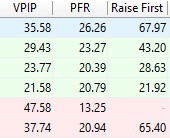
By looking at the HUD popup, you can see more detailed PFR stats for a particular player, with PFR broken down by table positions.
These numbers will tell you what percentage of hands a player raises from various positions, such as UTG, D, or SB.
Whenever you face a raise from an opponent with unusual overall stats, take a few seconds to look at that popup and find out what their PFR from that particular position is.
This number can help you determine their approximate opening range even further, and this can help you formulate a better strategy to counter theirs.
Putting PFR Into Practice
Knowing a player’s VPIP and PFR is only the starting point. The real skill is translating that information into a specific adjustment in real time. After coaching thousands of students’ hands, I find that most players can correctly identify player types but fail to change their actual decisions accordingly.
They know the player is a calling station, but still fire three streets of thin value. They know the player is a nit but still try to bluff the river. Identifying a player type without adjusting your strategy is a wasted read.
The core principle I teach is this: use VPIP and PFR to define what a player will have in any given situation, then build your strategy around that range. There are quite a few ways these stats help you do that, mostly by allowing you to narrow your opponent’s range before the hand is even dealt.
For example, imagine playing against a nit who raised from UTG with stats of 12/10. This player only raises with 10% of hands from all positions, but they raised from UTG in this hand. What does that tell you?
Naturally, the low number tells you that it is extremely likely the player is holding a monster. You could imagine their range is JJ+ and AK+ in this particular spot, as rare as it might be.
On the other hand, a player with stats of 52/45 raising from the cutoff tells you that the player’s range is extremely wide, making it vulnerable to being played back at.
If this player raised 50% or more of all hands in this spot, which is very likely, you can re-raise them with an extremely wide range and expect to get many fold, as well as many continues from weak hands.
Whether they fold or call too much after getting raised in this spot can be ascertained by looking at their “fold to 3-bet” stat, and you can use other stats to find other similar leaks in your opponents’ games.
When studying your sessions after you play, make sure to look for opponents who have unusual PFR and other stats and try to figure out the main leaks in their games you can use the next time you sit down at the table with them.