
Most poker strategy is taught for heads-up situations. That makes sense because the frameworks are cleaner, but it creates a real problem at the table: once a third player enters the pot, a lot of those rules stop applying.
Multiway pots are not just harder heads-up poker. They require a fundamentally different way of thinking about range advantages, bet sizing, and hand strength. If you bring your heads-up mindset into a multiway pot, you are going to leak equity to anyone who understands the dynamics better than you do.
This guide covers the core concepts that drive strategy in Texas Hold’em multiway pots, directly drawn from GTO simulations of these spots.

Your Range Advantage Nearly Disappears
In heads-up pots, one player often has a significant range advantage and can continuation bet at a very high frequency. In multiway pots, that almost never happens.
The reason is simple. When three or four players see the flop, you are stacking the top portions of multiple ranges against each other. Someone is going to connect with the board a meaningful percentage of the time. The combined range across all players is too wide for any single player to dominate the texture the way they can in a heads-up scenario.
Range advantage is what justifies betting frequently. Without it, you are firing into multiple opponents who are going to continue with stronger ranges than you expect.
Bet Less Often, Use Smaller Sizes, Check Far More
In heads-up pots, the preflop raiser often bets a large portion of their range. In multiway pots, that number drops dramatically.
When you do bet in a multiway pot, two things should generally be true: you have a hand strong enough to warrant it, and you are using a smaller sizing. Smaller bets make sense because you are not trying to create massive leverage against multiple opponents at once. You are looking to extract value and pick up folds in spots where your range actually supports the bet.
The direct consequence of betting less is checking much more. This is not a weakness. In multiway pots, checking is often exactly the right play, particularly when you are out of position. Firing into multiple opponents without the range support to back it up is one of the clearest ways to bleed chips in these spots.
You Can Fold Much More in Multiway Pots
This concept is one of the most misunderstood ideas in multiway play.
In a heads-up pot, MDF tells you roughly how often you need to continue to prevent your opponent from profitably betting any two cards. In a multiway pot, that defense requirement is shared across everyone facing the bet. If you need to defend 70% of your range heads up, in a three-way pot, each player might only need to defend around 35%.
The split is not perfectly proportional in practice because position and closing the action affect how much equity each player actually realizes. But the core principle is correct: you can fold substantially more in multiway pots without being exploited.
Those marginal poker hands you might peel with heads up, like a weak gutshot, a backdoor flush draw with an overcard, or bottom pair with no clear plan, you can usually fold them in multiway pots without giving anything away. You are simply not obligated to defend them the way you would be in a heads-up situation.
When You Are Not Closing the Action
The threshold gets even tighter when players still act behind you.
Say the preflop raiser bets, and you have two players left to act. Even a somewhat marginal continuing hand becomes very difficult to play here. If you call, the players behind can call and bloat a pot you are stuck in out of position, or raise and put you in an even worse spot. Your pot odds for the call look reasonable in isolation, but they do not account for that added risk.
Tighten up significantly any time you are not the last player to act facing a bet in a multiway pot. This is the spot where many players go wrong, and it costs them more than they realize.
Hand Strengths Are Downgraded Across the Board

When you bet in a multiway pot and get called, the caller’s continuing range is tighter than it would be in a heads-up pot. They have already chosen to continue against a bet with other players left to act, which filters out a lot of the weaker hands that would call heads up.
The practical consequence is that your hand’s value is effectively reduced. A top pair, good kicker in a heads-up pot might be something you comfortably go for three streets of value with. In a multiway pot after betting the flop and getting called, top pair often becomes a hand you want to proceed carefully with on the turn and river. The range that is called is concentrated enough that you cannot build as large a pot as safely.
The same applies to big pairs postflop. Aces on a nine-eight-six board in a three-way pot, facing a check-raise, is not where you want to be. The hand that looked premium preflop has become uncomfortable against the tight range that is willing to continue.
Draws Lose Value Fast in Multiway Pots
In a heads-up pot, a flush draw is almost never folded. The outs, the implied odds, and the overall equity make continuing mandatory in most cases.
In multiway pots, draws drop significantly in value, especially non-nut draws. The culprit is reverse implied odds.
If three hearts are on the board and you make your flush, the opponents who continue at that point are likely to have strong holdings: better flushes, full houses, or hands that are not going anywhere. Players without two hearts are not putting in a lot of money. But players who want to put in a lot of money are exactly the players you do not want to face when you are sitting on a nine-high flush.
In my experience, this is exactly the spot where players convince themselves to call because the direct pot odds look fine, without accounting for how hard it is to get paid off when they hit and how often they lose a large pot when they do. Stick to high-equity draws with strong potential holdings in multiway pots. Non-nut draws facing significant aggression from multiple players are usually folded.
Shift to a Linear Betting Range
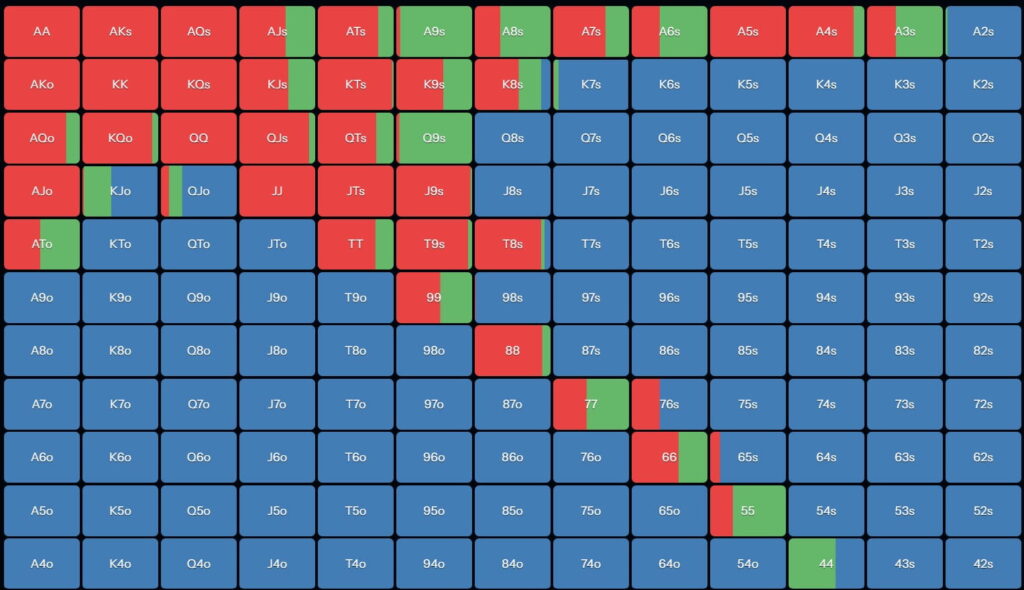
In heads-up pots, you often bet a polarized range: very strong hands and bluffs, while checking medium-strength hands. In multiway pots, a linear betting range works better.
A linear range means betting your good made hands, strong made hands, and your best draws. The junky bluffs, no-equity overcards with backdoor draws, weak gutshots with no real equity, are hands you check in multiway situations. They are not strong enough for value and not good enough as bluffs to justify the risk against multiple players who are continuing with tighter ranges.
The hands that are genuinely worth betting for protection in multiway pots are the strong ones, like top pair and overpairs, that can actually be outdrawn. When you bet bottom pair or marginal holdings for protection in a multiway pot, you are building a pot you cannot navigate well against ranges that are more concentrated than you expect.
Think of it simply: in a multiway pot, only pull the trigger with hands that clearly belong in a larger pot.
Conclusion
Multiway pots expose a heads-up mindset quickly. The range advantages you are used to relying on mostly disappear, the hands you count on lose some of their value, and the draws that play automatically heads up become genuinely dangerous spots.
The core adjustments are straightforward: bet less, size smaller, fold more, and restrict your betting to hands that genuinely warrant it. The difficult part is applying that discipline when your instincts pull toward heads-up habits.
Studying how poker solvers handle multiway situations will make this click. The amount of checking in GTO multiway solutions is often surprising to players who have primarily studied heads-up spots. That discrepancy tells you exactly where most players are leaking equity.