Suited connectors love to make a little bit of everything and rarely a lot of anything. Turning second pair with a backup draw is a perfect example: it feels too weak to bet for value and too strong to give up, so most players freeze and check. The truth is more interesting. Sometimes a marginal pair on a dynamic board wants to fire a big bet for protection and thin value, and sometimes that same hand should slow down on a scary river even when a solver says to keep firing. Knowing the difference is what separates good players from great ones.
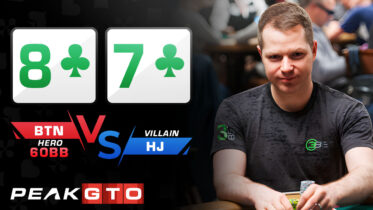
Today we will analyze a 60 big blind tournament hand where we call on the button with 8♣7♣ against a hijack open. The flop comes J♠6♥4♦, our opponent checks, and we make a small continuation bet that gets called. The turn is the 8♥, pairing us, and we bet pot. The river is the 2♥, completing a third heart so that any two hearts now make a flush, and we have to decide whether to keep firing. We will walk every street and explain why the turn is an aggressive spot and the river is a trap.
- Format: 8-max MTT, 60bb effective stacks
- Positions: Hero is on the button (caller, in position); Villain is in the hijack (preflop raiser, out of position)
- Hero’s hand: 8♣7♣
- Preflop: Hijack raises to 2.3bb, Hero calls on the button.
- Flop: J♠6♥4♦. Villain checks, Hero bets small (about 1.8bb), Villain calls.
- Turn: 8♥. Villain checks, Hero bets pot (about 10.7bb), Villain calls.
- River: 2♥. Villain checks. Hero must choose between jamming and checking back.
Preflop
We call on the button with 8♣7♣, a standard continue against the hijack open. As with the rest of this suited-connector series, mixing in some 3-bets with this hand is correct, but flatting in position keeps our range wide and lets us realize equity cheaply. We take the flop heads up and in position.
Flop: J♠6♥4♦
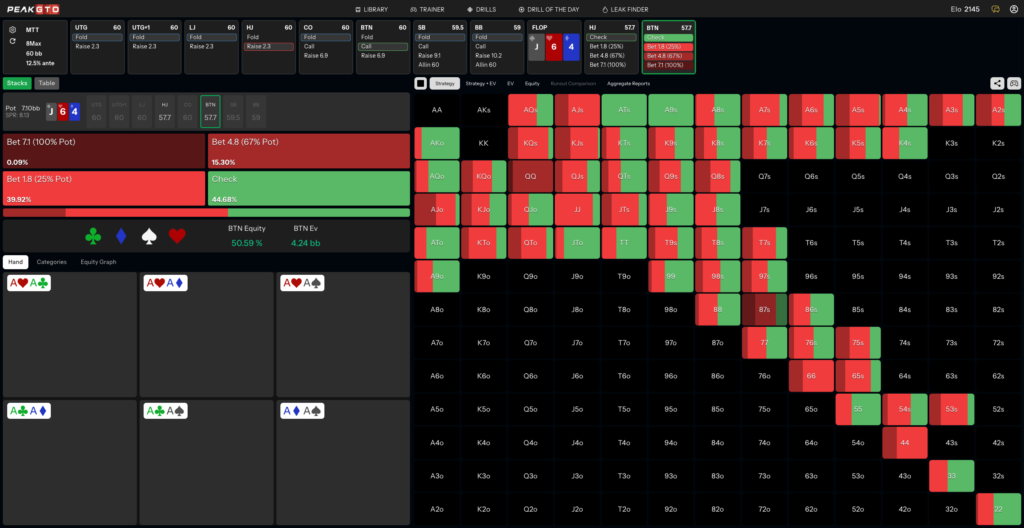
The hijack checks, and we have an easy spot to apply pressure. With 8♣7♣ we hold a gutshot to the five plus two cards that can pair into a useful made hand, and this is one of the hands that wants to bet the vast majority of the time. The solver mixes a 25 percent and a roughly two-thirds size, never a full pot, and we take the small 1.8bb option. Betting our gutshot keeps the pressure on a capped opponent who checked, and it sets up barrels on the many good turns to come. The hijack calls.
Why bet a hand with only four clean outs to the straight? Because a gutshot in position is worth far more than its raw equity. When the opponent checks the flop, their range is capped and full of hands that fold to sustained pressure, so we win the pot outright a good share of the time. Betting also disguises our hand for the many turns where we can keep barreling, and it denies a weak opponent the chance to realize equity for free. Checking back would surrender the initiative on the button, which is precisely what we want to avoid with a hand this dynamic.
Turn: 8♥
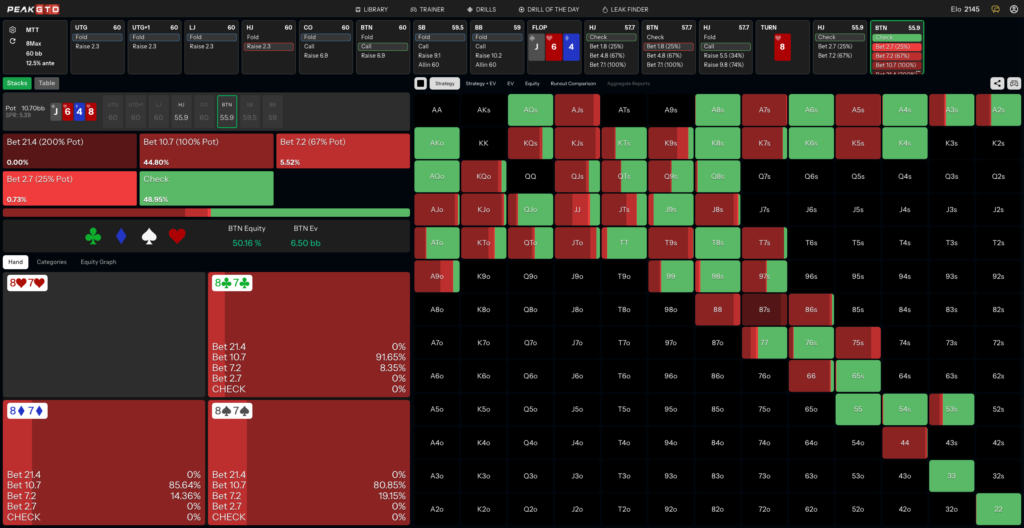
The turn is the 8♥, giving us second pair while we keep the gutshot. Most players see a medium made hand and instinctively check, but here the correct play is to bet, and to bet big. We pot it, around 10.7bb. The reasoning is that this is effectively a dynamic board where our opponent simply cannot have the made straight, since 75 is not in their range. We hold a piece of the straight ourselves and plenty of strong middle cards, so we can treat the spot like a board where no straight is possible and size up.
Second pair with a gutshot is the classic almost-always-good-but-vulnerable hand that loves protection and extra equity, which is exactly why it bets pot rather than checking. Studying the turn node in PeakGTO shows the whole range betting about half the time, with the pot size dominating when we do fire. One practical note: the opponent should almost never raise here, and if they do jam, the solver actually calls it off. In real games, however, those jams skew heavily toward top pair, so folding to a raise is the better exploit against most players. This time the hijack just calls.
It is worth being precise about what the pot-sized bet accomplishes. We are not firing because we expect to be called by many worse made hands, though a few exist. We are betting to charge the opponent’s overcards and straight and flush draws, to deny their free equity, and to build a pot for a river where we can apply even more pressure. The eight also improves many of the floats that called the flop, with hands like T9 picking up an open-ended draw, so we need to keep betting our value and protection hands now to stop our range from becoming hopelessly weak by the river.
River: 2♥
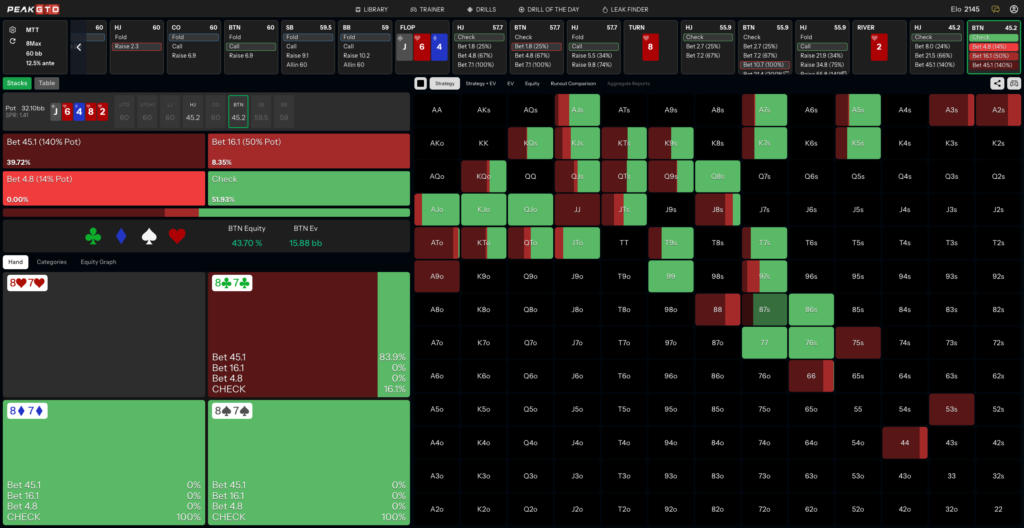
The river is the 2♥, putting a possible flush on the board, and the hijack checks. Here is where theory and practice split. The solver actually rips our 8♣7♣ all in roughly two-thirds of the time as a thin merge, a bet that wants to get called by a few worse hands while folding out the occasional better one. In a perfect world the opponent calls with hands like 7♣6♣, 6♣5♣, 5♣4♣, or even K♣5♣, which keeps our jam honest.
Against real opponents, this is a spot to override the solver and check. The problem is simple: almost nobody finds those thin calls with a worse made hand that just happens to hold a club, a weak pair or a king-high that loses to our second pair rather than a flush, and almost nobody folds a hand like KJ or QJ that beats us. When you jam, you are neither getting called by worse nor folding out better, which is the definition of a bet that should not exist. As GTO outputs go, this is a textbook case where the general heuristic that a marginal made hand checks the river should win out. We take our showdown value and check back, happy to have gotten value on the turn.
To see why the check is right, contrast this with a blank river. If a low card that missed every draw had fallen instead, our second pair would actually gain value, because the opponent never improved and our pair still beats their busted floats, so a thin value bet would make sense. On the heart, though, every heart draw that was peeling the turn just completed, and the hands that bricked are too weak to ever pay us off. This is one of those spots where blindly copying a solver’s mixed output quietly costs money. The lesson is to study why the solver acts the way it does, then ask honestly whether your specific opponent will cooperate with that plan.
Key Takeaways
- Flop: A gutshot with two cards that can pair into a useful made hand continuation bets the vast majority of the time against a capped, checking opponent. The small size keeps your range wide and sets up turn barrels.
- Turn: Turning second pair plus a gutshot, bet pot. Because the opponent cannot hold the straight, you can treat a connected board as dynamic and charge their many one-pair hands.
- River: The solver merges all in, but real opponents will not call worse or fold better. Override the output and check your marginal made hand.
- Overall: Suited connectors reward aggression when you have equity and protection, and discipline when your made hand can only get called by better. Match the line to the opponent, not just the solver.