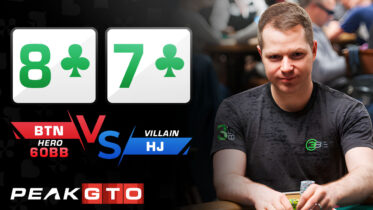
When your opponent checks and hands you the betting lead, a weak draw becomes a weapon. Semi-bluffing a gutshot is one of the most reliable ways to win pots you have no business winning at showdown, because you combine immediate fold equity with the chance to make a hand later. The trick is choosing the right combos, the right sizes, and knowing that even a completely busted draw on the river is often a mandatory bluff rather than a disappointed check.
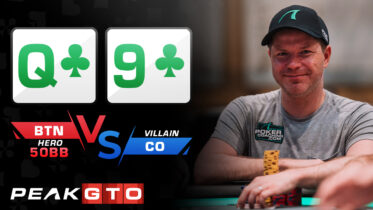
Today we will analyze a 60 big blind tournament hand where we call on the button with 8♣7♣ against a hijack open. The flop comes J♠6♥4♦, the hijack checks, and we bet small with our gutshot. The turn is the T♥, upgrading us to a double gutshot, and we bet pot. The river is the 2♥, putting a third heart on the board so any villain suited heart combo now has a flush, while we are left with eight-high, and we move all in. We will walk every street and explain why the busted draw is the perfect hand to keep firing.
Assumptions
- Format: 8-max MTT, 60bb effective stacks
- Positions: Hero is on the button (caller, in position); Villain is in the hijack (preflop raiser, out of position)
- Hero’s hand: 8♣7♣
- Preflop: Hijack raises to 2.3bb, Hero calls on the button.
- Flop: J♠6♥4♦. Villain checks, Hero bets small (about 1.8bb), Villain calls.
- Turn: T♥. Villain checks, Hero bets pot (about 10.7bb), Villain calls.
- River: 2♥. Villain checks, Hero jams all in (an overbet, about 140 percent pot). The solver jams this exact combo 100 percent of the time.
Preflop
We call on the button with 8♣7♣, a routine continue against the hijack. As in the rest of this suited-connector series, mixing in some 3-bets is correct, but flatting in position keeps our range wide and our hand disguised. We take the flop heads up with the betting lead waiting for us if the opponent shows weakness.
Flop: J♠6♥4♦
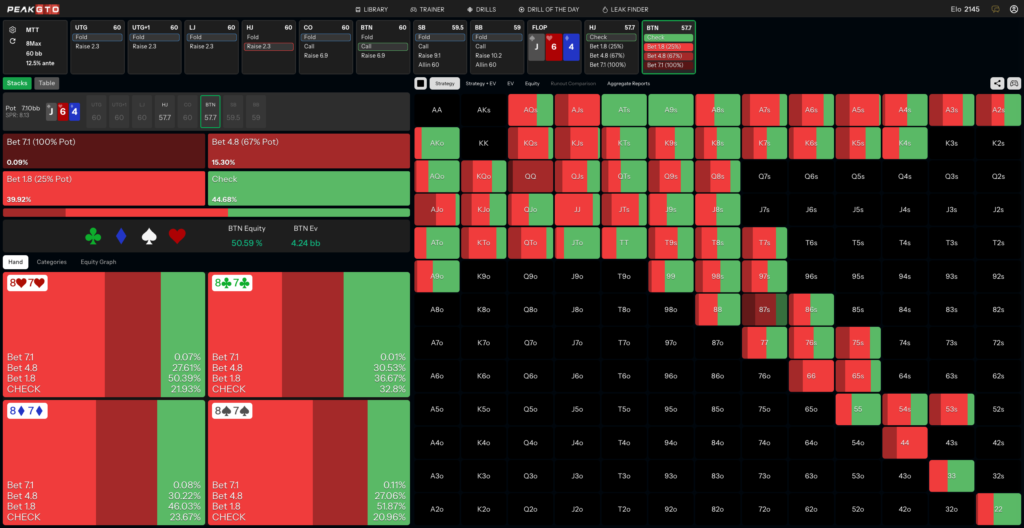
The hijack checks, which in theory they should do about two-thirds of the time. This is where most opponents leak value: they bet every strong hand and check a weak, capped range, which means we should attack their checks even more than a solver suggests. With 8♣7♣ we hold a gutshot to the five, and the solver bets this hand a large chunk of the time, mixing a small 1.8bb size with an occasional larger one. We take the small bet, which keeps our range wide and sets up barrels on the many good turns. The hijack calls.
The small size is the practical choice here. Because the opponent checked to us, this is effectively a stab at a pot the opponent has given up on, and unlike a true continuation bet from the preflop raiser we do not need a big size to fold out the opponent’s air. Using one size for simplicity lets us continue applying pressure cheaply across multiple streets. Betting now is much better than checking back and surrendering the initiative to a player who just told us they are weak.
Why is betting eight-high correct? Because the value of a draw in position comes from more than its raw equity. We win the pot outright whenever the opponent folds, we keep the betting lead for the rest of the hand, and we still hold outs to improve to the nuts. Checking back would hand a weak player a free card and let them realize their equity for nothing, while betting forces them to make mistakes on every street that follows. A gutshot is rarely a hand you want to give up with when the opponent has shown this much weakness.
Turn: T♥
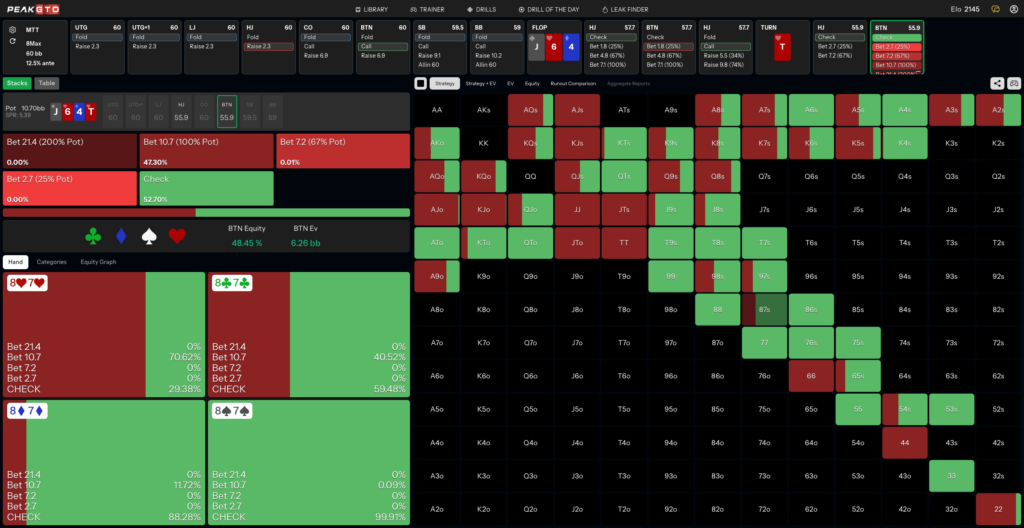
The T♥ upgrades us to a double gutshot: now a five or a nine completes a straight, giving us eight outs instead of four. It is not the prettiest card, since it connects with many of the opponent’s check-calls, but our hand has enough equity and our range has enough strong hands to keep betting. We pot it for about 10.7bb. If we get raised, we simply fold, since we are still only drawing.
When we barrel here we want to stay polarized, and that means finding junky bluffs with an overcard to the board, like K5 or A5, rather than leaning only on our draws. There is also a sharp blocker lesson with our exact hand. We would bet 8♣7♣ more often than the diamond or spade version, even though they look identical. With clubs we do not block the opponent’s busted diamond and spade hands, like A7 of a suit that will check and fold, so it is more likely they hold exactly the air we are trying to push off. You can confirm these combo-by-combo differences inside PeakGTO. The hijack calls again.
It is also worth noting how much the ten changes our equity. With only a bare gutshot we had four outs, but the double gutshot doubles that to eight, roughly the equity of an open-ended straight draw. That extra equity is what justifies a full pot-sized barrel rather than a timid stab. We have real outs when called, plenty of fold equity now, and a credible story for almost any river. We are not firing with nothing, we are betting a hand that improves to a winner often enough to make the aggression comfortable even when we get called.
River: 2♥
The 2♥ completes the backdoor heart flush, and the hijack checks. Our double gutshot has fully busted, leaving us with eight-high, the effective nut low. This is exactly the kind of hand that should keep firing. The hands that can win by checking are useless as bluffs, while a hand with little to no showdown value makes the best bluff, since betting is close to its only path to the pot.
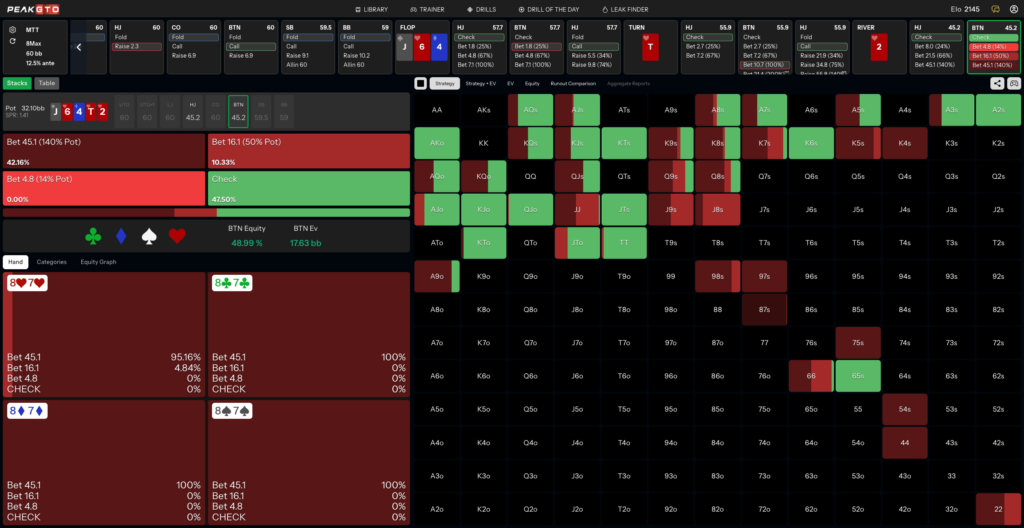
The correct size is an all-in overbet, roughly 140 percent of the pot. This is where many players cost themselves money: they cap their river bets at pot or smaller, which means they cannot bluff often enough to stay balanced behind their value hands. Across the whole range the solver runs a near coin flip here, jamming about 42 percent of the time and checking about 47.5 percent. The hands that always rip all in are the natural flush-blocker bluffs that hold the A♥ or Q♥, plus generic 87, 97, and 98 combos. Our exact 8♣7♣ is squarely in that group: the solver jams it 100 percent of the time. Eight-high beats nothing the hijack continues with, and the rare busted hands it does beat are folding anyway, so there is no pot to protect by checking and the jam is the only way the hand wins. That is the GTO baseline, not a deviation from it. The exploit only stacks on top: most opponents arrive here with a marginal range after calling twice and fold far too often to the overbet, so against that over-folding field the all-in prints even more than the solver already shows.
It helps to think in terms of what each hand can accomplish. A medium-strength hand that sometimes wins at showdown has a reason to check, because betting risks getting raised off a pot it could have won. A truly busted eight-high has no such future. When it beats nothing the opponent calls with and the few hands it does beat fold anyway, checking captures almost no value, so turning it into a bluff is the only way to win the pot. That is the general principle, and it is why the solver fires the largest size with the bluffs that hold no showdown value while parking its showdown-value hands in the checking range. Our exact 8♣7♣ has no showdown value worth protecting, which is exactly why it sits on the always-jam side rather than in the checking range.
Key Takeaways
- Flop: When a capped opponent checks, bet your gutshot a large share of the time. A small size keeps your range wide and sets up multi-street pressure cheaply.
- Turn: A card that turns a double gutshot is worth a pot-sized barrel. Prefer the club version of 87, which blocks none of the opponent’s busted hands that are folding anyway.
- River: The always-jam bluffs are the truly busted, no-showdown-value combos, the A♥ or Q♥ blockers and the busted straight draws like 87, 97, and 98. Our exact 8♣7♣ is one of them, jammed 100 percent of the time, since eight-high has nothing to protect by checking. Use the all-in overbet when you bluff so you can fire often enough to balance your value bets.
- Overall: Semi-bluffing a gutshot is about combining fold equity now with the threat of a strong hand later, then following through when you miss. The busted draw is the bluff, not the failure.